


Introduction
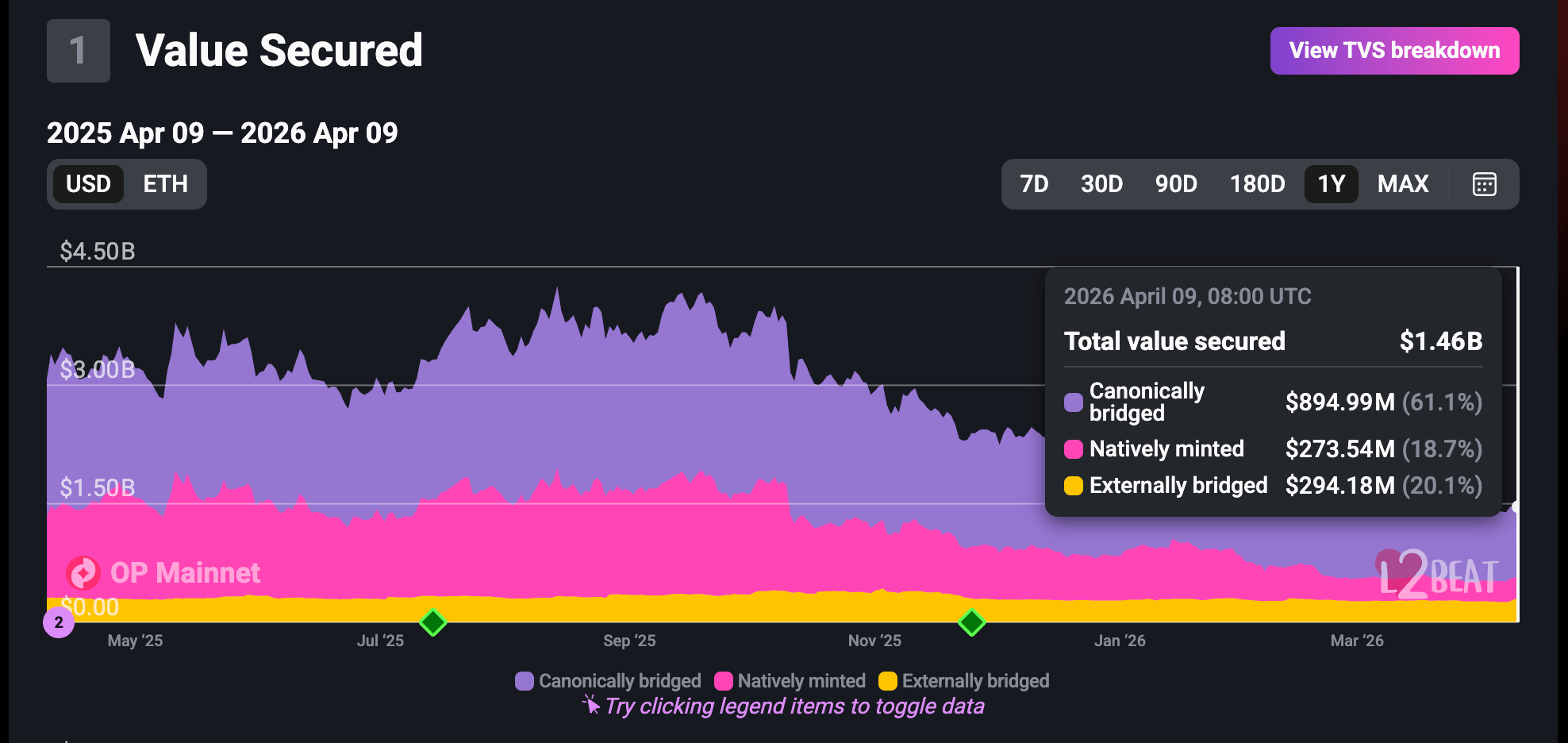
Choosing the right Optimism RPC providers for production matters more than most teams expect. OP Mainnet remains one of the most battle-tested L2 environments in production in 2026 — holding about $1.9 billion in total value secured (L2Beat, October 2026; the chart below is the April 2026 snapshot), processing millions of daily operations, and housing major DeFi protocols including ether.fi, Aave, Velodrome, and Derive. Optimism has been Stage 1 on L2Beat’s rollup maturity scale since June 2024 — meaning permissionless fault proofs are live on the CANNON fault-proof VM, and any third party (not just OP Labs) can challenge an invalid state root. It’s the line between “trust the team” and “trust the code.”

A note on the Superchain and Base’s departure: Optimism is the foundation for the OP Stack, a shared open-source rollup framework that powers over 30 chains in production — including Unichain, World Chain, Ink, Soneium, Mode, Zora, and Fraxtal. In February 2026, Coinbase announced that Base would migrate away from the OP Stack to its own unified stack, a move that reduced Superchain revenue and ecosystem size. Despite that, the OP Stack itself continues to grow: new chains are deploying on it, the framework remains MIT-licensed, and the infrastructure patterns you choose for Optimism apply across the entire remaining Superchain. If your application spans multiple OP Stack chains, your RPC provider choice matters across all of them — not just OP Mainnet.
The starting point every team needs to know: OP Mainnet’s public RPC endpoints are explicitly rate-limited and not suitable for production workloads. The official documentation states this directly, noting that teams experiencing rate limiting should run their own node or use a third-party provider. WebSocket connections are not supported on the standard public endpoints at all — meaning any application that relies on event subscriptions has no path to production using the public RPC alone. For step-by-step setup on Chainstack, see how to get an Optimism RPC endpoint in 2026.
OP Stack’s architecture also introduces two distinct failure modes that are worth separating clearly before evaluating any provider. The first is sequencer downtime — block height freezes, no new transactions are included, and no provider can circumvent this. The second is L1 submission issues — the sequencer continues producing blocks, but has difficulty posting batches to Ethereum, which delays the advancement of safe and finalized tags. Applications that branch on finality status can behave unexpectedly during these windows. A good Optimism RPC provider doesn’t prevent either failure mode, but a well-architected one gives you the monitoring, failover, and WebSocket stability to survive them without a 3am incident response.
Optimism RPC providers comparison (2026)
When evaluating Optimism RPC providers, look beyond headline uptime claims. Method-level performance, billing transparency, archive data support, and trace API availability are the variables that determine whether your provider works under real production conditions. The table below summarizes public positioning as of October 2026.
| # | Provider | Free Plan | Pricing Model | Uptime / SLA | Dev Experience |
|---|---|---|---|---|---|
| 1 | Chainstack | 3M req/mo, ~25 RPS | Request Units (1 RU standard, 2 RU archive); no method-weight multipliers | 99.9% formal SLA; 99.99%+ observed on Global/Dedicated | Dashboard metrics, archive + debug/trace from Growth, erigon_* extensions, Unlimited Node add-on |
| 2 | RouteMesh | Free community endpoint (reads) | Premium: $3–$6 per 1M calls (economy/performance routing) | No formal SLA; daily sync + replay correctness checks | 15+ upstream providers, health-scored routing |
| 3 | Dwellir | 100k responses/day, 20 RPS | 1 credit per response, no CU weighting; Developer $49, Growth $299, Scale $999; Unlimited Nodes from $119/mo | 99.99% SLA on dedicated clusters (custom terms) | Dedicated cluster $3,366/mo, HTTP + WebSocket, archive endpoint, trace/debug on paid plans, crypto payments |
| 4 | OnFinality | Public 5 RPS; Free plan 40 RPS | Growth: 500 RPS, no daily response limit | No published SLA on free tiers | Dedicated Nodes, archive, trace/debug on paid, WebSocket subscriptions |
| 5 | Alchemy | 30M CUs/mo, archive included | Compute Units (method-weighted; debug_traceTransaction = 40 CU) | ~99.9% historical; formal SLA on Enterprise only | Enhanced APIs (Token, NFT, Transfers), Webhooks, Gas Manager, Bundler, SDK support |
| 6 | Quicknode | No permanent free plan; 30-day trial (10M credits, 15 RPS), archive included; trace/debug from Build | API credits (method-weighted: debug/trace = 2×, trace_replay* = 4×) | 99.99% uptime stated on its security page; premium SLA on Enterprise | Streams, Webhooks, OP-Node API, 13+ OP Stack chains, marketplace add-ons, team dashboards |
⚡ Benchmark before you commit: Optimism isn’t currently one of the chains tracked on Chainstack’s public performance dashboard (compare.chainstack.com). Run your own latency test from your target region against each provider’s endpoint before committing — a simple curl loop or a k6 script hitting a couple of representative methods is enough to surface meaningful p95/p99 differences.
How to choose an Optimism RPC provider
Different Optimism workloads stress RPC infrastructure in different ways. Here are the three scenarios where provider choice has the most impact.
DeFi and liquidation workloads
Optimism’s DeFi ecosystem anchors around protocols where latency and consistency are directly financial: Aave V3 liquidation thresholds, Velodrome liquidity positions, Derive’s on-chain derivatives, and Morpho lending markets. These applications query constantly — prices updated, positions checked, liquidity rebalanced — and shared RPC endpoints degrade exactly when volatility peaks and every protocol is querying simultaneously.
The OP-specific risk here is sequencer-related data freshness. During L1 submission issues, safe and finalized block tags can lag behind latest by minutes rather than seconds. Protocols that make liquidation decisions based on finality status need providers that surface this correctly and don’t silently return stale state.
For this use case: Dedicated Nodes for isolated performance under market stress, full archive access for position history, confirmed debug_traceTransaction and trace_* support, and a provider with documented method-level behavior on OP Mainnet — not just Ethereum.
Superchain multi-chain applications
If your application runs on more than one OP Stack chain — say OP Mainnet plus Unichain, Mode, or Soneium — your RPC provider consolidation matters. Managing separate accounts, billing, and endpoints across providers for every OP Stack chain multiplies operational complexity without adding architectural value.
The same codebase works across all OP Stack chains: same OP Stack JSON-RPC behavior, same EVM equivalence. The only variable is which chains your provider actually supports under one roof. Providers that support 10+ OP Stack chains under unified billing and a single dashboard meaningfully reduce the toil of multi-chain deployments.
For this use case: prioritize providers with the broadest OP Stack chain coverage, a unified account structure, and consistent archive + trace support across all chains — not just flagship ones.
Enterprise and compliance-sensitive workloads
For teams with compliance requirements — fintech integrations, on-chain reporting, regulated entities building on OP Mainnet — the infrastructure decision includes security posture, not just performance. SOC 2 Type II and ISO 27001 certification, documented access controls, and the ability to provide security artifacts for vendor reviews are part of the evaluation.
Archive access also becomes a compliance tool in these contexts: on-chain audit trails, historical balance reconstructions, and transaction attribution all require full historical state rather than the pruned 128-block window of a full node. Teams doing regulatory reporting or forensic analysis on OP Mainnet need archive confirmed, not assumed.
For this use case: SOC 2 Type II and ISO 27001, formal SLA documentation, production-grade access controls, confirmed archive from genesis on OP Mainnet, and a provider who can produce security documentation on request.
In-depth Optimism RPC providers analysis
Below is a closer look at how each provider performs for OP Mainnet production workloads, including pricing structure, free tier limits, archive and trace API support, and notable capabilities.
Chainstack

Chainstack covers the full spectrum of Optimism infrastructure in a single console. For OP Mainnet specifically, it offers Global Nodes for geo-balanced RPC across US, EU, and APAC; Dedicated Nodes for isolated performance with full node-level control; archive nodes from genesis with debug and trace methods on paid plans (Growth and up) and no method-weight multiplier; and Self-Hosted deployment (OP-Reth + OP-Node) for teams that need the node inside their own infrastructure.
What makes the pricing model distinct is the absence of method weighting. Chainstack bills in Request Units — 1 RU per standard call, 2 RU per archive or debug call — with no multipliers applied to heavier methods. A debug_traceTransaction call on an archive block costs 2 RU, the same as any other archive call, with no extra multiplier for trace methods. For DeFi protocols running tracing pipelines at scale, this is a meaningful cost difference.
Chainstack serves the standard eth_*, debug_* and trace_* namespaces on Optimism plus Erigon-specific extensions (erigon_getLatestLogs, erigon_getBlockByTimestamp and others) for advanced block and log queries; the OP rollup-node methods (optimism_outputAtBlock, optimism_syncStatus, optimism_rollupConfig, optimism_version) are not exposed. See the full Optimism methods reference, API reference, and developer tooling docs. The OP Stack support extends across 10+ chains from the same account: OP Mainnet, Base, Unichain, Fraxtal, Soneium, Ink, Zora, Celo, Kroma, and Mint, with unified billing and endpoint management.
🤖 You can also access Chainstack Optimism RPC directly from Claude, Cursor, Codex, Windsurf, Gemini CLI, GitHub Copilot, Antigravity, Claude.ai, or ChatGPT using Chainstack MCP. Learn more about Chainstack MCP, or see the Chainstack Agents page for the fuller agent stack.
| Details | |
|---|---|
| Pricing | Developer — free, 3M req/mo (~25 RPS). Growth — $49/mo, 20M req (~250 RPS). Pro — $199/mo, 80M req (~400 RPS). Business — $499/mo, 200M req (~600 RPS). Enterprise — from $990/mo. Unlimited Node from $149/mo flat. Dedicated Nodes from the Pro plan, billed per node (compute plus storage). Crypto payments accepted (150+ tokens including OP). |
| Billing model | Request Units: 1 RU standard, 2 RU archive/debug. No method-weight multipliers. |
| Uptime / SLA | Formal SLA: 99.9% quarterly minimum with service credits. Global/Dedicated lines: 99.99%+ observed. Public status page. |
| Security | SOC 2 Type II and ISO 27001 certified. Production-grade access controls (IP allowlisting, origin rules). |
| Archive on OP | Growth and above (2 RU/call) |
| debug_traceTransaction | Growth and above; 2 RU on archive blocks |
| trace_ methods | Full suite on Growth and above: trace_block, trace_call, trace_callMany, trace_filter, trace_replayTransaction, trace_replayBlockTransactions, trace_transaction (2 RU on archive blocks) |
| OP Stack chains | 10+: Optimism, Unichain, Base, Celo, Zora, Fraxtal, Soneium, Ink, Kroma, Mint — most available on dedicated nodes; check availability per chain in the Chainstack |
For enterprise teams: SOC 2 Type II and ISO 27001 artifacts are available, IP and origin access rules are in production, and managed node upgrades eliminate the risk of client-version drift on OP Stack forks. The distinction between the formal SLA (99.9% quarterly minimum) and product-level positioning (99.99%+ observed) is worth documenting for vendor risk assessments — both figures exist and serve different purposes.
Pros: Method-agnostic RU billing, full trace/debug with no method-weight premium, SOC 2 Type II and ISO 27001, 10+ OP Stack chains, Unlimited Node option, Dedicated Nodes, crypto payments. Cons: Fixed RPS per tier (very high-frequency apps may need Dedicated); free tier is tight for heavy indexers; Dedicated Nodes require at least Pro plan.
RouteMesh

RouteMesh is an RPC aggregation and routing layer rather than a node operator — it routes requests across 15+ upstream providers, including Chainstack, with real-time health scoring and automatic failover. RouteMesh confirms full support for OP Mainnet (chain ID 10).
Pricing is split between a free community endpoint (read requests routed to public nodes, transaction sends routed to premium infrastructure) and a Premium tier priced $3-$6 per million calls depending on routing strategy (economy vs. performance). For teams that want redundancy without managing multiple provider relationships, RouteMesh’s automatic failover across many upstream operators is the pitch.
Pros: Automatic, health-scored failover across 15+ upstream providers (including Chainstack), confirmed full OP Mainnet (chain ID 10) support, a free community endpoint for read traffic, and flexible economy/performance pricing ($3-$6 per 1M calls). Cons: As a routing layer rather than a direct node operator, archive depth and debug/trace availability depend on whichever upstream provider serves a given request rather than being a property you configure directly; no formal SLA is published, which matters for latency-critical DeFi execution paths; and no published compliance attestation of its own means enterprise or compliance-sensitive deployments need to pair it with a certified upstream provider for the audit trail.
Dwellir

Dwellir is a Swedish RPC provider with a long Polkadot track record that now serves 150+ networks, Optimism among them. For OP Mainnet it offers an archive endpoint over HTTPS and WebSocket (chain ID 10), with trace and debug APIs on its paid plans, flat-rate Unlimited Nodes, and a dedicated node cluster for teams that want isolated, unmetered access. Its network list also covers other OP Stack chains such as Base, Unichain, World Chain, Ink, and Zora.
Shared plans bill one credit per response with no compute-unit weighting, so a debug_traceTransaction call costs the same as eth_blockNumber. Its Optimism page says the endpoints run archive nodes with full historical state and lists debug and trace APIs; teams that depend on specific trace_* methods or optimism_* rollup-node methods should confirm them on a trial endpoint first.
| Details | |
|---|---|
| Pricing | Free — 20 responses/second, 100,000 responses per day. Developer — $49/mo, 25M responses, 100/second. Growth — $299/mo, 150M responses, 500/second, eth_getLogs over up to 10,000 blocks. Scale — $999/mo, 500M responses, 5,000/second. Unlimited Nodes from $119/mo flat (25–1,000 RPS). Optimism dedicated cluster listed at $3,366/mo. Crypto payments accepted. Pricing checked October 9, 2026. |
| Billing model | One credit per response, no method-weight multipliers. |
| Uptime / SLA | 99.99% uptime SLA on dedicated clusters with custom terms; public status page for the shared service. |
| Security | No SOC 2 or ISO 27001 attestation found on its public pricing and dedicated-cluster pages. |
| Archive on OP | Shared and dedicated endpoints run archive nodes (full historical state) |
| debug_traceTransaction | Developer and above (not on Free) |
| trace_ methods | Trace APIs listed for paid plans; confirm the specific trace_* method on a trial endpoint |
| OP Stack chains | Optimism, Base, Unichain, World Chain, Ink, and Zora among its 150+ networks |
Pros: Flat per-response billing (no method surprises), flat-rate Unlimited Nodes and a dedicated cluster in one account, crypto payments, a permanent free plan. Cons: No SOC 2 or ISO 27001 attestation found; free tier capped at 100,000 responses per day; the Optimism dedicated cluster is listed at $3,366/month; confirm specific trace_* and optimism_* methods on a trial endpoint.
OnFinality

OnFinality runs managed Optimism infrastructure with a public endpoint (5 RPS), a Free plan (40 RPS with usage insights), and a Growth plan (500 RPS, no daily response limit, priority support). Dedicated Optimism Nodes are available for high-volume RPC, exchanges, indexers, archive-heavy analytics, and trace workloads.
Archive access covers historical blocks, balances, contract state, transactions, receipts, and event logs. Trace (trace_block, trace_call, trace_filter) and debug (debug_traceTransaction, debug_traceCall) methods are both available on paid plans, alongside WebSocket subscriptions for real-time blocks, logs, and events.
Pros: Archive access covering historical blocks, balances, contract state, transactions, and event logs; trace (trace_block, trace_call, trace_filter) and debug (debug_traceTransaction, debug_traceCall) methods on paid plans; WebSocket subscriptions for real-time blocks, logs, and events; Dedicated Optimism Nodes for high-volume RPC, exchanges, indexers, and archive-heavy analytics; and a Growth plan offering 500 RPS with no daily response limit. Cons: No SLA published on the free/public tiers (5 RPS public, 40 RPS Free); formal SLA terms for the Growth and Dedicated tiers weren’t independently confirmed and should be checked directly before a production commitment; no independently confirmed compliance certification for enterprise procurement.
Alchemy

Alchemy is listed as an official Optimism node provider and offers a permanent free tier — 30M Compute Units per month (roughly 1.1M standard calls) with archive access included at no extra charge. For teams in early development or running lower-volume applications, that’s a real advantage.
The platform’s strongest differentiation for Optimism workloads is tooling depth: Enhanced APIs (Transfers, Token, NFT), Webhooks for event-driven delivery, and Gas Manager and Bundler for account abstraction. Teams building liquidation bots or event-driven settlement systems on OP Mainnet will find these genuinely useful — they reduce the amount of custom indexing infrastructure you need to build.
The billing model is CU-based with method weighting: eth_getLogs costs 60 CU, debug_traceTransaction costs 40 CU. For teams running trace-heavy workloads at volume, costs can escalate in ways that are hard to predict from the free tier. The other practical consideration: formal uptime SLAs are only available on Enterprise plans — relevant for compliance-oriented procurement processes.
| Details | |
|---|---|
| Pricing | Free — 30M CUs/mo (300 CU/s, about 15 RPS). Pay As You Go — $0.525/M CU (from 300 RPS). Enterprise — custom. |
| Billing model | Compute Units: method-weighted. eth_call = 26 CU, eth_getLogs = 60 CU, debug_traceTransaction = 40 CU. |
| Uptime / SLA | ~99.9% historical; formal SLA on Enterprise only. |
| Security | SOC 2 certification. |
| Archive on OP | All tiers including free |
| debug_traceTransaction | Pay As You Go and Enterprise (not free tier) |
| trace_ methods | Trace API listed for OP Mainnet; Pay As You Go and Enterprise only (not Free) |
| OP Stack chains | 9+: OP Mainnet, Mode, Base, Zora, Fraxtal, Ink, Soneium, Unichain, World Chain |
Pros: Permanent free tier with archive included, deep developer tooling (Enhanced APIs, Webhooks, Gas Manager, SDK), official Optimism provider, good OP Stack chain coverage. Cons: Method-weighted billing makes trace costs hard to predict; formal SLA only on Enterprise; trace and debug are paid-plan only.
Quicknode

Quicknode has the strongest compliance posture in the competitive set — SOC 2 Type II, SOC 1 Type II, and ISO/IEC 27001 certification — and supports 13 OP Stack chains from a single account, the broadest coverage in this comparison. For teams running applications across multiple Superchain deployments, that consolidation has real operational value.
There is no permanent free plan — the entry point is a 30-day trial (10M credits, 15 RPS) with archive access included (trace and debug start on the Build plan). The trade-off is that Quicknode’s credit system applies method-weight multipliers: debug_traceTransaction costs 2× the standard call rate (40 credits vs. 20), and trace_replayTransaction and trace_replayBlockTransactions run at 4×. For workloads running tracing at scale, this multiplier stacks up.
Quicknode’s ecosystem beyond raw RPC is a genuine differentiator: Streams for real-time event pipelines, QuickAlerts for webhook-based monitoring, and an active marketplace of add-ons. The OP-Node API access is documented with Optimism-specific examples, which reduces integration friction for teams that need to query rollup-specific state.
| Details | |
|---|---|
| Pricing | Free trial — 30 days, 10M credits, 15 RPS. Build — $49/mo, 80M credits, 50 RPS. Accelerate — $249/mo, 450M credits, 125 RPS. Scale — $499/mo, 950M credits, 250 RPS. Business — $999/mo, 2B credits, 500 RPS. Enterprise — custom. |
| Billing model | API credits with chain multipliers. debug_traceTransaction = 2× standard (40 credits). trace_replay* = 4× (80 credits). |
| Uptime / SLA | 99.99% uptime stated on its security page; premium SLA on Enterprise. |
| Security | SOC 2 Type II + SOC 1 Type II + ISO/IEC 27001. |
| Archive on OP | All tiers including free |
| debug_traceTransaction | All tiers (2× credits) |
| trace_ methods | trace_block (2×); trace_replayTransaction and trace_replayBlockTransactions (4×); Build and above |
| OP Stack chains | 13+: OP Mainnet, Base, Cyber, Fraxtal, Ink, Lisk, Mode, Soneium, Unichain, World Chain, Zora, B3, Redstone |
Pros: 99.99% uptime stated, strongest compliance posture (SOC 2 + SOC 1 + ISO 27001), 13 OP Stack chains, 30-day free trial, Streams/QuickAlerts, documented trace/debug on OP. Cons: Credit multipliers for debug/trace (2–4×) make tracing pipelines expensive at scale; pricing page is JS-rendered and can be hard to evaluate; Dedicated requires higher-tier plan.
Archive and trace API support on Optimism
Archive data and trace methods are not edge cases for Optimism workloads — they are standard requirements for DeFi analytics, MEV research, protocol debugging, and compliance reporting. The availability matrix below reflects confirmed support based on provider documentation and API testing. Confirm the specific method with the provider on a trial endpoint before building a production dependency.
| Provider | Archive on OP | debug_traceTransaction | trace_block |
|---|---|---|---|
| Chainstack | Growth and above | Growth and above (2 RU on archive blocks) | Growth and above (2 RU) |
| Quicknode | All plans | Build and above (2× credits) | Build and above (2×) |
| Alchemy | All plans | Paid plans only | Trace API listed (pay-as-you-go and Enterprise only) |
| Dwellir | Archive endpoints (full historical state) | Paid plans | Trace APIs listed for paid plans |
The key takeaway: Chainstack, Quicknode, OnFinality and Dwellir document trace_* on Optimism for paid plans, and Alchemy lists a Trace API on OP Mainnet (pay-as-you-go and Enterprise only). Chainstack bills trace and debug at the 2 RU archive rate with no method-weight premium, while Quicknode applies a 2× credit multiplier (4× for trace_replay* calls). For protocols running trace_filter over wide block ranges or debug_traceTransaction across thousands of historical transactions, that billing model is the difference between a predictable infrastructure cost and an unpredictable one.
For teams building on archive data infrastructure, the decision is usually between Chainstack (method-agnostic billing, all tiers) and Quicknode (credit multipliers but strong compliance posture) — depending on whether compliance certification or cost predictability is the higher priority.
Optimism vs Arbitrum — an infrastructure perspective

Teams choosing between Optimism and Arbitrum for a new deployment are increasingly making an infrastructure decision as much as an ecosystem one. The table below covers the variables that affect RPC provider behavior, tooling compatibility, and operational design:
| Optimism (OP Mainnet) | Arbitrum One | |
|---|---|---|
| Rollup type | Optimistic Rollup | Optimistic Rollup |
| Block time | 2s (Flashblocks: 250ms preconfirmations) | ~0.25s variable |
| L1 finality | ~13 min (Ethereum finalization) | ~13 min (Ethereum finalization) |
| Challenge period | 7 days | 7 days |
| EVM compatibility | EVM-equivalent (op-geth, op-reth and op-erigon clients) | EVM-compatible (Geth + ArbOS layer) |
| Custom namespaces | optimism_* (rollup state, sync status) | arb_* (ArbOS-specific) |
| Trace API | trace_* via Reth/Erigon-based clients + debug_* | arbtrace_* (pre-Nitro) + standard debug_* |
| Fault proof system | CANNON FPVM (interactive bisection) | BoLD (WASM multi-round) |
| L2 Stage (L2Beat) | Stage 1 (since June 2024) | Stage 1 (BoLD, 2025) |
| TVS | ~$1.9B (L2Beat, Oct 2026) | ~$11B (L2Beat, Oct 2026) |
| DA model | Ethereum blobs (EIP-4844) | Ethereum blobs or AnyTrust (DAC) |
| Framework license | OP Stack — MIT licensed | Orbit — BSL unless settling to Arb One/Nova |
The practical infrastructure difference: OP Mainnet’s Geth-derived execution layer means standard Ethereum tooling works without modification. Any library, SDK, or toolchain that targets Ethereum JSON-RPC works on OP Mainnet without an adapter layer. Arbitrum’s ArbOS introduces custom arb_* methods and slightly different behavior for edge cases in gas estimation and transaction replay — meaning some tooling needs explicit Arbitrum support, not just generic EVM compatibility.
For RPC provider selection specifically, Optimism’s OP Stack architecture means that a provider supporting one OP Stack chain likely supports others. Arbitrum Orbit is a separate framework with separate deployment and support considerations — provider coverage doesn’t transfer the same way.
Choosing the right Optimism RPC provider for your stage
The right provider depends on where you are in the product lifecycle, what methods your application actually calls, and what compliance posture your organization requires.
- Side project or active development You don’t need a paid plan to start. Alchemy’s 30M CU free tier (with archive included) is the best sandbox for building on OP Mainnet. Chainstack’s free Developer plan (3M RU/mo) is the better pick if you want to learn the exact infrastructure you’d use in production — same endpoint, same methods, same behavior. Dwellir’s free plan (100,000 responses a day) is another no-card option for a quick sandbox.
- Production dApp with moderate traffic Move to a Growth or equivalent paid tier and choose based on your method mix. If your app calls standard methods (
eth_call,eth_getLogs,eth_getBlockByNumber), all major providers perform well. If you calldebug_traceTransactionortrace_*, Chainstack bills debug/trace at the 2 RU archive rate, while Quicknode applies a 2× credit multiplier (4× for trace_replay* calls); compare the effective price per request on your plan. - DeFi protocol or trading bot Use Dedicated Nodes. Shared infrastructure degrades precisely when you need it most — during high-volatility windows when the whole market is querying at once. Dedicated infrastructure is the only path to consistent tail latency, and for any protocol where a delayed transaction has financial consequences, it’s not optional. Require confirmed trace/debug support and full archive before signing a contract.
- Enterprise or compliance-sensitive deployment SOC 2 Type II and ISO 27001 is a hard requirement for many legal, fintech, or institutional teams. That narrows the field to Chainstack and Quicknode. Between them: Chainstack offers method-agnostic billing and broader OP Stack chain coverage; Quicknode offers the strongest formal compliance posture (SOC 2 + SOC 1 + ISO 27001) and a stated 99.99% uptime with a premium SLA on Enterprise. Both are defensible choices — the decision comes down to whether cost predictability at trace volume or certification breadth matters more to your procurement process.
Conclusion
Optimism is a production-grade L2 with real adoption, a credible security model, and an active DeFi ecosystem. The infrastructure decision that most teams underestimate is how quickly public RPC rate limits become the binding constraint — and how much the choice of provider shapes what’s possible at the method level, not just the throughput level.
For most production workloads on OP Mainnet, Chainstack is the clearest choice: method-agnostic billing means your trace_filter pipeline costs what you’d expect, SOC 2 Type II and ISO 27001 covers compliance procurement, and Dedicated Nodes give you performance isolation when the market moves. The Superchain coverage — 10+ OP Stack chains from the same account — means the infrastructure decision you make for OP Mainnet applies across your multi-chain stack without starting over.
FAQ
A full node retains approximately the last 128 blocks of state — sufficient for transaction submission and current balance queries. An archive node retains the full historical state from genesis, which is required for historical eth_call simulations, eth_getLogs over wide block ranges, and any debug_* or trace_* operation on older blocks. For DeFi protocols, analytics platforms, and compliance reporting, archive access is a baseline requirement, not a premium feature.
Largely yes. OP Mainnet clients include op-geth, op-reth and op-erigon, which means the debug_* and trace_* method interfaces behave the same way. The trace_* namespace requires a Reth- or Erigon-based client with trace support — not all providers run one on OP Mainnet specifically. Verify trace_block and trace_filter support directly with your provider before building a dependency.
The official public RPC endpoint does not support WebSockets. All major paid providers — Chainstack, Quicknode, Alchemy — provide WebSocket endpoints for Optimism, including support for eth_subscribe and Optimism-specific event streams. WebSocket reliability under load is worth testing specifically during high-traffic periods.
Flashblocks is a preconfirmation layer that reduces effective block time on OP Mainnet from 2 seconds to 250ms, giving applications faster transaction feedback before L1 finalization. It’s available via a separate WebSocket endpoint (wss://op-mainnet-fb-ws-pub.optimism.io/ws) on the official infrastructure, but the public URL is strictly rate-limited. Contact your RPC provider directly to confirm whether they offer a non-rate-limited Flashblocks WebSocket endpoint for production use.
It depends on your context. For consumer dApps with no institutional users, SOC 2 is rarely a blocker. For fintech integrations, regulated entity deployments, or enterprise procurement processes, SOC 2 Type II and ISO 27001 is often a hard vendor requirement — the certificate must exist in the vendor’s compliance documentation. Of the six providers in this comparison, only Chainstack and Quicknode hold SOC 2 Type II and ISO 27001 certification.
Sequencer downtime means block height freezes and new transactions cannot be included. No RPC provider can bypass this — it’s an upstream infrastructure event. The sequencer does have a fallback path: users can submit transactions directly to Ethereum L1 via the canonical bridge, though with higher latency and cost. Applications should implement sequencer health monitoring and graceful degradation — display a maintenance mode, pause write operations, and resume once block production resumes. A good RPC provider helps by surfacing sequencer status accurately and maintaining connection stability so your monitoring layer can detect the event cleanly.
Yes. Chainstack supports 10+ OP Stack chains — OP Mainnet, Base, Unichain, Fraxtal, Soneium, Ink, Zora, Kroma, Mint, and others — from a single account with unified billing. Request Units are shared across all endpoints, so you’re not paying separate plan fees for each chain. This is the main infrastructure consolidation advantage for teams building applications that span the Superchain.
Related reading
Optimism deep-dive
- How to get an Optimism RPC endpoint in 2026
- Optimism blockchain – Ethereum Layer 2 scaling solution
- Optimism: Bridge ether from Ethereum L1 to Optimism L2
- Build better with Optimism on Chainstack