


Ethereum’s continued growth in 2026 has led to greater demand for high-performance Ethereum RPC providers. The network still handles ~1.7 million transactions per day, spanning smart contracts, rollups, trading bots, and stablecoin transfers — so choosing the right Ethereum RPC provider is now a production-critical decision.
Each project optimizes for different priorities – some need low latency, others cost-effectiveness, or reliability. In this benchmark, we compare the best Ethereum RPC providers for web3 in 2026 across key metrics like speed, uptime, pricing, and security compliance.
We focus on two critical Ethereum use cases – stablecoin payments and enterprise applications – to see how each provider measures up.
Ethereum RPC providers comparison
What separates one RPC provider from another usually comes down to the same few metrics: pricing, latency, uptime, and scalability options available. Here’s how the leading Ethereum options measure up:
| # | Proveedor | Plan gratuito | Planes de pago y tarifas | Latencia y tiempo de actividad | Developer |
| 1 | Chainstack | 3 millones de solicitudes al mes, 25 solicitudes por segundo | A partir de 250 RPS y con capacidad para superar los 600 RPS en Enterprise personalizados, con un complemento de nodos ilimitados que permite realizar solicitudes sin límite por una tarifa mensual fija | Enrutamiento global de baja latencia con un tiempo de actividad superior al 99,99 % | Docs, dashboard metrics, testnet faucets (Sepolia/Holesky/Hoodi), archive, Access rules |
| 2 | Alchemy | 30 millones de transacciones al mes; hasta 25 transacciones por segundo | Pago por uso o mensual; mayor rendimiento de unidades de crédito en los planes de pago | Enrutamiento de baja latencia y tiempo de actividad disponibles en los planes superiores | Transact & Notify APIs, analytics, SDK support |
| 3 | QuickNode | No hay plan gratuito; solo hay una prueba de 10 millones de créditos | 50-500 RPS; planes mensuales basados en créditos (ponderados por método) | Distribución global, 99,99 % de tiempo de actividad en los planes de pago | Streams, Webhooks, team dashboards, multi-region setup |
| 4 | Ankr | 200 millones de créditos al mes, ~30 RPS | Pago por uso (10 $ por cada 100 millones de créditos), con una capacidad de hasta 15 000 RPS. | Red distribuida geográficamente, acuerdo de nivel de servicio (SLA) del 99,99 % en Enterprise | Simple dashboard, multi-chain support, HTTPS & WebSocket, archive available |
| 5 | GetBlock | 50k req/day (~1.5M /mo), 20 RPS | $39 for 50M (100 RPS); $399 for 600M (500 RPS); Dedicated from $1000 no cap | Regional nodes, 99% shared / 99.99% dedicated uptime | Basic dashboard, regional choice, easy setup |
| 6 | Infura | 3M credits/day (~depends on method), ~500 credits/sec | $50–$225/month for higher limits | Multi-region network, ~99.9% uptime | Ethereum-first with MetaMask integration, archive, debug/trace on paid tiers |
Conclusiones principales de la comparación:
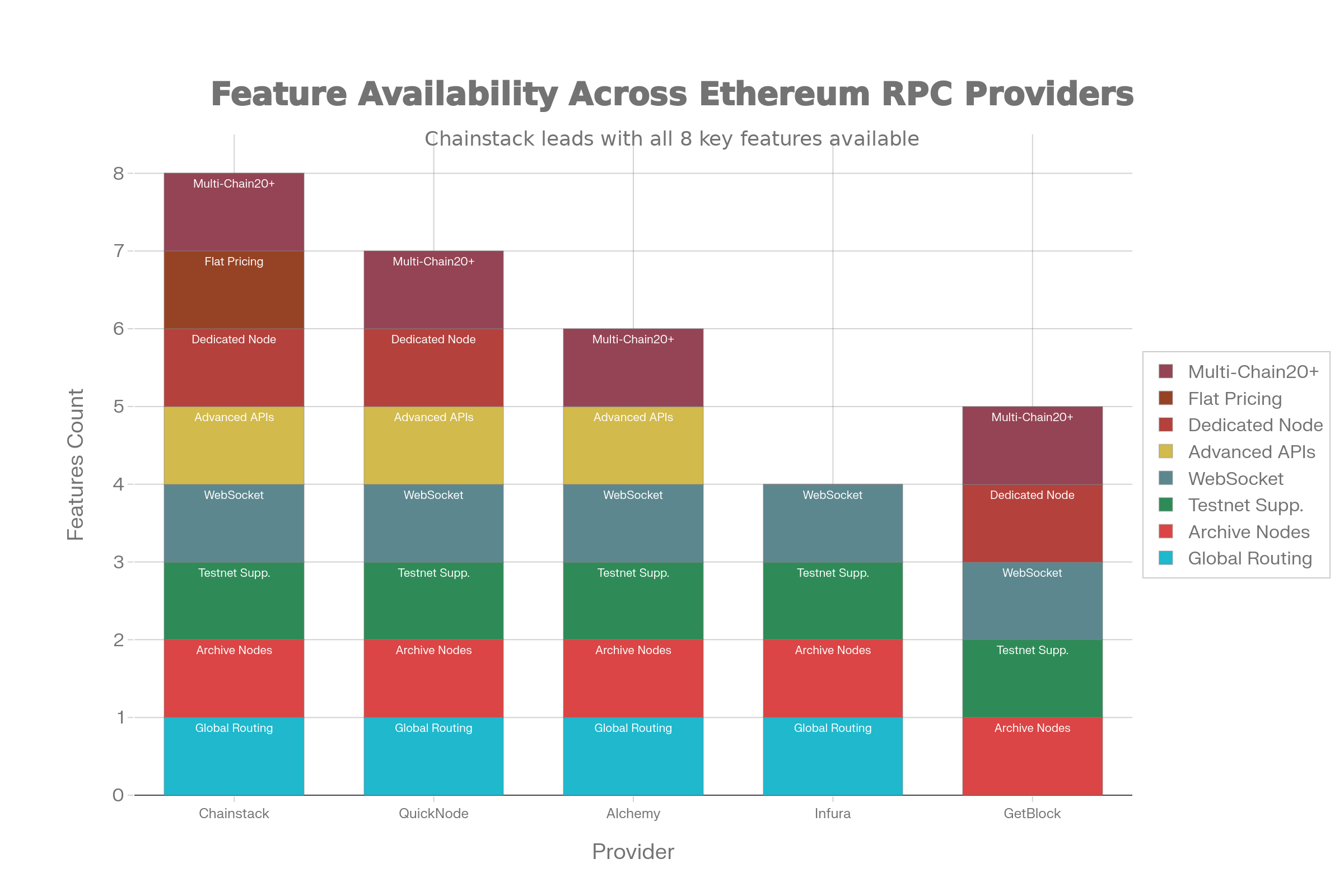
- Chainstack offers the most balanced feature set with transparent request-based pricing, highest uptime (99.99%+), and full SOC 2 Type II certification
- QuickNode leads in performance with maximum RPS and globally distributed infrastructure
- Alchemy provides the richest developer tooling including Notify and Transact APIs
- Infura remains reliable for Ethereum-first projects with deep MetaMask integration
- GetBlock is ideal for small projects and developers needing simple setup
When comparing Ethereum RPC providers side by side, differences in pricing models, uptime guarantees, and throughput limits become especially clear at production scale.
Before diving into detailed provider reviews, let’s examine how each performs across critical Ethereum use cases:
Choose Ethereum RPC providers by use case
Infraestructura de stablecoins y pagos
Stablecoins have become the backbone of on-chain payments, now making up ~30% of all crypto transaction volume (over $4 trillion in 2025). Payment applications require Ethereum RPC service with consistent throughput, near-zero downtime, and predictable costs. Even minor RPC outages or high latency can disrupt thousands of stablecoin transfers.
For teams building payment infrastructure with strict requirements around gas cost predictability and settlement finality, purpose-built chains like Tempo offer an alternative optimized specifically for stablecoin operations. Tempo delivers sub-second finality with deterministic execution costs designed for enterprise payment rails.
Top providers address this with robust multi-region infrastructure that automatically fails over if any node goes down. Chainstack’s network delivered 99.99%+ availability in testing, with multi-cloud architecture that reroutes traffic instantly if a region fails. Such redundancy ensures stablecoin transactions aren’t halted by regional outages.
Enterprise Ethereum RPC providers
Enterprise Ethereum deployments demand strong performance guarantees. Corporate and institutional users often have high-throughput workloads and strict SLA requirements.
Enterprise RPC essentials:
- High throughput: Chainstack offers high-throughput plans with custom RPS configurations on Ethereum and achieves ~99.99% measured uptime via global load balancing
- SLA guarantees: QuickNode handles enormous volumes (200B+ API calls/month) while maintaining 99.99% uptime SLA for enterprise clients
- Low-latency across regions: Multi-region data centers and intelligent routing keep response times uniform worldwide
SOC 2–compliant Ethereum RPC providers
Security and compliance are paramount for enterprises integrating with Ethereum. SOC 2 certification has become a key benchmark of a provider’s security controls and operational integrity.
Security leaders:
- Chainstack & QuickNode both hold SOC 2 Type II certification, reflecting rigorous audits of security, availability, and confidentiality practices
- Chainstack achieved SOC 2 Type II in late 2025, underscoring enterprise-grade security and 99.99%+ uptime SLA guarantees
- QuickNode maintains SOC 1 Type 2, SOC 2 Type 2, plus ISO 27001 certifications
Note: Not all popular RPC services have completed SOC 2; Alchemy lacks Type 1 or 2 certification as of 2025
In-depth Ethereum RPC providers analysis
Below, we take a closer look at how individual Ethereum RPC providers perform in real-world production environments, including latency consistency, scalability, and operational reliability.
Chainstack

Chainstack is a multi-chain infrastructure platform offering one of the most complete ways to connect to Ethereum without the overhead. By choosing Chainstack Ethereum RPC node, you get secure HTTP and WebSocket access to Ethereum Mainnet, Sepolia, and Holesky, backed by 99.99%+ uptime and globally distributed routing for consistently low latency.
Lo que lo hace destacar es la gran cantidad de opciones que ofrece desde una misma consola:
- Global Nodes for geo-balanced Ethereum RPC access.
- Nodos dedicadospara un rendimiento aislado y un control total sobre la configuración de los nodos.
- Archive nodes for deep historical reads, full historical blocks from the genesis to the latest one, debug and trace queries on the Ethereum blockchain.
- Reglas de accesopara gestionar los dominios y las direcciones IP permitidos directamente desde el panel de control.
- Complemento de nodos ilimitadospara un número ilimitado de solicitudes con una tarifa mensual fija, para que nunca tengas que preocuparte por alcanzar los límites del plan.
- Testnet faucets for Sepolia, Holesky, and Hoodi are available.
All of this adds up to the Ethereum setup that covers nearly every use case. Whether you’re deploying contracts, building DeFi products, or streaming on-chain data, Chainstack gives you reliable performance, clear pricing, and infrastructure to scale with.
| ¿Cuánto cuesta? | Developer — free, 3M requests/month (~25 RPS), $20 per extra million. Growth — $49/month, 20M requests (~250 RPS), $15 per extra million. Pro — $199/month, 80M requests (~400 RPS), $12.5 per extra million. Business — $499/month, 200M requests (~600 RPS), $10 per extra million. Enterprise — from $990/month, 400M requests (custom RPS), extra from $5 per million. Unlimited Node Add-on — flat monthly fee for unmetered requests starting from $149, priced by RPS tier. Dedicated Nodes — $0.50 / hour plus storage costs for exclusive, high-performance isolated Ethereum node instances, what means ~$0.25 per million requests effectively. While others price in shifting compute units, Chainstack keeps it simple with request-based billing and clear RPS tiers, so you always know what you’ll pay. What’s more, on Chainstack, you are able to pay in crypto. |
| Rendimiento | Tiempo de actividad: Disponibilidad superior al 99,99 %, respaldada por una red multicloud que redirige automáticamente el tráfico si una región deja de estar disponible. También hay una página de estado pública disponible. Latencia: Elige puntos de conexión en EE. UU., la UE o APAC para mantener tiempos de respuesta reducidos. Rendimiento: Los planes incluyen suficiente capacidad de RPS para absorber picos de tráfico sin obligarte a limitar la aplicación. Estabilidad: Se mantiene estable bajo carga, incluso durante picos en toda la red. Supervisión: Métricas integradas en la consola, además de paneles públicos de rendimiento y comparación, y una página de estado. |
| Ventajas | – High throughput at price point (~250 RPS on Growth, ~600 RPS on Business) – Predictable, request-based pricing with Unlimited Node add-on for flat, unmetered traffic within your chosen RPS tier – Built-in testnet faucets for Sepolia, Holesky, and Hoodi – 99.99%+ uptime SLA, SOC 2 Type 2, globally distributed routing for low latency One provider for Ethereum plus 70+ other chains |
| Contras | – Fixed RPS per tier; ultra-low-latency apps may need Dedicated Nodes – Free plan (3M calls, ~25 RPS) can be tight for bots or indexers – Dedicated Nodes require at least a Pro plan |
With Chainstack, you get the full stack: reliability, high RPS, global routing, and archive access, all with pricing that’s clear and consistently better than most. From testing to scaling, the setup doesn’t change, and the costs stay predictable, making it one of the most dependable ways to run Ethereum at any stage.
Alchemy

Alchemy offers Ethereum RPC through its Supernode, giving developers access to mainnet and testnets over HTTP and WebSocket, along with extras like Notify, Transact, and Mempool.
On top, Alchemy supports dozens of networks, giving access to historical blockchain data, real-time event streaming, and built-in MEV protection on some chains. Backed by global infrastructure, Alchemy suits teams looking for additional APIs and monitoring tools.
| ¿Cuánto cuesta? | Alchemy measures usage in compute units (CUs) rather than raw requests, which can make costs less predictable for teams sending large volumes of latency-sensitive calls compared to flat, request-based models. Alchemy starts with a free tier offering 30M CUs per month, roughly equal to 1.2M basic requests up to 25 RPS. Paid plans scale by total CU usage: Pay-as-you-go — $5 per 11M CUs (~$0.45 per million). Enterprise — custom pricing with lower per-unit costs at high volumes. |
| Rendimiento | Uptime: Reports 99.9% historical uptime, but an uptime SLA is only guaranteed on Enterprise plans. Latency: Region-based routing helps keep response times low; however, Alchemy does not publish official Ethereum-specific latency numbers. Throughput: Begins at about 25 RPS on the free tier, with scaling up to 300 RPS on paid. Reliability: The Supernode setup helps maintain data accuracy during heavy traffic. Monitoring: You can check usage, errors, and request patterns through the dashboard in real time. |
| Ventajas | – Covers Ethereum plus 40+ chains, – Built-in MEV protection on supported networks, – Rich tooling |
| Contras | – CU pricing isn’t intuitive, – Hard to verify real performance without public benchmarks, – Throughput caps by plan, very high RPS needs enterprise plan |
Alchemy de forma fiable bajo cargas pesadas y la latencia se mantiene baja en todas las regiones. Su modelo de precios basado en la capacidad de cálculo te ofrece flexibilidad a la hora de utilizar el servicio, pero también implica que la factura depende de la combinación de llamadas, y no solo del volumen, lo que puede dificultar la planificación a gran escala. Si estás desarrollando con funciones como Notify o la transmisión de mempool, Alchemy una buena opción, pero resulta menos idónea si buscas un escalado predecible.
QuickNode


QuickNode runs a multi-region infrastructure for Ethereum RPC, letting you connect to mainnet and testnets like Sepolia and Holesky over HTTP or WebSocket. Archive support is available for teams that need to query deep historical data.
It also supports dozens of other chains and offers add-ons such as Webhooks and Streams if you want event-based triggers or real-time blockchain feeds. It’s popular with high-traffic teams because the network scales well under pressure, but to get to that performance you would need to move to the higher-priced tiers.
| ¿Cuánto cuesta? | Build — $49/month, 80M credits plus $0.62 per extra million, up to 50 RPS. Accelerate — $249/month, 450M credits plus $0.55 per extra million, up to 125 RPS. Scale — $499/month, 950M credits plus $0.53 per extra million, up to 250 RPS. Business — $999/month, 2B credits plus $0.50 per extra million, up to 500 RPS. Enterprise — custom terms for higher volumes and dedicated support. Credits rollover unused portions, which helps variable Ethereum loads, though the model adds a layer compared to straight request counts. |
| Rendimiento | Tiempo de actividad: Objetivo de disponibilidad del 99,9 % en los planes de pago. Latencia: Puntos finales enrutados por región optimizados para una baja latencia; no se ha publicado ningún objetivo oficial en milisegundos, por lo que conviene realizar pruebas de rendimiento en tu región. Rendimiento: Los planes iniciales admiten entre 15 y 25 RPS; los niveles avanzados escalan hasta superar con creces los 500 RPS. Fiabilidad: Las solicitudes se redirigen automáticamente. Supervisión: El panel de control ofrece visibilidad en tiempo real del rendimiento de las solicitudes y de los errores. |
| Ventajas | – Scales up to 500+ RPS on higher plans, – Archive data available (by chain/plan), – Low latency from multi-region routing |
| Contras | Free trial caps at 15-25 RPS with only community support, – Method-weighted, credit-based billing makes costs less predictable, – No flat-rate unlimited option for heavy workloads |
QuickNode gives you speed, global routing, and developer tooling, which makes it good option for Ethereum apps. The main limitation is its credit-based (method-weighted) pricing. Because different methods burn credits at different rates, long-term cost planning takes more effort, especially if your workload isn’t static.
Ankr

Ankr provides Ethereum RPC through a globally distributed network of node operators, routing traffic across regions to keep latency low and reduce reliance on any single infrastructure provider. You can connect to Ethereum mainnet and testnets like Sepolia via HTTPS or WebSocket, with more than 30 regions in rotation and archive access available for historical queries and tracing
It’s a solid option for teams that prefer a pay-as-you-go model and want to tap into a decentralized setup, though it skips some of the advanced tooling and analytics you’d find in larger, more centralized providers.
| ¿Cuánto cuesta? | Ankr uses an API credits model where credit cost varies by method (heavier calls cost more). Pricing is pegged at $0.10 = 1M API credits (PAYG), and there’s a freemium tier. It’s enough for testing, but high-traffic apps will hit the ceiling quickly. Their paid plans use a pay-as-you-go model: Premium — $10 per 100M credits (~500K requests), with up to 1,500 RPS. Enterprise — from $1,000/month, 15,000 RPS, dedicated endpoints, and priority support. |
| Rendimiento | Uptime: Claims up to 99.9%. Latency: Region-routed. Throughput: 30 RPS on free; ~1.5K–15K RPS on paid tiers. Reliability: Distributed design reduces single-point failures but outages can still occur. Monitoring: The console shows usage and request stats, with more advanced visibility once you move to a paid. |
| Ventajas | – Freemium with 200M credits/month, – Supports HTTP, WebSocket, and archive queries, – Multi-chain support |
| Contras | – Advanced visibility/support gated to paid, – No fixed monthly plans, – Fewer built-in analytics |
Si no te importa que el rendimiento varíe según la región, Ankr ser una buena opción para realizar pruebas o para proyectos de menor envergadura. Sin embargo, si necesitas un rendimiento constante y una facturación predecible, las plataformas con niveles fijos de RPS y enrutamiento dedicado suelen ofrecer una opción más estable para las cargas de trabajo en producción.
GetBlock

GetBlock provides Ethereum RPC access on mainnet and testnets like Sepolia over HTTP and WebSocket, with the option to choose regions such as New York, Frankfurt, or Singapore to improve latency. Developers can use shared endpoints to get started quickly or switch to dedicated nodes when they need higher uptime guarantees, archive access, or more consistent performance under load.
While it skips the advanced APIs and deep analytics of bigger platforms, GetBlock remains a good option for teams that prioritize simplicity, regional control, and predictable access to Ethereum infrastructure.
| ¿Cuánto cuesta? | Free Tier — 50k CU per day, 20 RPS. Start (Shared) — $39/month, 50M CU/month, 100 RPS. Advanced (Shared) — $159/month, 220M CU/month, 300 RPS. Pro (Shared) — $399/month, 600M CU/month, 500 RPS. Enterprise (Shared) — from $799/month, custom CU/RPS and features. |
| Rendimiento | Uptime: 99% on shared plans, 99.99% on dedicated. Latency: Region-pinned routing for lower RTT. Throughput: 20 RPS on free, 100 RPS on Start, 500 RPS on Pro, unlimited on Dedicated. Reliability: Shared nodes work well for low-volume usage, but performance can vary when load increases. Monitoring: Basic dashboard is available but deeper analytics are only unlocked on higher tiers. |
| Ventajas | – Dedicated nodes offer unlimited requests and 99.9% uptime, – Low-latency via regional nodes, – Setup is quick |
| Contras | – Free tier is capped at 20 RPS, – Strict RPS ceilings on shared plans, – Monitoring features are limited compared to other infra providers |
GetBlock works well for early-stage testing or smaller workloads. However, as demand increases, throughput caps can limit you, and basic options for monitoring will make it harder to manage growth or troubleshoot performance issues at scale.
Infura

Infura provides Ethereum RPC access through infrastructure operated by ConsenSys, with direct integration into MetaMask for wallet connections. You get Ethereum mainnet and testnets like Sepolia via HTTPS and WebSocket, including archive data for historical queries. The service focuses on Ethereum-first support, with add-ons for Layer 2s (L2s) such as Polygon and Optimism.
| ¿Cuánto cuesta? | Infura uses a credit-based model where each request consumes credits based on method complexity. This structure works for Ethereum-focused apps but demands monitoring to avoid caps on high-volume days. Core (Free) — 3M credits/day, 500 credits/sec. Developer — $50/month, 15M requests/day, 4K credits/sec. Team — $225/month, 75M requests/day, 40K credits/sec. Enterprise — custom. |
| Rendimiento | Uptime: Minimum 99.9% uptime guarantee. Latency: No official ms target published. Throughput: Credit-per-second caps by plan, Effective RPS depends on method credit cost (see examples above). Reliability: Maintains performance during spikes. Monitoring: Dashboard with usage analytics and request visibility (24h on Free; up to 30 days on paid). |
| Ventajas | – Built-in MetaMask integration, – Broad L2 coverage, – Archive support and Debug/Trace on eligible plans |
| Contras | – IPFS API/Gateway access requires pre-approval, not open for all users, – Cost depends on method mix, – No public Ethereum-specific latency metrics |
Infura is a good choice for Ethereum-focused projects, especially those that rely on MetaMask and is consistent and easy to integrate. The main drawback is its credit-based structure (and IPFS access gating), which introduces limits and variable costs as usage grows. For teams that are comfortable with those trade-offs, it would be a good pick.
Top 5 Ethereum RPC providers 2026
🥇 1. Chainstack
Best all-around provider excelling across performance, reliability, security, and cost. Supports 70+ networks with Ethereum-first focus.
Puntos fuertes:
- Custom RPS on enterprise plans (400M+ requests/month), 99.99% uptime
- SOC 2 Tipo II certificado con un SLA superior al 99,99 %
- Precios transparentes basados en las solicitudes, pagos con criptomonedas
- Nodos globales para aplicaciones descentralizadas (dApps) de baja latencia. Nodos dedicados para cargas de trabajo aisladas y fiabilidad enterprise.
🥈 2. QuickNode
Global speed optimization with region-routed endpoints delivering consistently low-latency responses.
Aspectos destacados:
- 500+ RPS, 99.99% uptime SLA, 200B+ monthly calls
- SOC 2 Type II + ISO 27001 certified
- Advanced APIs, Webhooks, NFT/token data
- Credit-based pricing requires usage monitoring
🥉 3. Alchemy
Developer de Developer , con un amplio conjunto de herramientas que va más allá del RPC básico.
Puntos fuertes:
- Notify, Transact APIs, analytics dashboards
- 30 millones de unidades de crédito en el plan gratuito(aprox. 1,2 millones de solicitudes), 0,45 $ por millón de llamadas básicas
- 40+ chain support, MEV protection
- ~99.9% uptime, no SOC 2 certification
🏅 4. GetBlock
Entry-level option for developers testing apps or running smaller workloads. Works well for early-stage projects, but may require upgrades as demand grows.
Ventajas:
- Daily free tier with rollover unused requests
- Regional endpoint selection for latency optimization
- Fast setup, simple monthly quotas, dedicated nodes available
- Great for testing/hackathons; strict RPS limits on shared plans
🏅 5. Ankr
Multi-chain enabler with broad support and flexible infrastructure.
Aspectos destacados:
- 40+ supported networks, EVM + non-EVM
- Flat pricing model, unlimited plans available
- Dedicated and public endpoints
- Tools for gaming, DeFi, and staking platforms
- No SOC 2 certification, fewer enterprise features than top picks
🏅 6. Infura
Ethereum veteran with deep MetaMask integration.
Características principales:
- ~100k daily free requests, credit-based system
- Multi-region Ethereum API + IPFS support
- Enterprise SLAs via ConsenSys
- Proven stability for wallet/dApp integrations

Conclusión
Choosing the right Ethereum RPC providers in 2026 depends on your workload profile, compliance requirements, and tolerance for variable pricing models. The 2026 Ethereum RPC landscape is more competitive and mature than ever. Chainstack leads as the top all-around provider, combining enterprise-grade performance and 99.99% uptime via multi-cloud routing, transparent request-based pricing ($0.25-$2.50/M with unlimited options), and full SOC 2 Type II compliance. It perfectly serves stablecoin payments, and enterprise dApps include 70+ chain support.
QuickNode excels in speed (2-3× faster responses, 500+ RPS) for latency-critical apps, with dual SOC 2/ISO certifications. Alchemy dominates developer tooling (Notify/Transact APIs, generous free tier). Infura remains Ethereum’s trusted veteran with MetaMask integration. GetBlock suits budget-conscious devs with simple regional endpoints.
Developers now have mission-critical infrastructure options that deliver unprecedented reliability and performance.
Preguntas frecuentes
Ethereum RPC is the standard interface that lets applications communicate with the Ethereum blockchain. Through an RPC provider, you can read blockchain data (balances, transactions), send transactions, deploy smart contracts, and interact with dApps using JSON-RPC API calls. Without reliable RPC, your app can’t connect to Ethereum.
Chainstack para su uso en producción, ya que combina una estructura de precios predecible basada en las solicitudes con un rendimiento escalable para enterprise , un tiempo de actividad del 99,99 %, enrutamiento global de baja latencia, cumplimiento de la norma SOC 2 Tipo II yenterprise tantoenterprise . Cubre las necesidades de pagos, enterprise y DeFi mejor que la competencia.
Yes. Chainstack offers 3M requests/month (~25 RPS) free with full mainnet/testnet access, archive data, and testnet faucets. Alchemy gives 30M CUs (~1.2M requests), Infura ~100k daily requests, and GetBlock 50k daily. Chainstack’s free tier is most generous for actual development.
When you start building on Ethereum, the provider you choose shapes your baseline for speed, reliability, and how easily you can scale over time. While different platforms cater to different use cases, Chainstack bundles the full stack into a setup that takes minutes to deploy:
– Log in to your Chainstack account (o crea una si aún no la tienes).
– Crea un nuevo proyecto o selecciona uno ya existente.
– Choose Ethereum, then pick mainnet or a testnet like Sepolia or Hoodi.
– Deploy a node with RPC access and copy the HTTP or WebSocket endpoint into your app.

No solo tienes la opción de elegir entrenodos globales, que ofrecen un acceso compartido y geoequilibrado, onodos dedicados, que garantizan un rendimiento aislado y un control total, sino que además cada implementación viene lista para su uso en producción. Ambas opciones incluyen la sincronización ultrarrápida de Bolt, que permite tener el sistema listo en el mismo día, y compatibilidad con GraphQL.
You also get built-in security through Access rules, plus testnet faucets and MEV protection enabled by default. Everything required to connect, build, and ship on Ethereum is available in one place.
When evaluating Ethereum RPC node providers, it’s important to consider not only raw performance, but also long-term reliability, pricing transparency, and support for production workloads.
Reliable Ethereum RPC infrastructure

Getting started with Ethereum on Chainstack is fast and straightforward — deploy a reliable node in seconds through an intuitive console, no hardware or complex setup required.
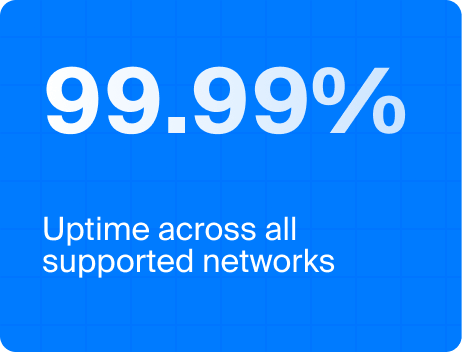
With 99.99% uptime, 24/7 SLA-backed operations and low-latency global endpoints, Chainstack ensures seamless RPC access for building and scaling DeFi, analytics, and trading applications.