


TL;DR
Why build a Polymarket Bot?
Polymarket operates as a decentralized prediction market, combining speed with full on-chain transparency. Unlike traditional prediction markets, Polymarket tokenizes outcomes as binary ERC-1155 assets through Gnosis’s Conditional Token Framework (CTF), creating opportunities for sophisticated trading strategies.
AI-powered prediction market bots benefit from:
- Correlated market detection: LLMs identify logical relationships between seemingly unrelated markets, uncovering hedge opportunities invisible to manual analysis
- On-chain transparency: Every position and outcome is verifiable on the blockchain through positionIds and collectionIds
- Event-driven architecture: Real-time market monitoring and automated portfolio construction
- Reasoning-powered hedging: LLMs close the reasoning layer—determining “what follows from A relative to B”—while the engine converts these insights into hedge candidates with probabilistic coverage
This approach goes beyond simple copy trading, enabling discovery of alpha through logical market relationships that would be impractical to identify manually.
What is Alphapoly?
Alphapoly (chainstacklabs/polymarket-alpha-bot) is an open-source platform for finding “alpha” in correlated prediction markets. It detects dependencies between markets, classifies them to find hedge pairs, monitors prices, and provides a UI for quickly entering discovered opportunities while tracking open positions.

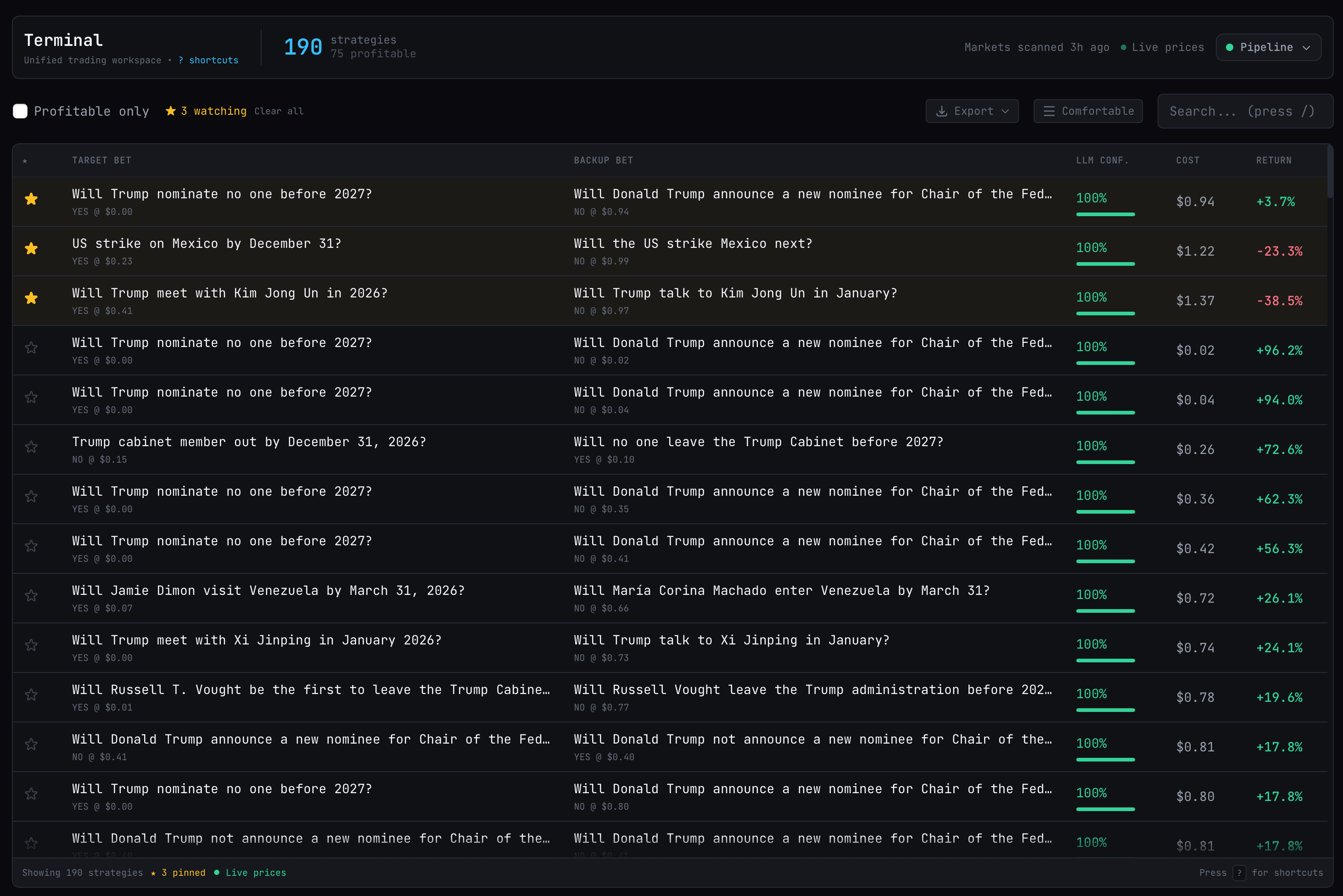
The system operates through a four-stage pipeline:
- Groups: Collecting multi-outcome market groups (e.g., “Presidential Election Winner”)
- Implications: LLM extracts logical relationships between market groups
- Portfolios: Selecting position pairs that mutually hedge risk with high probability coverage
- Positions: Tracking and monitoring purchased pairs
The UI is designed for “bot operators”—the dashboard displays strategies like a trading terminal, with Target bet and Backup bet in one row, along with LLM confidence, cost, and expected return. Live prices and pipeline toggles provide real-time control.
⚠️ Important: The project is provided “as is” for educational and research purposes and does not constitute financial advice. Trading prediction markets carries risk of loss.
Why RPC and LLM are essential
The Blockchain layer: Why you need Polygon RPC
Polymarket isn’t just a “feed of odds”—at the protocol level, outcomes are tokenized on Polygon. YES/NO shares are implemented as ERC-1155 tokens and issued through Gnosis’s Conditional Token Framework. In documentation terminology, these are positionIds/collectionIds.
This means any stable bot functions—checking positions, reading logs/events, monitoring balances, and especially sending transactions—require access to Polygon JSON-RPC. A few practical details critical for bots:
- Polymarket settles in USDC.e (bridged USDC)
- Polygon for Polymarket means chain ID 137—all libraries and web3 clients must point to the correct RPC
A “public RPC on luck” works for one-off checks but breaks down with 24/7 polling, log scanning, and automation. Public endpoints face rate limits, 429 errors, and unstable latency under shared load.
What RPC provides in practice: Your Polygon RPC URL is the entry point for JSON-RPC methods—eth_call, eth_getLogs, eth_sendRawTransaction. This isn’t a “web3 detail”—it’s the transport layer. Without it, your bot is either blind or unable to execute.
The Intelligence layer: Why you need an LLM
LLM in this architecture isn’t decorative. Alphapoly uses it to extract logical connections between market groups and construct covering pairs (hedge pairs), not just sort by price.
The LLM closes the reasoning part: “what follows from A relative to B.” The engine then converts this into hedge candidates with probabilistic coverage. This separation is reflected in the dual model strategy:
- IMPLICATIONS_MODEL: Extracts relationships between market groups
- VALIDATION_MODEL: Validates the extracted implications
This division is pragmatic for production: use an “expensive and powerful” model where errors cost more, and a lighter model for draft passes. It helps manage both systematic errors and cost/quality tradeoffs.
What you need to run a Polymarket bot
Before you start, gather these essentials:
- RPC Endpoints: HTTPS URL to monitor events and submit orders to the Polygon blockchain
- LLM Access: OpenRouter API key for accessing language models
- Polymarket CLOB Access: Polymarket uses Cloudflare protection that blocks requests from certain IPs, ensuring that the bot runs under allowed IPs
- Python Environment: Python 3.12+ and the uv package manager
- Node.js: Node.js 18+ for the frontend
- Polymarket Account: Optional for on-chain execution (the bot works as a detector/tracker without this)
Choosing the right Polygon RPC node
Chainstack offers two deployment models for Polygon nodes, each suited to different operational needs:
Global Nodes (Elastic)

Global Node is Chainstack’s implementation of the elastic approach as a globally load-balanced service. Requests route to the nearest available location, reducing latency, and the balancer can switch backends if a node degrades (e.g., falls behind in block height).
Key characteristics:
- Usage-based pricing with no upfront costs
- WebSocket support for event subscriptions
- Deploys in seconds (Chainstack documentation states “ready in seconds”)
- Ideal for local development, demos, and MVPs where you want stable RPC without manual failover
Trade-off: Shared infrastructure can introduce variable latency during network congestion.
Dedicated Nodes

Dedicated Node is an exclusive node deployed for a single client. Computational resources aren’t shared, and configuration can be adapted to specific scenarios.
Key characteristics:
- No rate limits on requests or WebSocket subscriptions
- Consistent low latency even during market volatility
- Debug/trace APIs enabled (where protocol supports), useful for debugging transaction failures
- Fixed monthly pricing for cost predictability
- Resource isolation ensures predictable performance
Recommended for: 24/7 services with active market scanning and especially on-chain transaction execution. Chainstack’s Polygon documentation positions dedicated nodes as “go-to” for request-intensive loads, including traders.
Quick Comparison
| Node Type | Latency | Cost Model | Best For |
| Global/Elastic | Usually lower (geo-routing) | Pay-per-request | Dev, prototypes, testing |
| Dedicated | Predictable, no shared load | Fixed monthly (compute/storage) | Production bots 24/7 |
Recommendation: Global Node is the best way to start and debug the pipeline. Dedicated node becomes essential when Alphapoly transitions to production—especially with regular scanning, monitoring, and on-chain execution. Bot load is often “step-wise” (peaks during recalculations), and performance depends on RPC response stability.
Local Installation and setup a Polymarket bot
Clone and Install
Clone the Alphapoly repository:
git clone https://github.com/chainstacklabs/polymarket-alpha-bot.gitcd polymarket-alpha-botInstall dependencies (install uv and npm first):
uv sync
npm install
Quick Start
Copy .env.example to .env:
cp .env.example .env
With make (auto-detects fnm/nvm/volta):
make install && make dev
Without make:
# Backend
cd backend && uv sync
cd backend && uv run python -m uvicorn server.main:app --reload --port 8000 &
# Frontend
cd frontend && npm install
cd frontend && npm run dev
Access the application:
- Dashboard:
http://localhost:3000 - API Documentation:
http://localhost:8000/docs
Configure environment
Copy the example configuration:
cp .env.example .envConfigure your .env file with the following:
# OpenRouter LLM Configuration

OPENROUTER_API_KEY=sk-or-v1-...
IMPLICATIONS_MODEL=<your-chosen-model>
VALIDATION_MODEL=<your-chosen-model>

# Chainstack Polygon RPC
CHAINSTACK_NODE=https://polygon-mainnet.core.chainstack.com/<YOUR_KEY>

# Optional: Market filters and polling
POLYMARKET_TAG=politics
MARKET_POLLING_ENABLED=true
POLL_INTERVAL_SECONDS=300
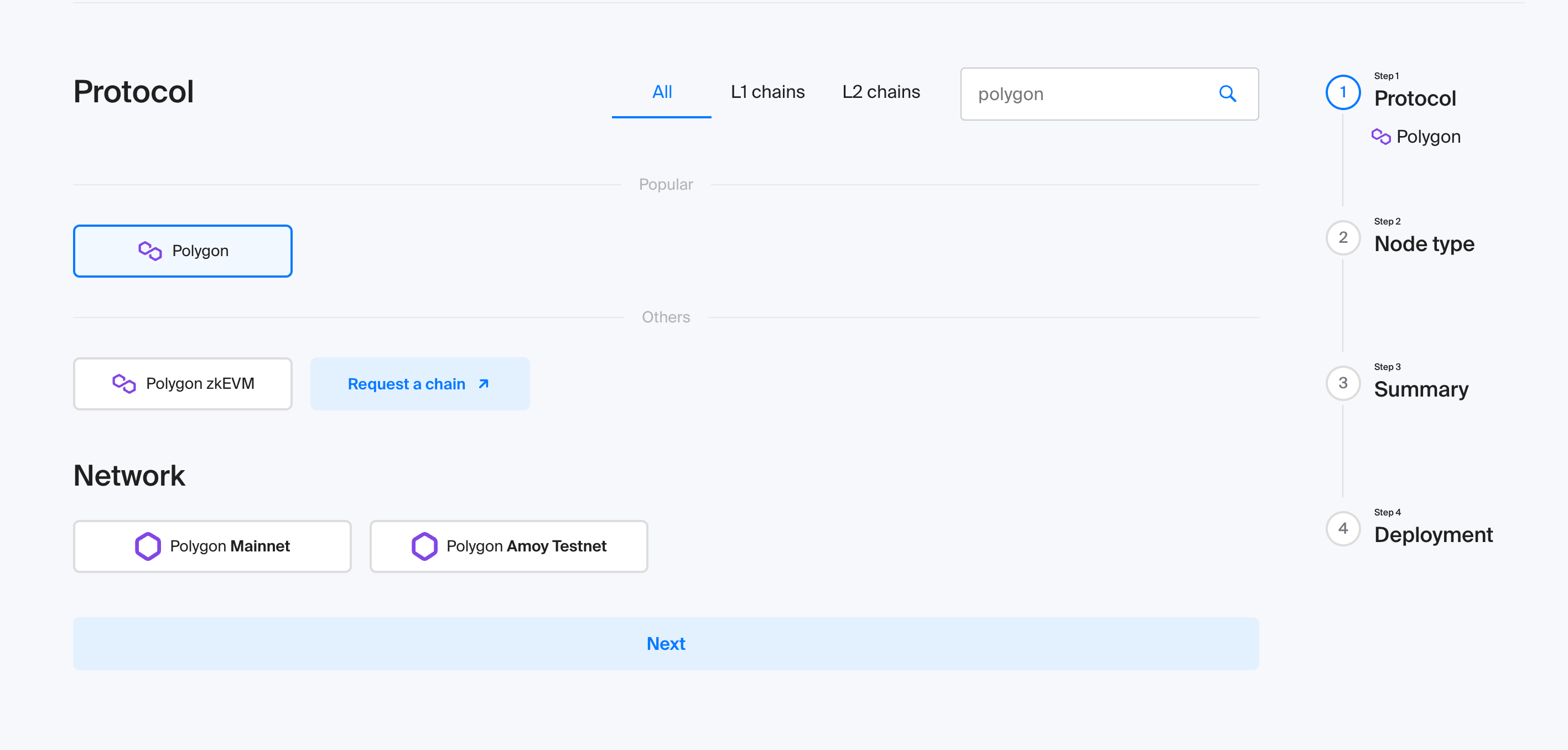
Getting your Chainstack endpoint:
- Log in to the Chainstack console (or sign up if needed).
- Create a new project.
- Select Polygon as the blockchain.
- Choose the network:
- Polygon Mainnet
- Deploy a managed RPC node.
- Open the project dashboard and copy the generated HTTPS RPC endpoints.

Configuration tips:
- Development: Start with
MARKET_POLLING_ENABLED=falseand enable it once the pipeline is stable - Production: Enable polling to incrementally fetch new markets
- Market focus: Use
POLYMARKET_TAGto limit to specific topics (e.g., politics, sports, crypto)
How Alphapoly works
Alphapoly operates through a sophisticated four-stage pipeline that combines AI reasoning with market analysis:
Groups: Market Collection
The system fetches multi-outcome market groups from Polymarket. For example, a “Presidential Election Winner” market group contains multiple possible outcomes (different candidates), each represented as a separate tradable position.
Implications: LLM Reasoning
The LLM (via IMPLICATIONS_MODEL) extracts logical relationships between different market groups. This is where AI adds value—identifying non-obvious connections like:
“If Candidate A wins the primary, Candidate B’s general election odds decrease.”
“Policy X passage implies higher probability of Economic Outcome Y”
These implications are then validated by the VALIDATION_MODEL to reduce systematic errors.
Portfolios: Hedge Pair Construction
Using the validated implications, Alphapoly constructs position pairs that mutually hedge risk. The system calculates:
- Probability coverage: How likely the hedge protects against loss
- Cost analysis: Entry cost for the pair
- Expected return: Potential profit if the correlation holds
- LLM confidence: How certain the AI is about the logical relationship
The dashboard displays these as actionable strategies with Target bet and Backup bet clearly labeled.
Positions: Tracking and Execution
Once you enter a position (either manually through the UI or automatically if configured), the system:
- Monitors on-chain state: Tracks your positions via Polygon RPC
- Updates in real-time: Shows current P&L and position status
- Logs activity: Maintains a complete audit trail
The key insight: This isn’t simple copy trading or manual analysis. The LLM handles the reasoning layer (“what implies what”), while the engine handles the execution layer (“how to construct and monitor hedges”). This separation allows for sophisticated strategy discovery at scale.
Conclusion
Alphapoly represents a sophisticated approach to prediction market trading—using LLMs for reasoning, not just execution. The system doesn’t merely copy trades or react to price movements. Instead, it discovers logical relationships between markets and constructs hedging portfolios that would be impractical to identify manually.
The architecture demonstrates how to combine modern AI with blockchain infrastructure:
- LLMs handle the reasoning layer: “What follows from A relative to B”
- The engine handles execution: Portfolio construction, risk analysis, position tracking
- RPC provides the transport: Reliable on-chain access via Polygon
- For infrastructure, the choice is clear:
- Development: Start with Chainstack Global Nodes for fast deployment and low initial cost
- Production: Migrate to Dedicated Nodes for consistent performance, no rate limits, and operational predictability
The open-source nature of Alphapoly makes it an excellent starting point for building your own prediction market strategies. Whether you’re researching market correlations, testing AI-driven trading hypotheses, or building production automation, the combination of LLM reasoning and robust blockchain infrastructure opens new possibilities in decentralized prediction markets.
Explore the Alphapoly repository and deploy your Chainstack Polygon node to get started.
FAQ
Yes, for detector/tracker mode only. The .env.example notes that RPC is required for on-chain actions. You can start with just the LLM component and UI to discover strategies, then add RPC later when you want to execute trades or monitor on-chain positions.
The pipeline separates extraction (finding relationships) from validation (checking quality). This allows you to:
– Use a faster, cheaper model for initial extraction
– Use a more powerful model for validation where errors are costly
– Optimize for both quality and cost efficiency
Global Node: Best for development and testing. Shared resources mean lower cost but variable performance. Perfect for prototyping Alphapoly and validating the pipeline.
Dedicated Node: Essential for production 24/7 operation. No rate limits, consistent latency, and resource isolation. Bot workloads are often “step-wise” (spikes during recalculations), making predictable infrastructure critical.
Copy trading: Mirrors another trader’s positions mechanically
Alphapoly: Uses AI to discover logical relationships between markets and constructs hedge portfolios. It finds alpha through reasoning, not imitation.
The LLM can identify correlations like “If X happens, Y becomes more likely” that would be impractical to spot manually across hundreds of markets.
Polymarket operates on Polygon mainnet (chain ID 137). Make sure your RPC endpoint and any wallet configurations point to mainnet, not testnet.
Resources
- Alphapoly Repository – Full source code, README, and dashboard screenshot
- Chainstack Polygon Documentation – Getting started guide and endpoint setup
- Chainstack Global Nodes – Elastic infrastructure documentation
- Chainstack Dedicated Nodes – Single-tenant deployment guide
- Polymarket CTF Documentation – Conditional Token Framework overview
- OpenRouter – LLM API access and model selection
- Why Public RPCs Aren’t Enough – Understanding RPC limitations under load