


RPC providers connect decentralized applications to blockchain nodes, allowing them to read data and send transactions on various networks. It’s essential for any Web3 app because it abstracts the complexity of running blockchain infrastructure, providing developers with reliable, low-latency access to blockchain data and state. In other words, an RPC provider is the bridge that lets your application communicate with the blockchain seamlessly, it’s crucial for everything from fetching balances to submitting new transactions in real time.
In summary, Alchemy is a powerful and developer-friendly RPC provider with a rich feature set and proven performance. It’s an excellent choice for building on popular chains and benefitting from advanced tools. However, when it comes to cost predictability and unlimited scaling, Chainstack has an edge.

Alchemy company history
Alchemy is a leading blockchain infrastructure company. The platform was founded in 2017. After initially experimenting with consumer apps, the founders pivoted to developer infrastructure upon realizing how difficult it was to build blockchain applications with the tools available at the time. Alchemy launched its platform to simplify Web3 development. Over the years, Alchemy expanded beyond its Ethereum roots to support dozens of chains, helping power many of the most popular dApps across almost 200 countries today.
Alchemy’s core products
Alchemy offers a suite of products and APIs for Web3 development. Its core offerings include:
- RPC API: A powerful endpoint for interacting with blockchains using standard JSON-RPC calls. It offers fast, reliable node infrastructure for reading and writing chain data and scaling apps.
- Smart Websockets: A WebSocket service that pushes real-time blockchain events (new blocks, transactions, address activity, NFT events) to your app with easy setup.
- Rollups: A rollup-as-a-service platform to launch and scale custom Layer-2 chains with built-in developer tooling and APIs.
- Cortex: The intelligent blockchain engine that powers Alchemy’s products, improving performance, reliability, and throughput across the platform.
Performance and key factors
- Latency: Alchemy has invested heavily in global infrastructure to deliver low-latency RPC responses. Developers using Alchemy can expect near real-time data retrieval and transaction submission without noticeable delays.
- Reliability & Uptime: The platform is known for its strong reliability. Alchemy operates a distributed, fault-tolerant architecture across multiple regions to avoid single points of failure. Many top projects trust Alchemy for its proven track record of keeping infrastructure running smoothly during critical times.
- Throughput: Alchemy’s RPC service is designed to scale as your application grows. Even the free tier can handle around 300 RPS on Ethereum-equivalent workloads, which is sufficient for many small to mid-sized projects. Higher paid plans allow significantly greater throughput by allocating more compute units per second.
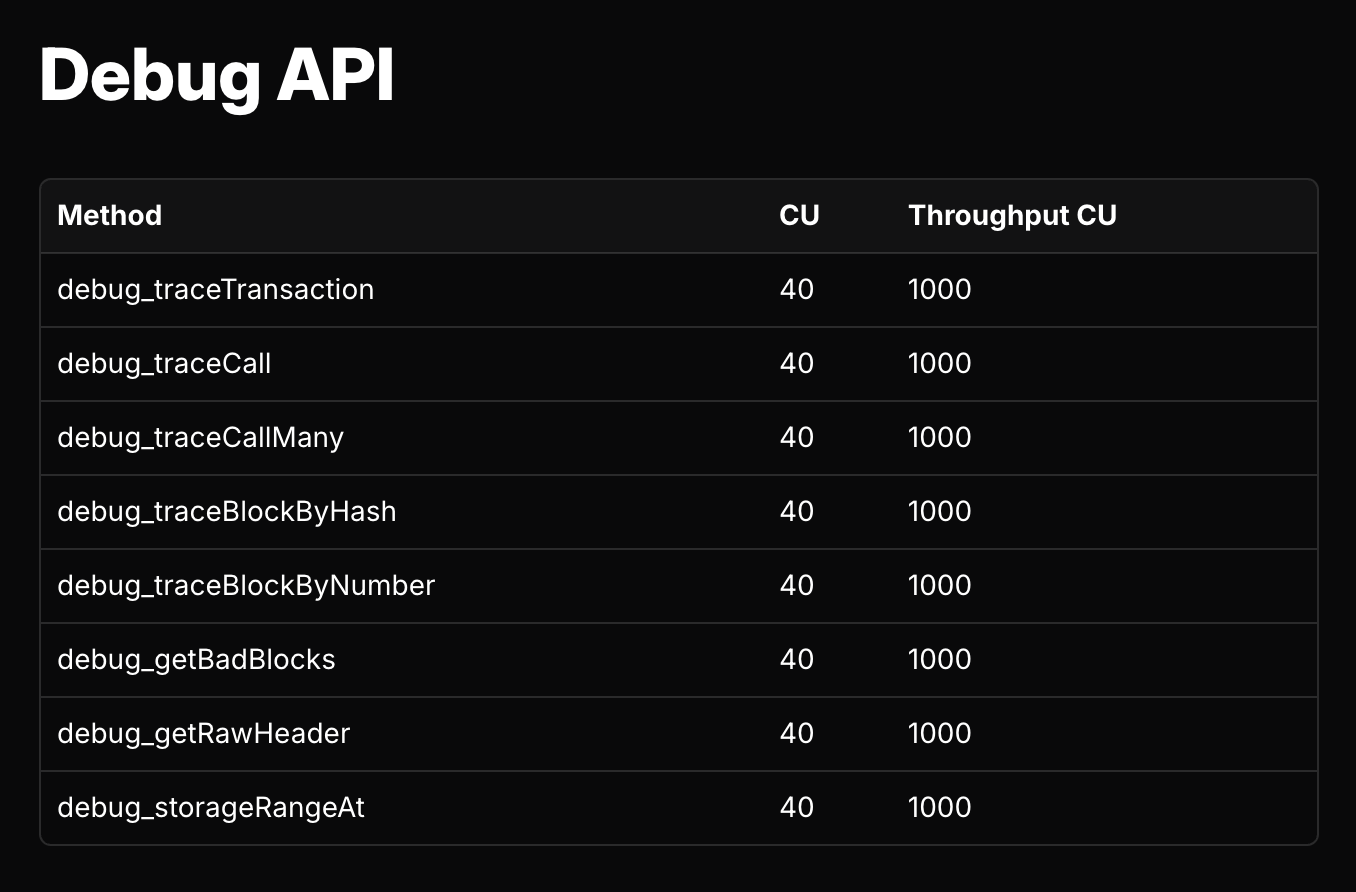
- Cost model: Alchemy’s pricing is based on compute units rather than raw request counts. Every RPC method is assigned a weight depending on how resource-intensive it is. This usage-based model can be flexible, but it also means costs aren’t always predictable upfront, especially if an application makes a lot of “light” calls that nonetheless add up in compute units.

| Area | Alchemy strengths | Potential weaknesses |
|---|---|---|
| Performance & scale | Low latency on major chains; Supernode handles high RPS and bursts | Heavy methods get costly |
| Reliability & uptime | Multi-region, autoscaling architecture; strong uptime track record | Highest SLAs and priority support are enterprise-tier |
| Tooling & ecosystem | Rich suite: Build, Monitor, Notify, Transact; polished docs and UX | Proprietary stack; depth strongest on Ethereum-first flows |
| Pricing & control | Generous free tier; flexible CU-based billing | Method-weighted costs are harder to predict; limited per-node infra control |
Alchemy pricing
Alchemy offers a free plan that includes up to 30 million Compute Units per month, which translates to roughly 1.8 million simple RPC requests depending on the method mix. This allowance is noticeably lower than what is available on Chainstack’s free Developer plan.
Above that, Alchemy uses a Pay As You Go model where pricing is based on Compute Units rather than simple request counts. In practice, this means different RPC methods consume different amounts of compute, and heavy methods like logs, traces, or complex calls can significantly increase usage.
| Metric | Chainstack | Alchemy |
|---|---|---|
| Plan used in example | Pro | Pay As You Go |
| Included usage | 80M Request Units | 0 Compute Units included |
| Workload equivalent | 73.5M method calls | 73.5M method calls |
| Compute usage (example workload) | Fits in included usage | 1.955B Compute Units |
| Plan price | $199 | $0 |
| Overage charges | $0 | $745 |
| Total monthly cost | $199 | $745 |
The difference becomes clear when looking at a real workload example. In the scenario above, the same set of method calls that fits within Chainstack’s included usage generates nearly 2 billion Compute Units on Alchemy, resulting in about $745 in overage charges.
For small projects, the pricing model can work well. However, for production workloads with heavy reads, logs, or traces, forecasting costs becomes more difficult because pricing depends on weighted compute usage rather than request volume.
Alchemy vs. Chainstack comparison
Both Alchemy and Chainstack are high-performance Web3 infrastructure providers, but there are some key differences in their approach that can sway developers towards Chainstack:
Multi-chain support: Alchemy has expanded to support around 50+ blockchains including major ecosystems like Ethereum, Polygon, Solana, Base, and even newer chains like Hyperliquid. Chainstack, however, is multi-chain by design and currently supports 70+ protocols.
Pricing and scalability: Alchemy’s usage-based billing means costs scale with activity, and certain calls count more against your allowance. By contrast, Chainstack uses transparent flat-fee pricing with no method weighting. Every RPC call is simply a request, making monthly bills much more predictable. Notably, Chainstack offers an Unlimited Node option – an add-on available even on its entry-level plans – which lets you make unlimited RPC requests for a fixed monthly price.
Performance and reliability: Both providers excel in low-latency, globally distributed infrastructure. Chainstack matches Alchemy’s speed and also boasts 99.99%+ uptime SLA on its infrastructure, achieved through real-time adaptive failover and load balancing. This level of reliability is offered across all Chainstack plans, whereas Alchemy’s strict uptime guarantees and priority support are typically reserved for higher enterprise tiers.
FAQ
Alchemy runs a multi-cloud, multi-region setup with redundancy and monitoring, which delivers generally strong reliability. Detailed uptime guarantees and priority support, however, are mostly limited to higher-tier or enterprise plans.
Alchemy bills using Compute Units, with each RPC method assigned a different weight and throughput capped in CUs per second. This model is flexible but method-weighted, making costs harder to predict and requiring active usage monitoring.
Alchemy offers low latency via global infrastructure and handles moderate to high traffic well. Throughput is limited per app, and throttling applies once limits are hit, so retries and rate control are often needed. Strong SLAs are typically reserved for enterprise users.
Both providers offer production-grade RPC. Alchemy’s CU-based pricing can be efficient but less predictable at scale, while Chainstack’s flat, request-based pricing and Unlimited Node option focus on cost predictability and consistent performance across plans.