


The powerhouse duo: TRON and USDT-TRC20
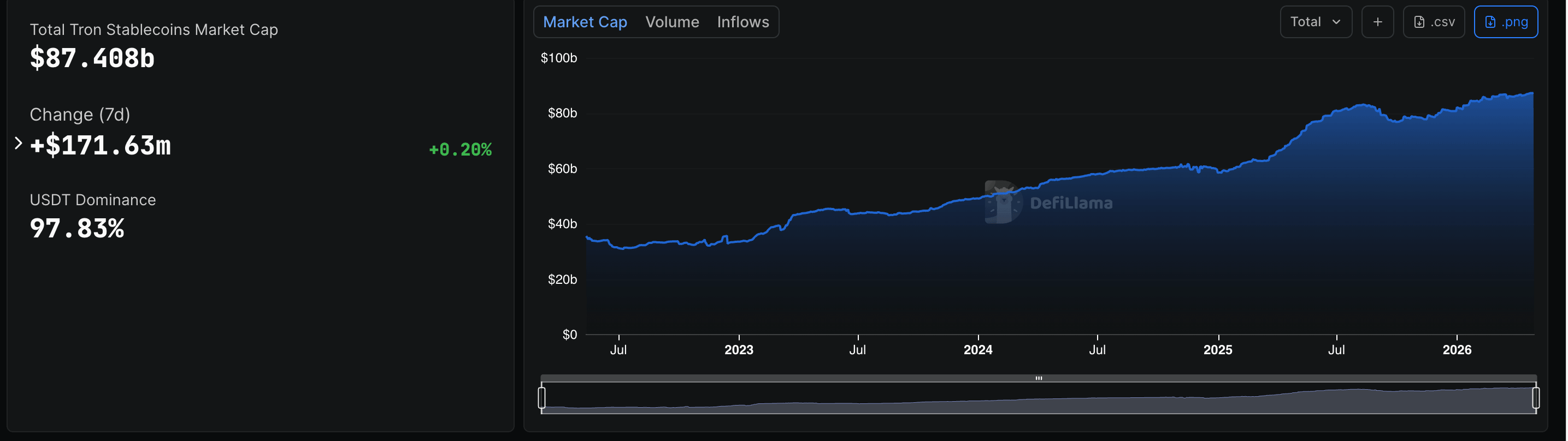
TRON hosts over 45% of all circulating USDT, roughly $89 billion, processed across more than 13 million daily transactions. Blocks confirm every 3 seconds via 27 elected Super Representatives, the network sustains 2,000+ TPS, and the bandwidth-and-energy fee model keeps transfer costs at fractions of a cent. This combination is why payment processors and exchanges often prefer TRON for stablecoin infrastructure over traditional EVM chains.

That speed also creates pressure on every layer of the stack, particularly the RPC layer. A 3-second block time means state changes fast, and a node that falls behind starts serving stale data. In a high-velocity settlement environment, stale reads translate directly into missed or misreported transactions. Getting the infrastructure right starts with understanding what TRON demands from the RPC interface sitting between your application and the chain.
Understanding the TRON RPC interface
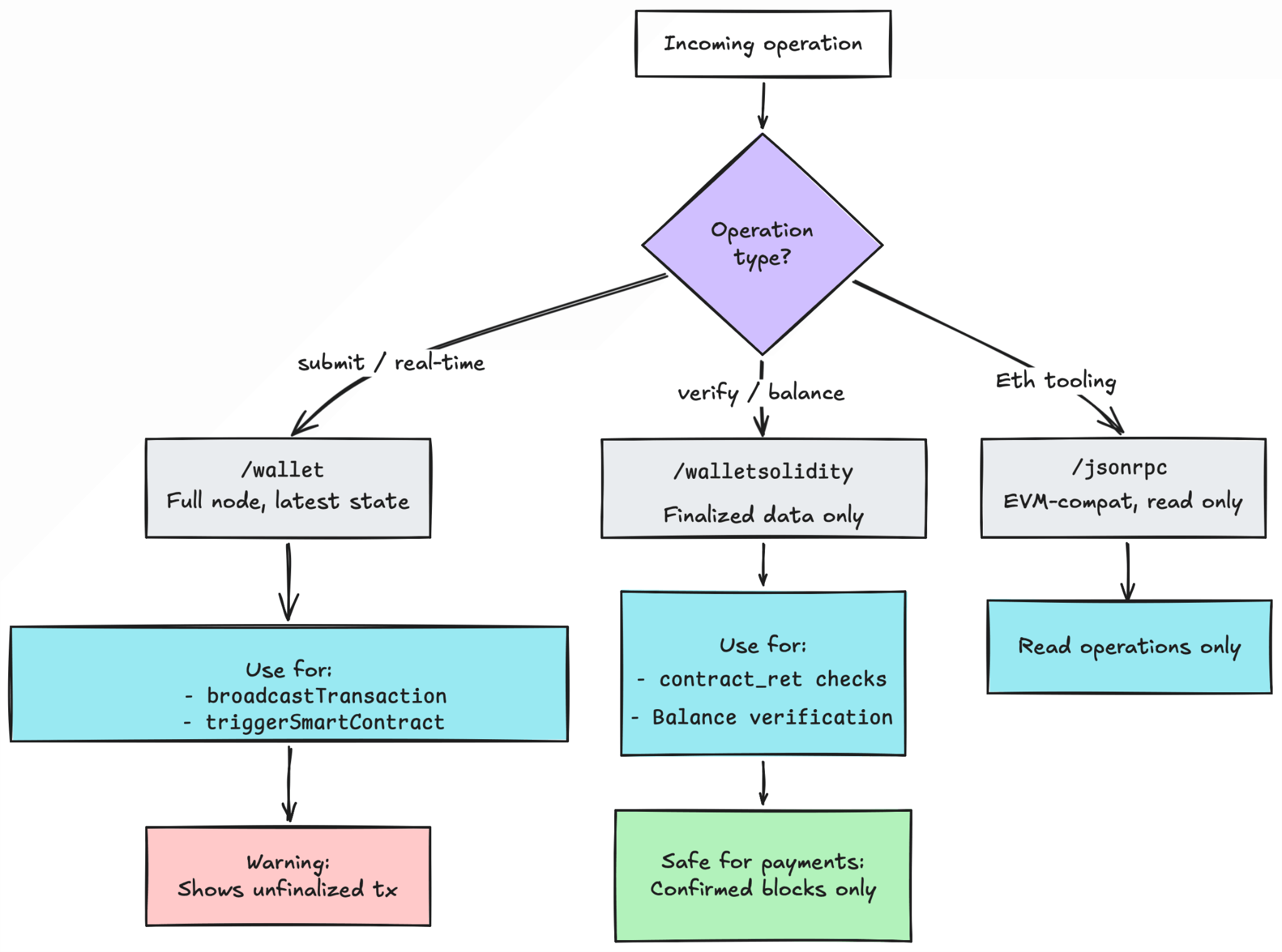
That stale data risk starts at the API layer. TRON exposes three interfaces and picking the wrong one for a given operation causes real problems in production. /wallet talks to the Full Node and returns the latest chain state, so it’s what you use for transaction submission and real-time reads. /walletsolidity only returns confirmed, finalized data, making it the right choice for payment verification and balance checks. The most common cause of “missing transaction” errors is using /wallet where /walletsolidity is needed. A transaction that’s been broadcast but not yet finalized shows up in one and not the other. /jsonrpc is a limited EVM-compatible interface for teams bringing Ethereum tooling to TRON, though write operations aren’t supported through it.

Protocol choice is mostly a throughput question. HTTP REST is fine for simple dApp queries or one-off tasks. For high-frequency indexing and exchange backends, gRPC with Protocol Buffers is worth the setup: it cuts serialization overhead by 30-50% compared to JSON and keeps connections persistent via HTTP/2, which matters when you’re making thousands of calls per second. Getting the interface right keeps your data fresh. Getting the resource model right keeps your transactions from failing silently.
📖 For a full walkthrough of all four TRON API interfaces including gRPC, see the TRON tooling guide.
Managing bandwidth and energy
TRON’s resource model replaces conventional gas with two separate resources: bandwidth, consumed by every transaction, and energy, consumed by smart contract execution. Staking TRX to acquire both enables near-zero fee USDT transfers, but at high volumes the economics require careful modeling. The three options are staking TRX directly, renting energy from marketplace providers, or paying per transaction in TRX, and most production operations end up blending all three depending on load patterns. Chainstack’s guide on mastering energy and bandwidth with Python covers programmatic resource management for production workloads.
Before broadcasting any contract call, wallet/estimateenergy lets you pre-flight the energy cost and avoid submitting transactions that will fail mid-execution. That estimate should never go into fee_limit as-is though. Network congestion can push actual energy consumption above the pre-flight figure, so building in a 10% buffer is the difference between a transaction that completes and one that runs out of energy on-chain having already spent the resources. With the resource model handled, the next layer is making sure each individual operation against the USDT contract is called correctly and verified fully.
Core RPC methods for USDT-TRC20 operations
For reading USDT state, triggerConstantContract handles balanceOf and decimals calls as the local database reads against the node. They never propagate to the p2p network, consume no bandwidth or energy, and are safe to poll aggressively for balance displays or pre-transfer checks.
Here’s how to check a USDT balance using TronWeb.js with your Chainstack endpoint:
const { TronWeb } = require('tronweb');

const tronWeb = new TronWeb({
    fullHost: 'YOUR_CHAINSTACK_ENDPOINT'
});

const USDT_CONTRACT = 'TR7NHqjeKQxGTCi8q8ZY4pL8otSzgjLj6t';
const WALLET_ADDRESS = 'YOUR_WALLET_ADDRESS';

async function getUSDTBalance() {
    try {
        const contract = await tronWeb.contract().at(USDT_CONTRACT);
        const balance = await contract.balanceOf(WALLET_ADDRESS).call();
        console.log(`USDT Balance: ${balance / 1e6}`); // USDT has 6 decimals
    } catch (error) {
        console.error('Error getting balance:', error);
    }
}

getUSDTBalance();
Writes follow a strict sequence:
- Build the transaction with
triggerSmartContract - Sign it locally
- Broadcast with
broadcastTransaction - Verify finality by checking contract_ret on
/walletsolidity

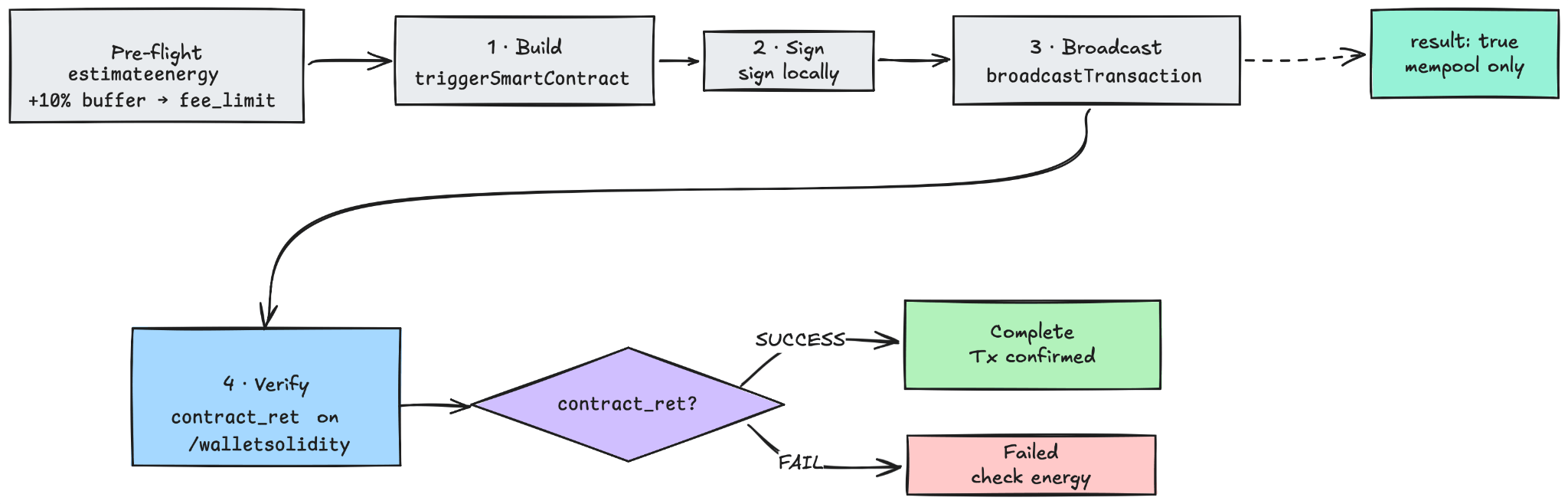
A “result”: true from broadcast means one thing, that the transaction hit the mempool, nothing more. Checking contract_ret is what tells you whether execution actually succeeded, since a transaction can land on-chain and still fail at the contract level due to insufficient energy.
Here’s how to send a USDT transfer:
const { TronWeb } = require('tronweb');

const tronWeb = new TronWeb({
    fullHost: 'YOUR_CHAINSTACK_ENDPOINT',
    privateKey: 'YOUR_PRIVATE_KEY'
});

const USDT_CONTRACT = 'TR7NHqjeKQxGTCi8q8ZY4pL8otSzgjLj6t';
const RECIPIENT = 'RECIPIENT_WALLET_ADDRESS';
const AMOUNT = 10 * 1e6; // 10 USDT (6 decimals)

async function sendUSDT() {
    try {
        const contract = await tronWeb.contract().at(USDT_CONTRACT);
        const txid = await contract.transfer(RECIPIENT, AMOUNT).send({
            feeLimit: 30_000_000
        });
        console.log('Transaction ID:', txid);
    } catch (error) {
        console.error('Transfer error:', error);
    }
}

sendUSDT();
Note: Replace
YOUR_CHAINSTACK_ENDPOINTwith your TRON node endpoint. For full code examples including gRPC and Python, see the TRON tooling docs.
TRON has no native subscription or event push model, so monitoring incoming USDT transfers requires a polling architecture. The reliable approach is calling getblockbynum sequentially and filtering internal_transactions for the USDT contract address (TR7NHqjeKQxGTCi8q8ZY4pL8otSzgjLj6t) and method ID a9059cbb, the transfer function selector. That’s all you need for a complete, durable record of every USDT movement.
Choosing a reliable TRON RPC provider
As USDT-TRC20 volume grows, the architecture of your RPC layer needs to match the workload profile. For user-facing applications, geo-balanced nodes that route across US, EU, and APAC regions keep read latency low regardless of where your users are. For high-throughput payment settlement and exchange backends in particular, dedicated single-tenant compute matters more. On shared infrastructure, a traffic spike from another tenant can degrade your latency precisely when market volatility is driving your own volume up. Dedicated nodes eliminate that risk entirely.
The polling architecture described earlier also has a direct cost implication. Since TRON has no native event subscription model, production monitoring requires continuous calls to getblockbynum, and that request volume adds up fast. Providers with uncapped request tiers, Chainstack’s Unlimited plan being one option, let your polling loop run at whatever frequency your infrastructure demands without rate-limit failures or unexpected overages during high-activity periods.
Security rounds out the picture. Open RPC endpoints are actively scanned by drainer scripts, so JWT or basic auth, IP whitelisting, and SOC 2 Type II and ISO 27001 compliant infrastructure aren’t optional hardening steps for integrations handling live USDT flows. They are the starting point.
📖 For a detailed comparison of TRON RPC providers — including pricing, gRPC support, and SOC 2 compliance — see our Best TRON RPC Providers in 2026 guide.
USDT transfer comparison: TRON vs Ethereum vs BSC
| TRON (TRC-20) | Ethereum (ERC-20) | BSC (BEP-20) | |
|---|---|---|---|
| Avg transfer fee | <$0.50 | $2–10+ | <$0.10 |
| Confirmation time | ~3 sec | ~12 sec | ~3 sec |
| USDT supply hosted | ~$86B (~46%) | ~$75B (~44%) | ~$5B (~3%) |
| Daily transactions | ~10.7M | ~1.2M | ~4.5M |
| Fee model | Bandwidth + Energy | Gas (Gwei) | Gas (Gwei) |
| RPC interface | HTTP + gRPC | JSON-RPC | JSON-RPC |
Conclusion
Every recommendation in this piece traces back to the same underlying risk. A TRON infrastructure that falls behind, miscounts energy, or misreads finality doesn’t just degrade. It loses money. Getting it right means treating node type selection, energy pre-estimation, finality verification, block polling, and endpoint security not as configuration details but as operational commitments.
As USDT-TRC20 cements itself as the settlement layer for emerging market currencies, the RPC endpoint is no longer just an API. It is a financial gateway, and the gap between reliable infrastructure and a liability is largely operational.
FAQ
The TRC-20 USDT contract address is TR7NHqjeKQxGTCi8q8ZY4pL8otSzgjLj6t. Use this address when calling triggerConstantContract for balance checks or triggerSmartContract for transfers. The transfer function selector is a9059cbb.
Fractions of a cent when the sender has staked TRX for energy and bandwidth. Without staked resources, transfers cost roughly $0.30–$1.00 in TRX burned for energy. Pre-flight every transaction with wallet/estimateenergy and add a 10% buffer to fee_limit.
/wallet returns the latest chain state including unconfirmed transactions — use it for broadcasting and real-time reads. /walletsolidity returns only finalized, confirmed data — use it for payment verification and balance checks. The most common “missing transaction” error comes from reading /wallet when you should be checking /walletsolidity.
TRON has no native event subscription model. Poll getblockbynum sequentially and filter internal_transactions for the USDT contract address (TR7NHqjeKQxGTCi8q8ZY4pL8otSzgjLj6t) and method ID a9059cbb. This gives you a complete record of every USDT movement.
TRC-20 is significantly cheaper. TRON USDT transfers cost under $0.50 with ~3 second confirmation. Ethereum ERC-20 USDT transfers cost $2–10+ depending on gas and take ~12 seconds. TRON hosts ~$86B in USDT (~46% of supply) vs Ethereum’s ~$75B (~44%), and processes roughly 10x more daily USDT transactions.
Related reading
- Best TRON RPC Providers in 2026 — pricing, gRPC support, and enterprise compliance compared
- How to get a TRON RPC node — public endpoint URLs, setup guide, and tooling
- TRON: Mastering Energy & Bandwidth with Python — programmatic resource management
- Stablecoins in cross-border settlements — USDT and USDC adoption trends
- TRON tooling docs — full code examples for TronWeb.js, gRPC, web3.py, and Hardhat