- 100M+ monthly RPC requests across across multiple chains
- 99.99% successful RPC response rate in production
- ~30% reduction in RPC infrastructure costs vs. previous setup
On October 10, 2025, crypto markets broke. A market-wide liquidation cascade — one of the largest in the industry’s history — sent platforms scrambling. Deposit flows surged. Oracle reads spiked. Positions were opened and closed in seconds across every major chain. For most trading infrastructure, this is the moment things start going wrong.
For Stobix, it was the moment their infrastructure held.
Meet Stobix
Stobix is an AI-powered decentralized perpetual futures protocol offering up to 200x leverage across multiple blockchain networks. The platform combines self-custody trading with real-time AI-driven market insights — an AI assistant that monitors technical indicators, tracks market sentiment, and delivers relevant insights as users navigate the market.

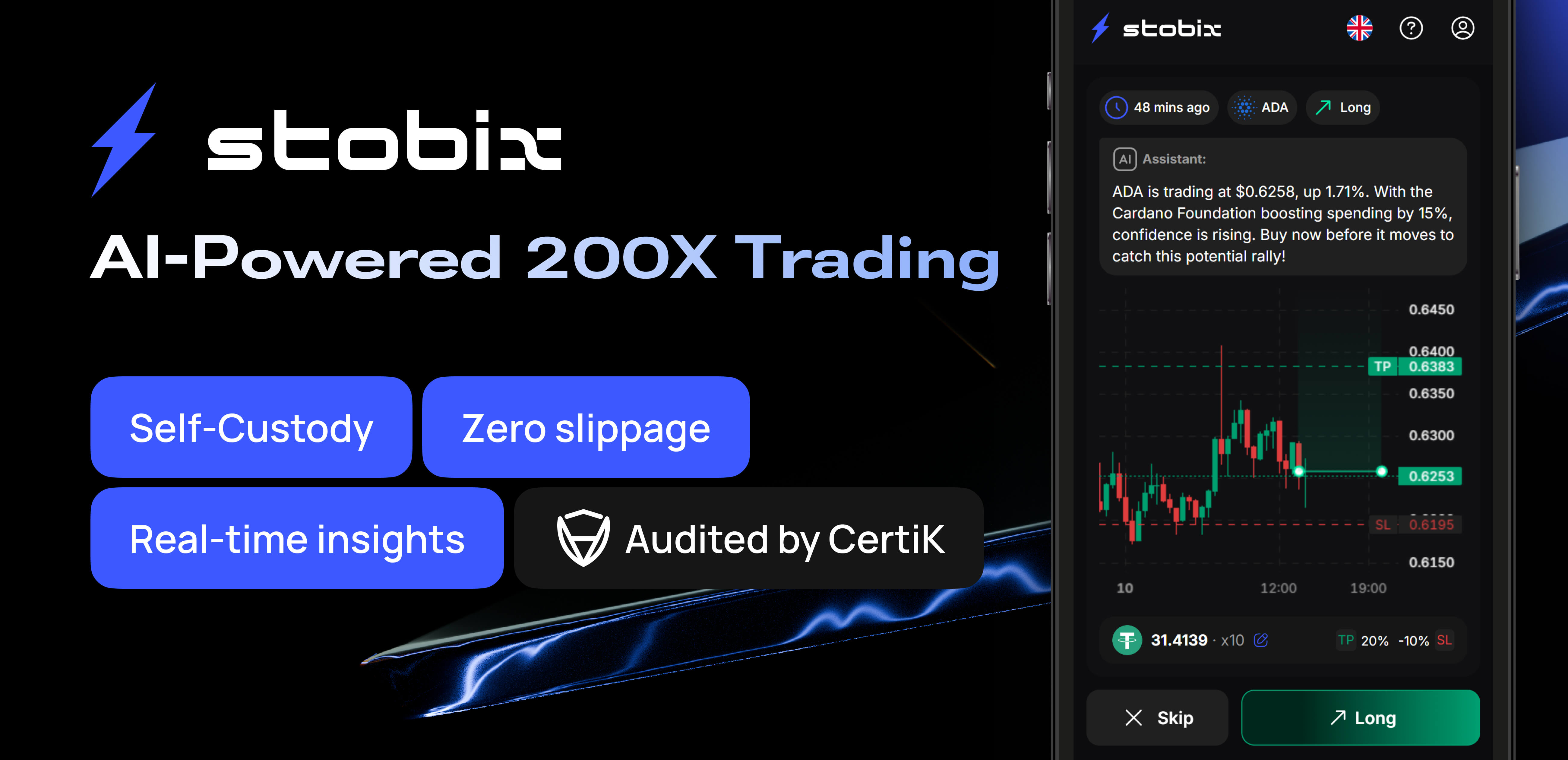
What makes Stobix’s infrastructure problem unusually hard is the combination of product type and network breadth. Perpetual futures with high leverage are not a read-heavy, eventually-consistent workload. Liquidation accuracy, position updates, and oracle data freshness all depend on RPC quality in real time. A slow response isn’t a UX inconvenience — it’s a safety-critical failure that can affect user funds.
That problem is compounded across multiple chains: Ethereum, BNB Smart Chain, Arbitrum, Base, Polygon, Avalanche, Solana, Tron, and Bitcoin. Each has its own finality model, data layout, and RPC quirks. Keeping that stack consistent, predictable, and cost-efficient at 100M+ requests per month is not a solved problem.
Michael Semin is the founder and CTO of Stobix — he architected the protocol from the ground up and continues to lead infrastructure, product development, and engineering. When he talks about RPC quality, he means it the way a pilot means it when talking about avionics: not “better would be nice” but “this is load-bearing.”
The challenge: infrastructure that looks fine until it doesn’t
Before settling on Chainstack, the Stobix team ran the standard evaluation cycle: public RPC endpoints, self-managed nodes, and several paid providers.
The failure modes were consistent across all three. Public endpoints are unreliable under load — usable for development, not for production trading where a dropped oracle read can cascade into a liquidation error. Self-managed infrastructure scales operational overhead linearly with chain count: one node per chain per region, multiplied by multiple networks, quickly becomes a full-time engineering workload in its own right. Paid providers performed well on benchmark dashboards and degraded in production — specifically under high-traffic conditions, which is exactly when a perp DEX needs them most.
Cost predictability was the second compounding issue. RPC billing at scale, with unpredictable traffic spikes during market volatility, made capacity planning genuinely difficult. Monthly spend was not a fixed line item — it was a variable with a tail that depended on how volatile the market was. For a trading business, that’s an uncomfortable coupling between infrastructure costs and market conditions.
The forcing function wasn’t a single incident. It was the recognition, as Stobix scaled across more chains and added more product features, that they needed RPC infrastructure that stayed predictable under real production trading workloads — not just on synthetic tests.
Why Chainstack
The team evaluated Ankr, Alchemy, and Quicknode alongside Chainstack, plus several smaller providers. The evaluation criteria were specific: multiple chains including non-EVM networks, consistent latency under load, and predictable pricing at their request volume — all three simultaneously.
Consistent latency where it matters: p99, not average
In trading infrastructure, average latency is a misleading metric. What matters is tail latency — the p99 during the worst hour of the worst day. A trading platform can survive occasional slow responses on a calm Tuesday afternoon. It cannot survive slow responses during a market-wide event, when every user is active simultaneously, oracle reads are maxing out, and liquidation logic needs to execute precisely.
Chainstack’s Global Nodes provided geo-balanced infrastructure that maintained consistent p99 performance under production trading workloads — not just synthetic benchmarks. That distinction drove the decision.
Multi-chain coverage without multi-chain operational overhead
Operating multiple chains with Chainstack Global Nodes compressed what had previously been a per-chain infrastructure project into a configuration change. New chain support — which previously involved evaluating providers, setting up fallbacks, tuning rate limits, and monitoring quirks per chain — became significantly simpler to add and maintain.
“Adding a new chain used to involve evaluating providers, setting up fallbacks, tuning rate limits, and monitoring quirks per chain. With Chainstack, it became closer to a configuration change than an infrastructure project.”
— Michael Semin, Founder & CTO, Stobix
For a team operating across multiple networks, this is a meaningful operational shift. The engineering hours that were going into RPC maintenance became available for product work.
Building with Chainstack
Stobix runs Chainstack Global Nodes as primary RPC infrastructure across its supported chains.
The workload is read-heavy but latency-sensitive: eth_getLogs queries for position monitoring, oracle freshness checks, deposit and balance reads, and transaction execution — all of which surge simultaneously during market volatility. That’s the pattern that breaks most infrastructure, and it’s the pattern Chainstack’s isolated node infrastructure is built to handle.
For a leveraged trading platform, market volatility doesn’t just mean more traffic — it means financial urgency. When prices move fast, users rush to deposit collateral, close positions, and execute withdrawals simultaneously. Each of those actions touches the RPC layer: balance reads, transaction submissions, confirmation checks. A slow or dropped response at that moment isn’t a UX inconvenience — it’s a direct financial impact on the user. That’s the exact surge pattern Chainstack handles for Stobix.
Chainstack is also not just a Stobix dependency. Michael’s team uses it across other internal products as well — a signal that operational consistency held up well beyond the initial deployment.
The results
- 99.99% successful RPC response rate across all supported chains
- p99 latency under 250ms on heavy queries on primary EVM chains
- ~30% reduction in RPC infrastructure costs vs. the previous setup, with elimination of unexpected cost spikes during high-traffic events
- Engineering time on RPC-related issues dropped substantially, freeing the team to focus on product development
But the most meaningful result happened on October 10, 2025.
That day produced one of the largest liquidation cascades in crypto market history — more than $19 billion liquidated in roughly 24 hours. For Stobix, it meant a major simultaneous surge in open positions, liquidations, oracle reads, and user actions — all at once, across multiple chains.
“Our infrastructure, including the Chainstack RPC layer, handled the load without degradation. Latency stayed within normal bounds, RPC error rate did not spike, and no manual intervention was required. For a trading product, that’s the moment infrastructure has to work. Anyone can look good on a calm Tuesday; the question is what happens during a market-wide liquidation cascade.”
— Michael Semin, Founder & CTO, Stobix
What’s next
Stobix has shipped its mobile app and continues expanding chain coverage and product features. The AI agent layer — real-time market sentiment monitoring, technical analysis, and market intelligence — is an active development area. As the platform scales, the RPC infrastructure stays constant: Chainstack Global Nodes across all supported networks.
“October 10 was one of the hardest days crypto has seen in years. Seeing Stobix handle that load without a single incident is exactly what we build Chainstack for.”
— Eugene, Founder of Chainstack
Build like Stobix
Trading platforms, DeFi protocols, and real-time on-chain products need RPC infrastructure that holds up when markets don’t. Chainstack Global Nodes give you consistent performance, multi-chain coverage, and predictable costs at any scale.
Bottom line

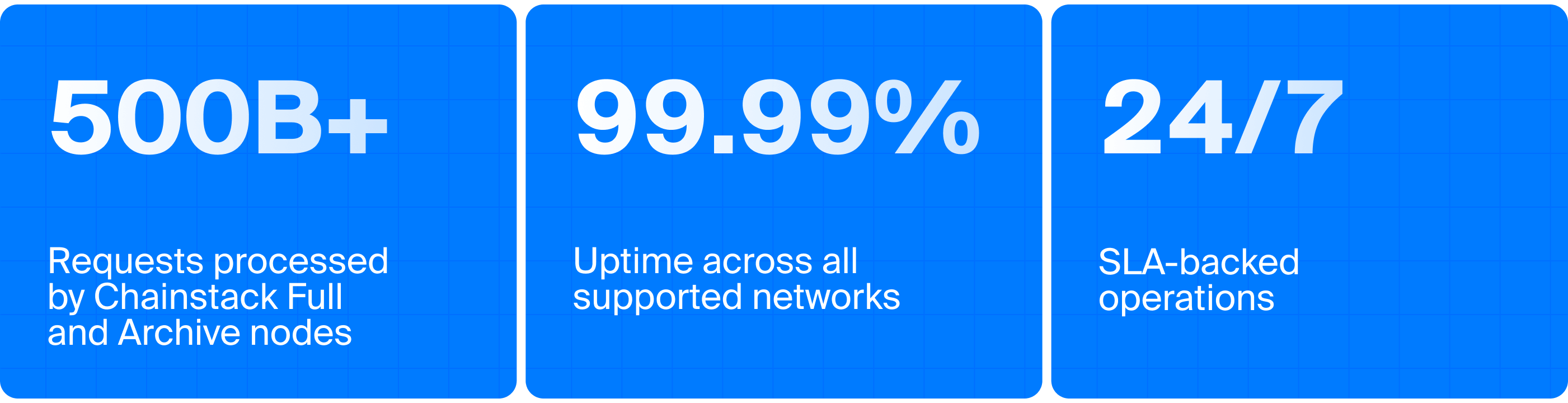
For teams building trading and DeFi infrastructure, RPC quality is not a background concern — it’s directly tied to user safety and platform reliability. Stobix’s experience shows what the right infrastructure looks like under real conditions: consistent latency during liquidation cascades, predictable costs at scale, and multi-chain coverage that doesn’t require a dedicated ops team to maintain.
If you need RPC infrastructure that holds up when markets don’t — and you need it across more than one chain — that’s what Chainstack is for.