


Running a TRON node yourself has historically been a commitment. Java-Tron isn’t especially exotic — a JVM-based full node with well-understood mechanics — but the operational layer around it required real DevOps investment. You provision the hardware, install Java-Tron with the right JDK version, wait days for the initial sync, set up monitoring, and then run the cycle again every time TRON ships a mandatory network upgrade. Teams handling USDT settlement, exchange flow, or high-volume payment rails did this because they had to — the value of full control over broadcast, throughput, and independent verification of settlement outweighed the DevOps cost. Teams without those requirements didn’t.
The operational math has shifted. What made running a TRON node hard was rarely TRON itself — Java-Tron is stable and production-hardened by years of running the world’s largest stablecoin settlement network. The hard part was everything around the node: deployment, monitoring, self-healing, updates, failover. Chainstack Self-Hosted now supports TRON Mainnet, which means that operational layer becomes software you consume rather than a stack you build.
This piece is about who actually benefits from a TRON node on their own infrastructure, what running one looks like day-to-day, and how the newer answer compares to the older one.
Why running a TRON node used to be a project
Java-Tron is the reference implementation of the TRON protocol. It’s what exchanges, custodians, payment processors, and DeFi protocols on TRON all run under the hood. When you run your own node, you get the same feature set they do:
- Dual API surface — HTTP JSON-RPC on port 8090 for standard integrations, plus a full gRPC API for high-throughput or streaming workloads. The gRPC layer is what most production TRON operators reach for at scale.
- Full mempool visibility — every unconfirmed TRC-20 transfer, every pending TRX transaction, every energy/bandwidth resource change. Payment processors watching for incoming USDT get push notifications the moment a transaction enters the network.
- Direct transaction broadcasting with propagation control. Your transaction enters TRON’s gossip network from your own Super Representative peer set; you can watch propagation, retry if needed, and react to network conditions.
- Independent verification of settlement. For an entity holding customer USDT or reconciling stablecoin flows, the answer to “how do you verify balances?” is “we run our own node.” Everything else is trust in a third party.
Unlocking that feature set on your own infrastructure meant building the ops layer around Java-Tron yourself: procure hardware sized for ~3 TB and growing, install Java-Tron with the correct JDK version, wait for the initial block download (TRON’s chain has processed over 13 billion transactions since mainnet launch), stand up monitoring, hook up alerts, plan for mandatory network upgrades, plan for failover. That’s the setup burden the article is really about. The teams that took it on did so for very specific reasons — worth naming, because they’re where the case for a self-hosted TRON node actually lives.
Who actually runs their own TRON node, and why
- Stablecoin payment processors. Kolo, NEXUS, WalletConnect Pay — every serious USDT payment company on TRON runs its own nodes. The economics are decisive. TRON processed $1.96 trillion in stablecoin settlements in Q1 2026, driven almost entirely by TRC-20 USDT. A payment processor sitting in that flow can’t afford to poll a shared RPC endpoint for confirmations, wait on someone else’s mempool refresh cycle, or hit a rate limit during a high-volume window. Broadcasting from your own node means you control transaction propagation and can rebroadcast aggressively. Fee estimation from your own resource-model calculation is more accurate than any third-party oracle. When the entire business is “we settle USDT at low fees, fast,” none of this can be outsourced.
- Centralized exchanges. Binance, OKX, HTX, Gemini, Bitstamp — every exchange running TRC-20 USDT deposits and withdrawals runs its own TRON nodes. Two reasons. First, scale: Binance alone captures 30–50% of labeled stablecoin inflows on TRON. At that volume, shared RPC providers become both a rate-limit ceiling and a single point of failure. Second, compliance: exchanges holding customer TRX and TRC-20 assets must independently verify balances against the chain — regulators and auditors don’t accept “we trust a third party’s API.”
- Remittance and regional payment operators. TRON has become the dominant stablecoin rail in emerging markets. Regional Commerce data shows TRON captured over 40% of crypto shopping volume in Africa and LATAM in Q1 2026. Remittance corridors, neobanks, and merchant processors serving these markets run their own TRON nodes for the same reasons payment processors do: broadcast reliability, mempool accuracy, and settlement independence. When your customer is paying rent in USDT and expects it to confirm in under a minute, the RPC layer isn’t a place to save money.
- Institutional custodians and prime brokers. Anchorage Digital added TRON support in 2026. Custodians holding institutional USDT on TRON — including balance sheets that increasingly include stablecoin treasury positions — verify against their own nodes. The 2024–2026 wave of stablecoin adoption by fintechs and neobanks (Mastercard Crypto Partner Program, MetaMask native TRON support) all pushes more institutional value onto TRON, and all of those integrations sit on top of self-hosted infrastructure.
- DeFi protocols on TRON. SunSwap (TRON’s largest DEX by USDT volume), JustLend, and USDD’s ecosystem all run their own nodes for the same reason DeFi on Ethereum does: application logic that depends on chain state can’t tolerate a shared provider’s latency or rate-limit envelope. SunSwap’s USDT–WTRX pool processed billions of dollars in swaps in Q1 2026 alone.
- Analytics and compliance platforms. Chainalysis, Elliptic, and the T3 Financial Crime Unit all run TRON nodes at scale for transaction tracing and compliance monitoring. Any platform in the business of serving TRON data as a product needs full and direct access to the chain, typically across multiple nodes for redundancy plus indexed databases on top.
At a glance:
| Audience | Use case | What running your own unlocks | Examples |
|---|---|---|---|
| Stablecoin payment processors | Accept USDT payments at scale | Controllable broadcast, real-time confirmation detection, accurate resource-model fee estimation | Kolo, NEXUS, WalletConnect Pay |
| Centralized exchanges | Custody TRC-20 assets, process deposits/withdrawals | Rate limits that hold at exchange scale, audit-grade infrastructure control | Binance, OKX, HTX, Gemini, Bitstamp |
| Remittance operators | Serve emerging-market USDT flows | Broadcast reliability, low-latency mempool access | Regional processors across Africa, LATAM |
| Institutional custodians | Hold and verify institutional USDT | Independent balance verification, compliance-ready infrastructure | Anchorage, Mastercard partners |
| DeFi protocols on TRON | Run production DEX / lending / stablecoin logic | Direct gRPC access, full mempool, historical query depth | SunSwap, JustLend, USDD |
| Analytics & compliance | Serve TRON data as a product | Multi-node redundancy, custom indexer feeds, full historical access | Chainalysis, Elliptic, T3 FCU |
The pattern across all of these: when TRON data is load-bearing for your business — USDT settlement, custody, compliance, application state — you don’t rent it.
What running your own actually costs
The operational reality is more pragmatic than the “sovereign infrastructure” version. A TRON full node is heavier than Bitcoin but lighter than an Ethereum archive node. Costs are predictable enough to plan around.
- Initial sync. TRON’s chain has processed over 13 billion transactions since mainnet launched in May 2018, and it produces a new block every 3 seconds. A clean sync from genesis takes days on good hardware — Java-Tron replays every block, validates every signature, and rebuilds state as it goes. Most professional setups bootstrap from a snapshot to bring a node current in hours instead of days.
- Storage growth. ~3 TB steady-state and growing steadily. TRON blocks are small individually (3-second cadence, mostly USDT transfers and TRX transactions), but they add up: the network processes 8–10 million transactions per day on average. Plan for 4–5 TB of storage headroom if you want to avoid resizing within the first year. NVMe strongly preferred — SATA SSDs will bottleneck IBD, and rotational drives simply won’t keep up.
- Updates. TRON ships mandatory network upgrades several times a year. The GreatVoyage series is the current upgrade branch — v4.8.1 ‘Democritus’ shipped in February 2026, with a mandatory upgrade deadline of March 9, adding ARM64 architecture support, JDK 17 compatibility, and SELFDESTRUCT opcode alignment with Ethereum. Missing a mandatory upgrade means your node forks off the network at the activation block. The schedule is more forgiving than Ethereum’s twice-yearly hard forks, but the operational discipline is the same.
- Monitoring and reliability. Sync drift happens. Peer connections degrade. Disk fills up. The GreatVoyage upgrade cycle occasionally introduces breaking changes that require configuration adjustments. Without monitoring, you find out something is wrong because a USDT transfer failed to confirm. With monitoring, you find out because an alert fires before customers notice.
- The “run it and forget it” myth. Plenty of Java-Tron nodes do run for months without intervention. They also drift out of sync silently, miss mandatory upgrades, and become slowly less useful without anyone noticing. For personal or evaluation use, that’s fine. For production USDT settlement, it’s a quiet path to a broken Saturday.
What changed: Chainstack Self-Hosted now supports TRON
The historical reason teams reached for shared RPC over self-hosting wasn’t that they wanted shared RPC — it was that the operational overhead of self-hosting a TRON node was too high to justify for a single chain, and they’d rather pay a provider’s premium than build a TRON DevOps function in-house.

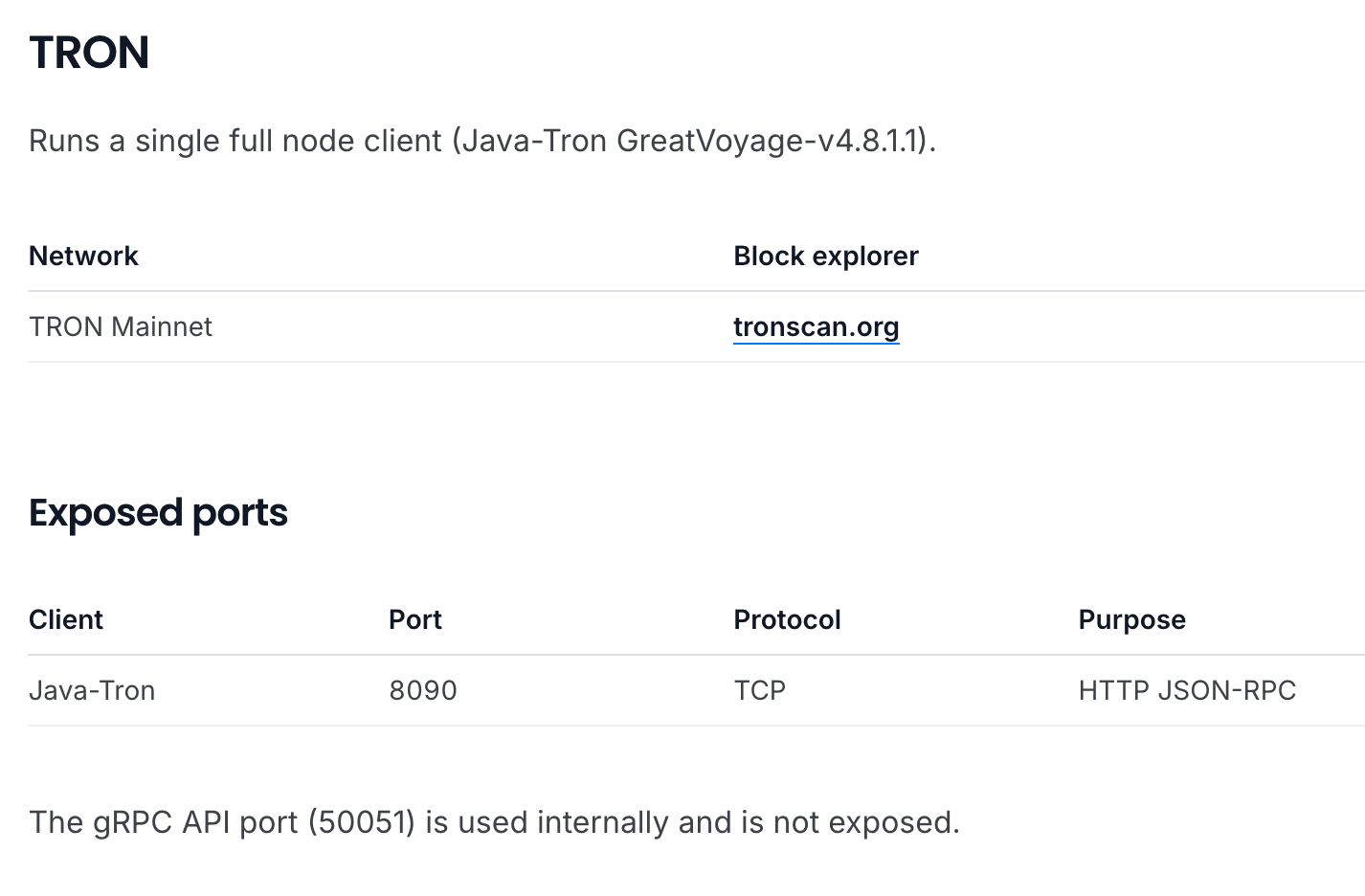
Chainstack Self-Hosted is what happens when you separate “own the node” from “build the operational stack around it.” Self-Hosted now supports TRON Mainnet on Java-Tron GreatVoyage-v4.8.1.1, with the same deployment workflow as the rest of the platform: pick the protocol, pick the network, deploy (Supported deployments). You get the node running on hardware you own, with the control plane — deployment, self-healing at the Kubernetes level, and monitoring through the bundled Grafana and VictoriaMetrics stack — handled by Chainstack (Monitoring).
A TRON full node fits on 8 vCPU, 32 GiB of RAM, and ~3 TB of NVMe storage (System requirements; Supported deployments).
The exposed endpoint is Java-Tron’s HTTP JSON-RPC on port 8090 — the same interface every TRON SDK speaks. The gRPC API (port 50051) is used internally and isn’t exposed by default (Supported deployments).
- Unlike Ethereum and Optimism Mainnet on the platform, TRON doesn’t currently ship with a snapshot-bootstrap preset — it syncs conventionally from genesis, so the multi-day initial sync described earlier still applies. See the system requirements page for the current snapshot-availability breakdown by network.
- What you do get is Kubernetes-level self-healing: if a node pod crashes, the deployment automatically restarts it and resumes from its last state on the persistent volume.
- Mandatory GreatVoyage upgrades still require you to redeploy the node on the new Java-Tron version yourself — Self-Hosted doesn’t currently auto-update client versions for you.
- Multi-endpoint failover to a Chainstack-managed TRON node is on the roadmap but not yet shipped.
- You still own the node. The data never leaves your perimeter. You can SSH into the box and hit
wallet/getnowblockagainst it like any other Java-Tron install. The difference is you didn’t build the deployment stack around it yourself — though today that means bring-your-own snapshot and bring-your-own upgrade discipline for TRON specifically, unlike Ethereum and Optimism Mainnet, which get snapshot bootstrap out of the box.
When to self-host TRON, and when not to
The decision isn’t religious. It’s a workload question.
Run your own TRON node if:
- You’re accepting USDT payments in production. The broadcast reliability, mempool visibility, and confirmation-timing arguments compound until they’re decisive.
- You operate an exchange, custody service, or fintech touching TRC-20 assets at meaningful volume.
- You run a remittance corridor, merchant processor, or payment gateway serving stablecoin flows.
- Your application makes more than a few hundred thousand RPC calls per day. Managed RPC pricing scales with call volume; your own node runs at a flat hardware cost regardless of throughput.
- You need gRPC access, full mempool subscriptions, or high-frequency event streaming that shared RPC tiers don’t offer.
- Compliance, audit, or regulatory frameworks require infrastructure control over customer asset movements.
Reach for managed Chainstack TRON instead if:
- You’re learning, prototyping, or running a low-volume side project. Chainstack TRON nodes with a free Developer tier covers most of that scale without the setup.
- You only need occasional historical lookups or read-only analytics on TRON data.
- You’re integrating a wallet or app that only needs basic TRC-20 balance queries and transaction submission.
The middle ground — production workloads that wanted their own TRON node without committing to a full DIY setup — used to have no clean answer. DIY self-hosting worked, but the setup and monitoring stack around Java-Tron was itself a quarter of DevOps work. Chainstack Self-Hosted is what removes that barrier: your infrastructure, none of the setup marathon.
If your TRON workload is heading toward “load-bearing for the business” — and given TRON settles nearly $2 trillion in USDT quarterly, that threshold arrives faster than most teams expect — running your own node was always the right answer. What’s new is that the path from “I should probably do this” to “it’s deployed and monitored” doesn’t have to take a quarter anymore.
FAQ
From genesis, several days on good hardware — Java-Tron has to replay 13+ billion transactions and rebuild state as it goes. Unlike Ethereum and Optimism Mainnet on Chainstack Self-Hosted, TRON doesn’t currently ship with a snapshot-bootstrap preset, so the multi-day sync from genesis is what to plan for today. Check the system requirements page for the current list of snapshot-enabled networks.
~3 TB steady-state, growing steadily as the network processes 8–10 million transactions per day. Plan for 4–5 TB if you want to avoid resizing within the first year. NVMe is strongly preferred over SATA SSD — TRON’s 3-second block cadence generates enough write pressure that slower disks become a bottleneck.
The current Self-Hosted TRON deployment exposes Java-Tron’s HTTP JSON-RPC on port 8090. gRPC (typically port 50051) is used internally between the node’s components and is not exposed by default. If your workload depends on gRPC — typically high-throughput indexers, streaming subscribers, or advanced trading integrations — check the supported clients and protocols page for current exposure options and reach out if your use case needs more than HTTP.
TRON’s GreatVoyage upgrade series requires all nodes to be running compatible versions by the activation block, or they fork off the network. Chainstack Self-Hosted doesn’t currently auto-update client versions for you — you’ll need to redeploy the node on the new Java-Tron version yourself ahead of the activation block, the same way you would on a fully self-managed setup.
Currently TRON Mainnet only. Additional networks may be added — check the supported clients and protocols page for the current list.
Chainstack Self-Hosted ships with Kubernetes-level self-healing: if the node pod crashes, the deployment automatically restarts it and resumes from the last state on the persistent volume. Multi-endpoint failover to a Chainstack-managed TRON endpoint is on the roadmap but isn’t available yet, so for now you’re on your own for diagnosing anything beyond a simple pod restart.
The current Self-Hosted lineup beyond TRON spans Ethereum (Mainnet, Sepolia, Hoodi), the OP Stack family (Optimism, Base, Unichain, Zora), Starknet, Polygon PoS, and Bitcoin. Solana Mainnet and Devnet with the Agave client are explicitly listed as coming soon on the supported clients and protocols page.
Yes, in the sense that a standard Java-Tron full node serves any TRC-20 token — USDT, USDD, and any USDC contract deployed on TRON — the same way, through JSON-RPC. Worth noting: Circle discontinued native minting of USDC on TRON back in February 2024, so USDC on TRON today isn’t Circle-issued the way it is on Ethereum or other CCTP-supported chains. USDT dominates TRON volume by a wide margin regardless.
Read more
Chainstack Self-Hosted documentation:
- Introduction to Chainstack Self-Hosted
- Supported clients and protocols
- System requirements
- Quick start
- Deploying nodes
- Managing nodes
- Monitoring
Chainstack TRON products:
External: