


On January 29, 2026, Optimism launched OP Enterprise, a product that lets a company run its own OP Stack chain while Optimism handles operations, upgrades, and incident response. Three weeks later, on February 18, Base announced that it was moving to a unified, Base-operated stack, as The Block reported. By February 26 Optimism had said in a governance forum reply that the prior Superchain revenue share with Base “will not continue”. Since then Unichain, a launch customer, has announced that Optimism will take over its production operations, Ink and Soneium have announced Fully Managed moves, and Optimism now publishes uptime and incident-response terms by tier.
This guide explains what OP Enterprise is, what each tier promises, which chains use it, how it connects to Optimism’s revenue model, how it compares with other managed-chain offers, and what it leaves unchanged for developers who need RPC access. Facts are as of November 16, 2026. Several are still moving, including the interop dates, the Unichain migration, and pricing, and the text marks them as such.
⏭ Skip ahead: if you build on OP Stack chains and want the infrastructure angle, jump to Where RPC providers fit.
Short answer: OP Enterprise is Optimism’s managed-chain offering. A customer gets its own OP Stack chain and either has Optimism run it (Fully Managed), runs it with Optimism’s support (Self Managed), or deploys on the shared OP Mainnet. According to the product page, the customer keeps control of chain configuration, economics, and roadmap. Fully Managed lists a 99.9% uptime SLA, an optional Mission-Critical add-on raises that to 99.95%, and no prices are published. It is not a replacement for an independent RPC provider, and Chainstack is independent of Optimism.
What is OP Enterprise?
Optimism describes OP Enterprise as managed blockchain infrastructure from the team behind the OP Stack: it handles operations, security, upgrades, and scaling, and the customer keeps its chain configuration, economics, and product roadmap. The pitch in the launch post is speed and predictability. It says vendor negotiations for chain infrastructure can take months and cost hundreds of thousands to millions of dollars, and it concedes that every major platform now sells enterprise services.
The product page lists these capabilities, all of them Optimism’s own descriptions:
- Compliance controls. Screening that rejects sanctioned addresses at the sequencer before a transaction reaches a block, and permissioned chain access for operators that need it.
- A critical-threat pause. Optimism says it can pause bridge withdrawals in response to a critical threat.
- Managed operations. 24/7 operations with 30-minute status updates during an incident.
- Integrations and liquidity partners. The page cites 30+ integrations, plus customer logos for Kraken (Ink), ether.fi, and Bitpanda.
The code stays open. The launch post says the OP Stack is MIT licensed and customers can fork it, a claim the criticism section below tests against who controls upgrades.
What are the OP Enterprise tiers and SLAs?
The table uses the OP Enterprise product page as of November 16, 2026. Optimism’s facts post adds that Fully Managed carries service credits if the uptime threshold is missed, without publishing a formula.
| Tier | Who operates the chain | Published service terms |
|---|---|---|
| Fully Managed | Optimism deploys, operates, and upgrades the chain | 99.9% uptime SLA; SEV 1 response in 30 minutes; 160 hours of integration support in year one |
| Self Managed | The customer, in its own cloud, with Optimism support | 24/7 incident response with a 1-hour SLA on critical issues; no uptime SLA listed; 80 hours of integration support in year one |
| OP Mainnet | Nobody: the app deploys on the shared public network | No upfront cost and no chain to operate; the page cites 99.99% historical uptime, which is a track record and not a contract term |
| Mission-Critical Support (add-on) | Same as the tier it is added to | 99.95% uptime; SEV 1 response in 15 minutes; multi-region deployment; dedicated technical account manager |
Three caveats matter if you are comparing quotes. First, Optimism’s pages do not agree on everything. The product page says the add-on can be added to any tier, while the launch post describes it as an add-on for Fully Managed and Self Managed. The product page lists 80 hours of integration support for Self Managed, while the launch post lists 40 hours of custom engineering support. The product page quotes 5 Mgas/s of throughput per chain, the launch post cites a 10 Mgas/s baseline growing past 100 Mgas/s, and the Ink announcement targets 200 Mgas/s by the end of 2026. Treat throughput figures as targets until a contract fixes them.
Second, early coverage that quoted 99.99% uptime and 8 to 12 weeks to launch traces back to the original version of the launch post, which called 99.99% an SLO, a target, as the Internet Archive’s January 29 snapshot shows. The post has since been revised and now says 6 to 8 weeks, or days on OP Mainnet, and the product page lists 99.9% as the SLA. Third, there are no prices. The page carries a pricing heading with no figures and the launch post mentions pre-negotiated discounts, so budget conversations start with a sales call.
Which chains run on OP Enterprise?
Not every OP Stack chain is an OP Enterprise customer. The table lists the chains that Optimism or the chains themselves have named, with the status each source gives. Dates are announcement dates, not confirmed go-live dates, unless the row says otherwise.
| Chain | What is public | Source |
|---|---|---|
| Unichain | Launch customer with Mission-Critical Support since January. A migration of production operations to Optimism is scheduled: testnet on October 13 and mainnet on October 29. Optimism runs sequencers, RPC, monitoring, and incident response, and the chain stays a Stage 1 rollup. On-chain records show control moving to Optimism Foundation safes by early November. No completion announcement was found at the time of writing. | Optimism launch post, Uniswap, L2BEAT (now ETHBEAT) |
| Celo | Named as a launch customer that operates its network with Mission-Critical Support. | Optimism launch post |
| Ink | Fully Managed, announced June 23. Optimism targets 200 Mgas/s and block times as low as 200 ms by the end of 2026. Alea Research reports the cutover from Gelato on July 28. | Optimism, Alea Research |
| Soneium | Fully Managed, announced September 30, with a 99.9% monthly uptime target and 24/7 on-call response. | Optimism |
| Vision Chain | Called the first fully managed OP Enterprise chain. Mainnet is targeted for later in 2026, and no launch confirmation was found at the time of writing. | Optimism |
| GIWA | Plans to be the first chain on Self Managed, with definitive agreements to follow. GIWA said on September 27 that its mainnet was not live. | Optimism, crypto.news |
| Whitechain | Moved from a standalone L1 to an OP Stack L2 on Self Managed with Mission-Critical support. Developer Mainnet is live, with the full public launch planned for later in November. | Optimism, @Optimism |
| Base | Optimism’s governance reply calls Base an OP Enterprise customer, but Base runs its own stack since its Azul upgrade on May 28. | Optimism governance, Base docs |
The wider OP Stack is larger. Optimism’s own OP Stack overview, updated in October, cites 54 chains, 66.8% of L2 and L3 transactions, 908 million average monthly transactions, and $22.2 billion in total value secured. Those are Optimism’s figures, sourced from L2BEAT, Dune, and similar tools, and they cover chains that are not OP Enterprise customers. OP Stack chains such as X Layer, which migrated in December 2025, show up in those totals without being named as OP Enterprise users in the sources used here.
Why is Optimism selling uptime?
The context is the Superchain revenue model. Under the Standard Rollup Charter, as Optimism’s 2024 explainer describes it, each Superchain chain commits the greater of 2.5% of chain revenue or 15% of onchain profit to the Collective, with profit defined as fee revenue minus L1 gas costs. In practice a few chains carried the system. DL News reported that Base had supplied 41% of the Collective’s lifetime revenue and 90% of it in January 2026, and that its lifetime payments topped $16 million. Alea Research, whose analysis is the source for the next figure, tallied that Base paid 849 of the Collective’s 1,115 ETH from January to September 2026, about 76%.
Base then left. After the February 18 announcement, replies posted to that governance thread on February 26 and March 3 said the revenue share would not continue, that Base is an OP Enterprise customer, and that OP Enterprise revenue goes to the Optimism Foundation and is not part of the token buyback program. The replies come from the forum’s system account, not a named author. That program, designed in a January proposal, routes half of incoming Superchain revenue into OP purchases. Alea reports that the Foundation will explore routing OP Enterprise revenue into buybacks, which is a statement of intent and not a policy. Separately, L2BEAT lists Base’s exit from shared Superchain governance on March 4.
The pattern is visible even without prices. A percentage of revenue from the biggest chain is gone, and Optimism now sells services to chains of any size, with Ink, Soneium, and Unichain’s move to Optimism-run operations all announced since June. Whether service fees replace the lost share is unknowable from public data, because the fees are not published. That is an interpretation, not an Optimism statement.
What does Optimism run on a managed chain?
A managed chain is still an OP Stack chain, so the components are the ones node operators already know. The table shows what changed in 2026, with each change tied to a source.
| Component | 2026 status | Source |
|---|---|---|
| Execution client | op-geth support ended on May 31. New feature work, including the Karst hardfork, happens on op-reth only, and chains still on op-geth can no longer follow the canonical chain. | Optimism docs |
| Consensus client | op-node is not being deprecated. kona-node is a separate component whose release notes say it is not production-ready, so production deployments should use op-node. | Optimism docs, kona-node release notes |
| Fault proofs | The proof program moved from op-program to kona-client. Unichain says it stays a Stage 1 rollup with permissionless fault proofs. | Optimism docs, Uniswap |
| Hardforks | Karst activated on July 8, 2026. Upgrade 20 moved the dispute system to super roots in late September, a prerequisite for interop that does not enable it. Sources date it between September 24 and October 1. | L2BEAT (now ETHBEAT) |
| Interop | Targeted for OP Sepolia and Unichain Sepolia on December 10, 2026, and for OP Mainnet and Unichain on January 11, 2027, pending governance approval. | Optimism docs |
The interop row replaces an earlier December 15 target that appears in some analyses. The docs notice also says the exact timestamps are not set, so read it as a plan. If you operate a node on one of these chains, the notice asks operators to change their topology before activation, running op-supernode instances that derive both chains.
How does OP Enterprise compare with other managed-chain options?
The table sticks to what each vendor or a named third party has published. Where costs are not public, it says so. It is not a ranking.
| Option | Who operates the chain | Published cost model | Notes |
|---|---|---|---|
| Self-deploy the OP Stack | You | MIT-licensed code; Superchain chains commit the Standard Rollup Charter share | You staff operations and upgrades yourself |
| OP Enterprise | Optimism (Fully Managed) or you (Self Managed) | Not published | SLAs by tier; see the table above |
| Conduit | Conduit | Dwellir’s comparison lists a quoted monthly fee plus 5% of sequencer profit, and a $250 per month trial testnet | Introduced Conduit Stack, described as an OP Stack-compatible framework, on June 22; announcement, Dwellir comparison |
| Gelato, Caldera, AltLayer | The vendor | Not published, per the Dwellir comparison | Ink moved from Gelato to OP Enterprise, per Alea Research |
| Arbitrum chains | You or a partner | Chains outside Arbitrum One and Nova pay 10% of protocol net revenue to the Arbitrum Foundation, per the docs | Offchain’s enterprise services are described as embedded engineering; the page does not mention managed hosting |
| ZKsync Prividium | The institution | Not published | Matter Labs open-sourced the permissioning engine in September under Apache 2.0; other parts stay commercial |
| Polygon CDK | Polygon and partners | The CDK page says no protocol fees | The page lists 24/7 managed deployment with an enterprise SLA; Polygon zkEVM shut down on July 1, 2026, per Alchemy |
The pricing column is the real gap. Most cells are either unpublished or described only by a third party, so anyone budgeting a chain launch should treat them as questions for sales.
What are the criticisms of OP Enterprise?
Four criticisms keep coming up. Optimism has an answer to some of them, and the facts cut both ways.
Operator concentration
If one provider runs sequencers for several chains, a shared failure is possible. CryptoSlate calls a shared provider a common organizational dependency, adds that announcements do not disclose whether cloud regions, signing keys, or other infrastructure are shared, and says correlated failure is possible but has not been observed. Optimism’s facts post answers that user funds stay withdrawable even if the sequencer pauses, because withdrawals settle through Ethereum. That holds for chains with working fault proofs. As CryptoSlate reports, L2BEAT flags Soneium for whitelisted proposers whose failure would freeze withdrawals, and L2BEAT’s Soneium page says its fault proof system is deployed but not functional. The guarantee depends on each chain’s own setup.
Vendor lock-in
The launch post says the code is MIT licensed, customers can fork it, and the choice is always theirs. Governance is less portable than code. Uniswap’s announcement says Unichain contract upgrades sit under Optimism Governance and the Security Council, and L2BEAT shows Ink’s system configuration owner moving to Optimism Foundation safes in July and August. Leaving is possible, but it is a governance decision as well as a deployment one.
Token accrual
OP Enterprise revenue goes to the Optimism Foundation, not to the Collective, and it is excluded from the buyback program. Holders of OP therefore do not benefit from it directly unless the Foundation chooses to route money to buybacks, which Alea says it will explore.
Execution risk
Announced is not live. Vision Chain targets mainnet for later this year, GIWA said in September that its mainnet was not live, Unichain’s cutover has no completion post, and interop is a January 2027 target pending a vote. Self Managed chains carry no uptime SLA from Optimism at all. None of this means the product fails. It means a procurement team should ask for a live reference customer on the tier it is buying.
Where RPC providers fit
OP Enterprise covers the chain operations layer. Uniswap’s announcement says Optimism runs Unichain’s sequencers, RPC, monitoring, and incident response. The OP Enterprise product page lists RPC only as an integration category and gives no request limits. The launch post says Fully Managed includes public RPC endpoints, up to 5 billion requests a month with multi-provider redundancy and up to 20k requests per second of burst capacity. Neither page describes archive or trace API access, so check that in the contract. An independent endpoint is a separate piece of infrastructure, and for most production apps it is a complement. It gives you a second read path that does not share the chain operator’s rate limits, plus archive and debug or trace methods where your application needs them.
Chainstack is an independent RPC provider. It is not part of OP Enterprise, and nothing here implies a partnership with Optimism. According to the Chainstack networks docs, Global Nodes cover Optimism, Base, Unichain, and X Layer on mainnet and testnet, and Ink, World Chain, Zora, and Celo on mainnet. Soneium, Kroma, Mint, and Superseed are available through Dedicated Nodes on request. The docs table marks full and archive modes and debug and trace as available for the Global Node chains. Each chain has its own tooling page, for example for Optimism, Unichain, and Ink.

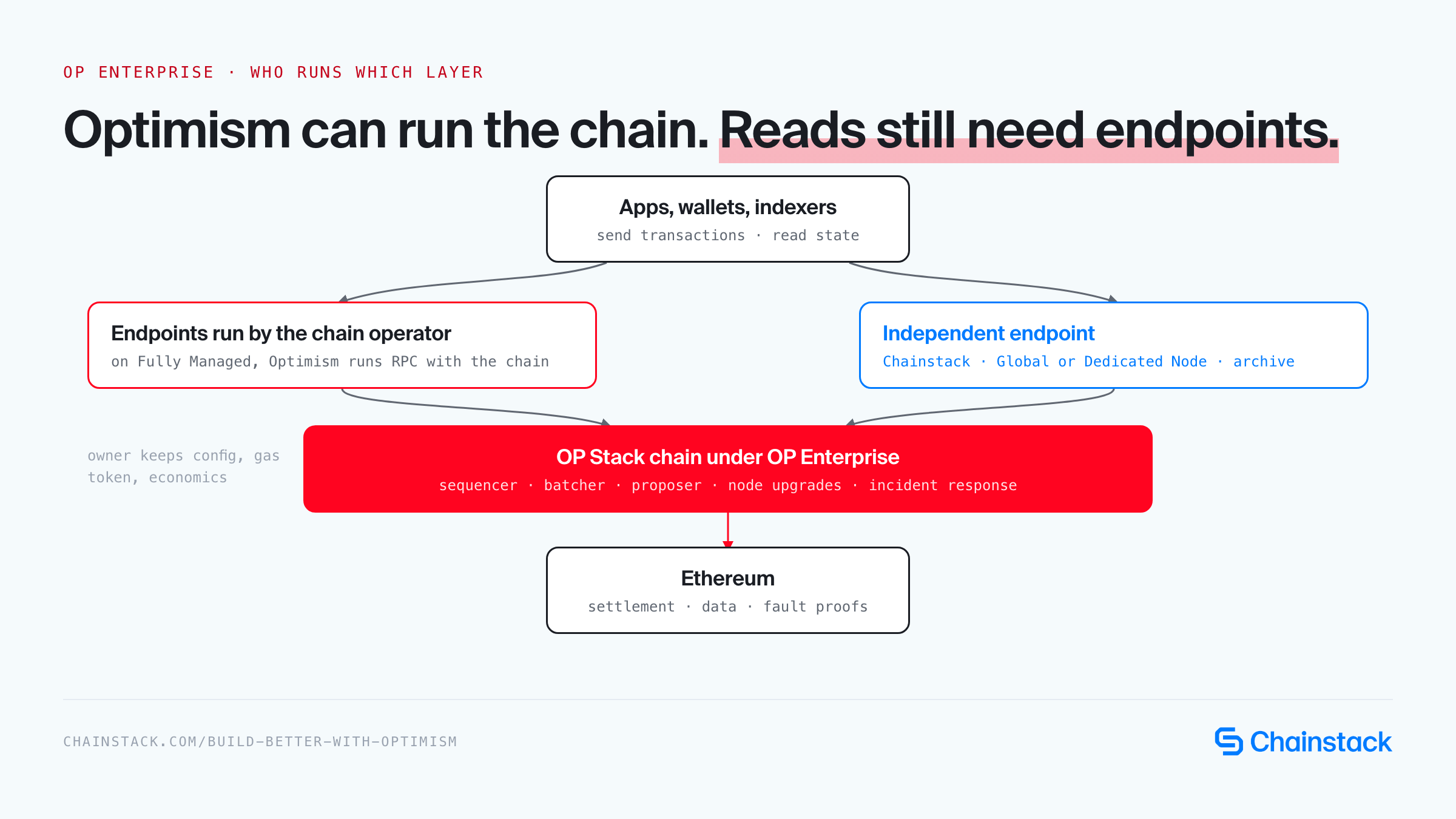
One caution: a second endpoint cannot fix a halted sequencer, because both paths read the same chain. It guards against rate limits, provider-side incidents, and missing archive or trace access. A simple health check compares two endpoints before you trust either one:
import requests

ENDPOINTS = {
    "operator": "YOUR_CHAIN_OPERATOR_ENDPOINT",
    "chainstack": "YOUR_CHAINSTACK_ENDPOINT",
}

def rpc(url, method, params=None):
    r = requests.post(
        url,
        json={"jsonrpc": "2.0", "id": 1, "method": method, "params": params or []},
        timeout=15,
    )
    r.raise_for_status()
    body = r.json()
    if "error" in body:
        raise RuntimeError(body["error"])
    return body["result"]

def snapshot(url):
    return {
        "chain_id": int(rpc(url, "eth_chainId"), 16),
        "head": int(rpc(url, "eth_blockNumber"), 16),
    }

snaps = {name: snapshot(url) for name, url in ENDPOINTS.items()}
print(snaps)

assert len({s["chain_id"] for s in snaps.values()}) == 1, "endpoints serve different chains"
lag = abs(snaps["operator"]["head"] - snaps["chainstack"]["head"])
print("head difference in blocks:", lag)
🚀 OP Mainnet and other OP Stack chains deploy from the same Chainstack console flow, and the Developer plan is free. Get an Optimism endpoint →
How to get an OP Stack chain endpoint on Chainstack

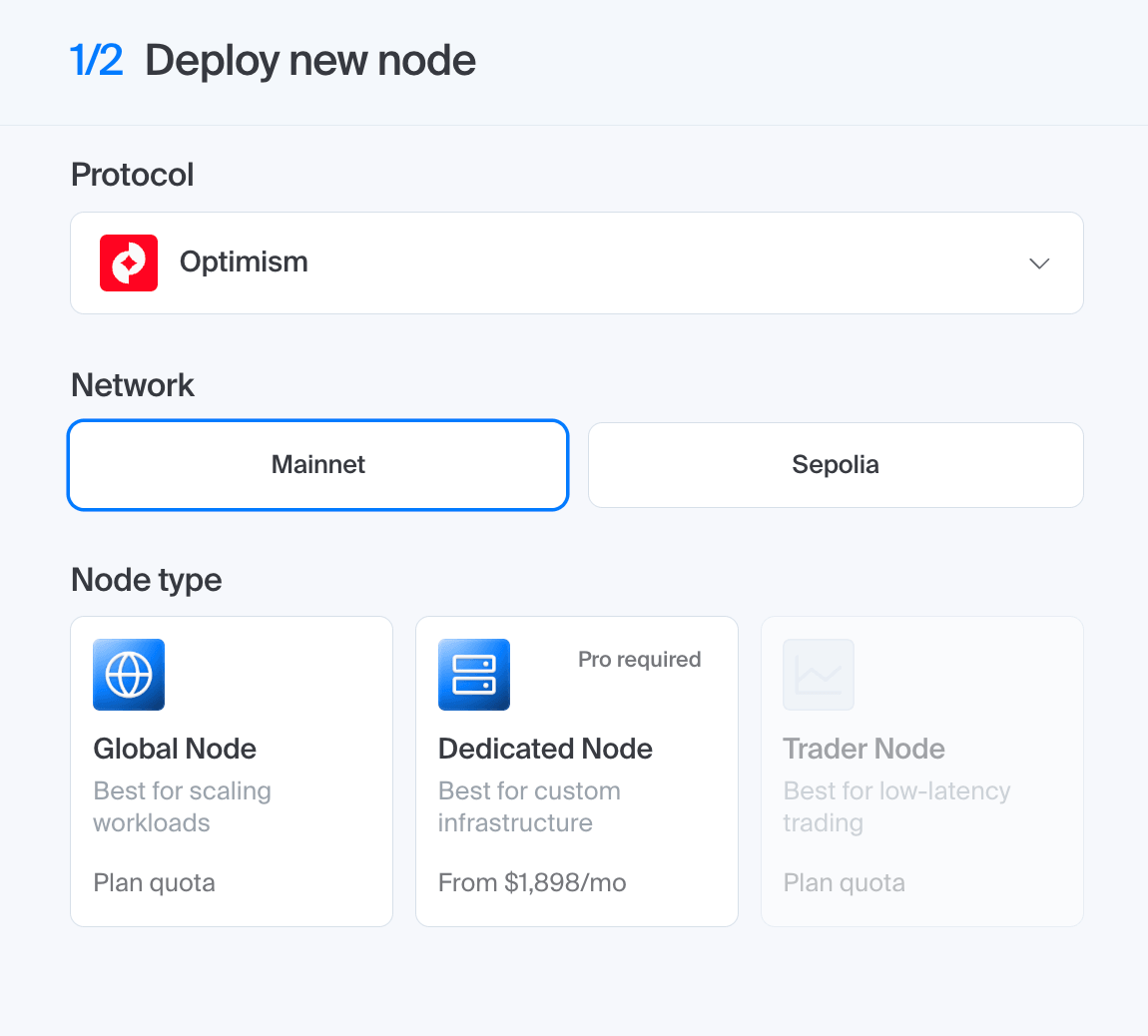
- Log in to the Chainstack console, or create an account.
- Create a new project.
- Select the blockchain protocol, for example Optimism, Base, or Unichain.
- Choose Mainnet or Testnet where the chain offers both.
- Deploy a Global Node.
- Open Access and credentials and copy your HTTPS endpoint.
The pricing page lists the paid plans, Dedicated Nodes from the Pro plan, and the flat-fee Unlimited Node add-on for higher throughput.
Conclusion
OP Enterprise turns the OP Stack from a codebase into a service. Optimism sells it by tier, with uptime and incident-response terms on its product page, and a growing list of named chains, from Unichain and Ink to Soneium and Whitechain. The business logic is easy to see after Base’s exit, though the pricing is not public, so nobody outside Optimism can say how much it replaces.
For builders the checklist is short. Read the tier terms, not the headlines, because the SLA is 99.9% on Fully Managed and absent on Self Managed. Treat interop and throughput as targets. Ask who owns upgrades before you rely on the fork option. And keep an independent read path with archive and trace access for the chains you depend on. Several details here are still moving, so re-read the linked sources when you build.
FAQs
OP Enterprise is Optimism’s managed-chain offering, launched on January 29, 2026. Customers get an OP Stack chain that Optimism runs (Fully Managed), supports (Self Managed), or hosts on OP Mainnet. Optimism says the customer keeps control of configuration, economics, and roadmap. See the product page.
Optimism does not publish prices. The product page has a pricing heading without figures, and the launch post mentions pre-negotiated discounts. Fully Managed carries service credits if uptime falls short, according to Optimism’s facts post.
The product page lists a 99.9% uptime SLA and 30-minute SEV 1 response for Fully Managed, and 99.95% with 15-minute response for the Mission-Critical add-on. Self Managed has a 1-hour SLA on critical issues and no uptime SLA. Early coverage that quoted 99.99% traces to the original launch post, which called it an SLO.
Optimism names Unichain, Celo, Ink, Soneium, Vision Chain, GIWA, and Whitechain, and its governance reply calls Base a customer. Several are announcements and not confirmed go-lives. Unichain’s migration was scheduled for October 29, and Vision Chain and GIWA had not confirmed mainnet launches.
Base announced a move to its own unified stack on February 18, 2026, and Optimism’s governance reply said the prior revenue share would not continue. Base is also described there as an OP Enterprise customer. See the governance thread and the Base Azul upgrade docs.
Optimism’s docs target December 10, 2026 on OP Sepolia and Unichain Sepolia, and January 11, 2027 on OP Mainnet and Unichain, pending governance approval. The exact timestamps are not set. See the interop prep notice.
Not necessarily. Fully Managed includes public RPC endpoints (the launch post cites up to 5 billion requests a month with multi-provider redundancy), but neither the product page nor the launch post describes archive or trace access. Many teams add an independent endpoint for redundancy, archive data, and debug or trace methods. It cannot help if the sequencer itself halts.
Additional resources
- Optimism on Chainstack
- Chainstack docs: Optimism tooling
- Chainstack docs: supported protocols and networks
- Optimism: OP Enterprise product page
- Optimism: introducing OP Enterprise
- Optimism: governance, sequencer, and OP Enterprise facts
- Optimism docs: end of support for op-geth and op-program
- Optimism docs: prepare for interop on OP Mainnet and Unichain
- Uniswap: Unichain is upgrading to OP Enterprise
- Alea Research: Optimism sells uptime