


Introduction
Base is one of the most important Ethereum L2s for production apps in 2026, but getting a Base RPC endpoint is no longer just about copying a public URL from a docs page. Base offers standard public RPC endpoints, Flashblocks-aware endpoints for low-latency reads, and the usual choice between public and managed infrastructure.

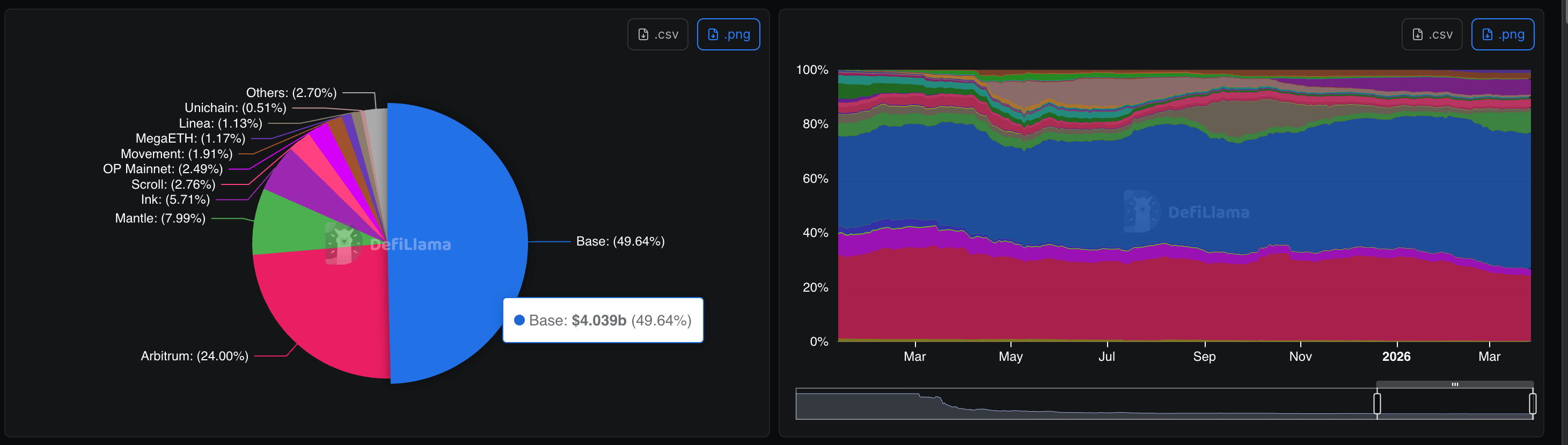
That means the real question is not only where to find a Base RPC URL, but which type of Base endpoint your application actually needs. A wallet, payment app, indexer, or trading system can all connect to Base through JSON-RPC, but they will not all succeed on the same infrastructure. This guide covers how to get a Base RPC endpoint, how Base RPC differs from standard Ethereum RPC in practice, and when to move from public access to production-grade infrastructure.
What is a Base RPC endpoint?
Base is an Ethereum layer 2 rollup developed by Coinbase, running on the OP Stack. It works just like any EVM-compatible chain: your app talks to it through an RPC endpoint. A Base RPC endpoint is simply a URL that lets your app send JSON-RPC requests to a node synced with the Base chain.
There are two types of RPC endpoints you’ll find:
- Public RPC endpoints – Free, open-access URLs shared by the community or providers. These don’t require authentication and are great for testing and prototyping.
- Private RPC endpoints – Access-controlled URLs from platforms like Chainstack, which come with actual guarantees: lower latency, higher uptime, usage analytics, and better performance overall.
Most devs start with a public RPC when in early-stage development or prototyping. Yet, as your dApp scales, the free endpoint will start failing you; that’s why switching to a private Base RPC endpoint becomes essential for performance, reliability, and speed at scale.
How Base RPC differs from Ethereum RPC
Base uses the Ethereum JSON-RPC standard, but the infrastructure behavior is not identical to Ethereum mainnet.
| Dimension | Ethereum mainnet RPC | Base RPC | Why it matters |
|---|---|---|---|
| Network model | L1 execution + PoS settlement | OP Stack L2 with sequencer-based execution | Base supports Ethereum tooling, but confirmation and execution flow differ from L1 |
| Public RPC posture | Depends on provider | Official public endpoints are rate-limited and not suitable for production | Public Base RPC is fine for testing, but not for production reliability |
| Flashblocks support | Not applicable | Base also offers Flashblocks-aware endpoints with earlier preconfirmed state | Low-latency apps can read state earlier than with standard RPC alone |
pending behavior | Standard pending-state semantics | Flashblocks-aware endpoints can expose preconfirmed pending state | Important for real-time apps, games, and trading systems |
| Best fit | L1-native apps and settlement-critical workflows | Consumer apps, wallets, backends, and low-latency Base workloads | Endpoint choice should match workload, not just chain support |
Base RPC endpoint options
There are several ways to connect to Base, and they are not interchangeable. The right choice depends on whether your app needs simple development access, production stability, historical data, or low-latency preconfirmed reads.
| Option | Example / format | Requires auth | Best for | Main trade-off |
|---|---|---|---|---|
| Public standard Base RPC | https://mainnet.base.org / https://sepolia.base.org | No | Testing, prototyping, low-volume development | Rate-limited and not suitable for production |
| Public Flashblocks-aware Base RPC | https://mainnet-preconf.base.org / https://sepolia-preconf.base.org | No | Testing Flashblocks behavior and preconfirmed reads | Also rate-limited and not suitable for production |
| Managed standard private Base RPC | Provider-issued authenticated endpoint | Yes | Production apps, wallets, payment systems, general backends | Paid infrastructure, but with reliability and observability |
| Managed Flashblocks-enabled Base RPC | Flashblocks-ready provider endpoint on supported node types | Yes | Low-latency apps, games, bots, trading-style workloads | Requires provider support and correct handling of preconfirmed state |
| Archive Base RPC endpoint | Managed archive node or archive-enabled endpoint | Usually yes | Analytics, indexers, historical queries, large backfills | Higher cost than standard full-node access |
| Self-hosted Base node | Self-managed OP Stack node deployment | No external auth | Teams needing full control and custom infrastructure | Highest ops overhead: sync, storage, upgrades, monitoring |
For most teams, the decision is not just public vs private, but whether standard Base RPC is enough or whether Flashblocks-aware and archive-capable infrastructure is required.
How to get a public Base RPC URL
Base ecosystem offers a few free public RPC endpoints, which are perfect for experimenting, learning, or spinning up small-scale apps.
Here are a few places to find public Base RPC URLs:
- Base official documentation: Base provides public RPC endpoints maintained by ecosystem contributors. This is a rate-limited global endpoint that offers basic access to the Base mainnet. But note the alert on the Base documentation page: RPC endpoint is Rate-limited and not for production systems. One example is:
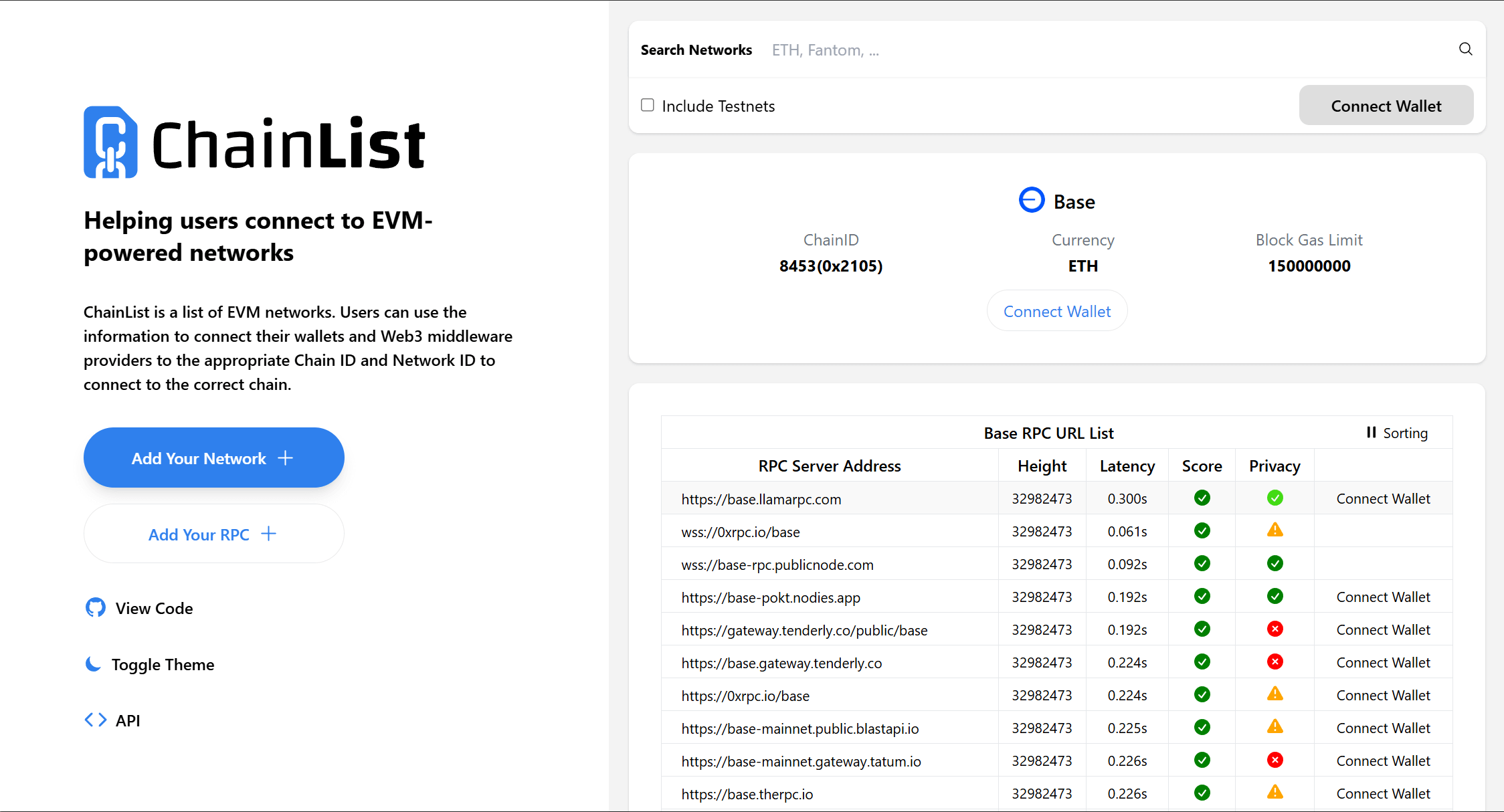
https://mainnet.base.org. Link - Third-party infrastructure aggregators: Platforms like Chainlist list public endpoints for networks like Base. These endpoints are sometimes wrapped with caching or rate limits, depending on the provider.
- Community GitHub repositories: Some projects aggregate and share public RPC lists via GitHub. Repositories like
ethereum-lists/chainsare good places to look for up-to-date RPC URLs with metadata.

Is public Base RPC enough for production?
Usually not.
A public Base RPC endpoint is a good starting point for developers who want to test contracts, connect a wallet, or run low-volume scripts. But once your application starts serving real users, public infrastructure becomes the weak point.
The biggest limitations are shared capacity, rate limits, no performance guarantees, and limited observability. If your frontend depends on fast state reads, if your backend listens to events continuously, or if your bot reacts to new state in real time, public Base RPC will eventually create avoidable failures.
Pros of public RPCs:
- No setup required, just copy and paste the URL.
- Free to use: no account or API key needed.
- Ideal for prototyping and testing environments.
Cons of public RPCs:
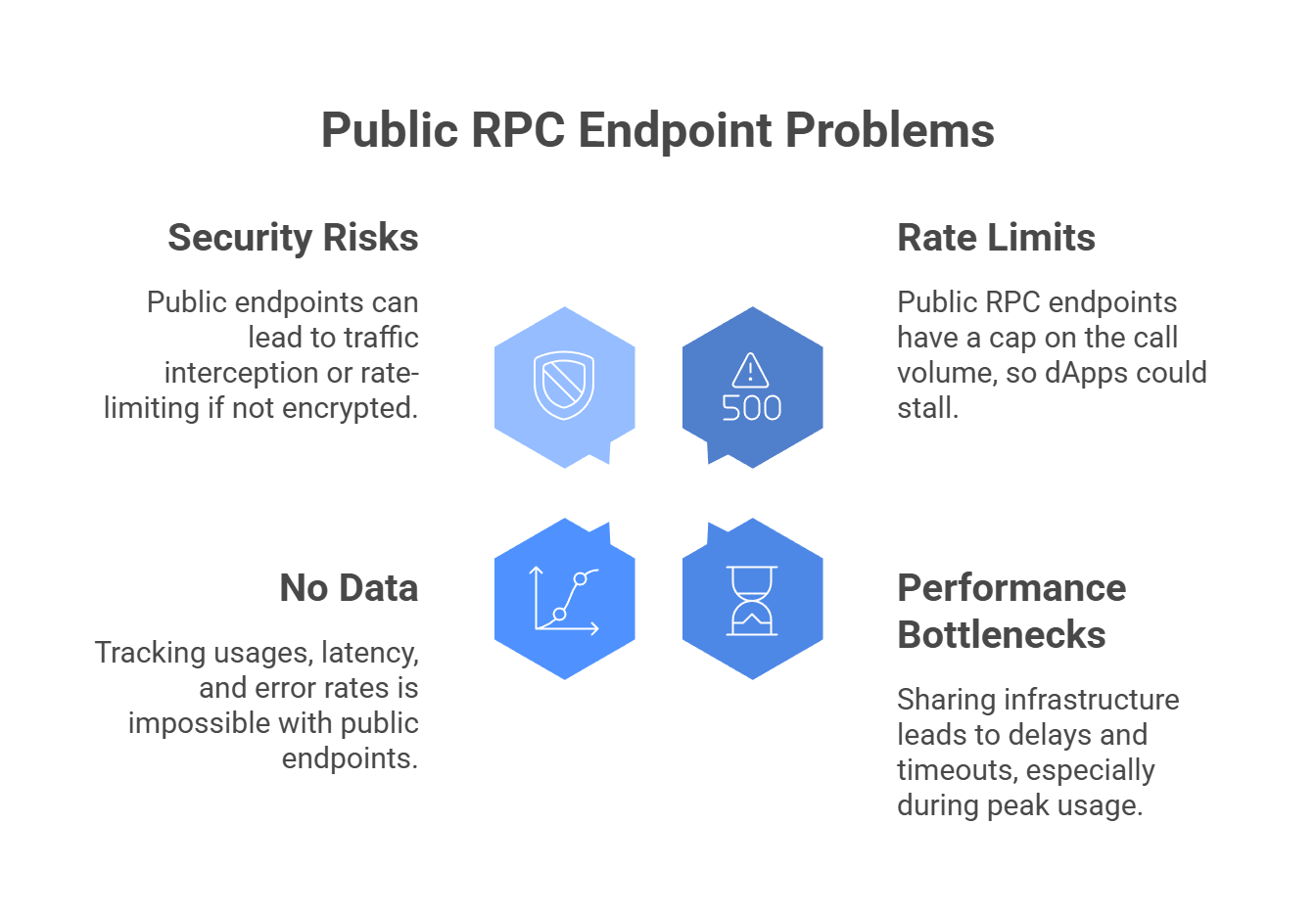
- Rate limits – Because public RPC endpoints have a cap on the call volume, your dApp could stall or fail during high traffic.
- Performance bottlenecks – Since you’re sharing infrastructure, delays and timeouts are pretty common, especially during peak usage.
- No data – Tracking usages is impossible, along with latency and error rates.
- Security risks – A public endpoint can mean that traffic gets intercepted or messed up if not encrypted; or your requests get rate-limited or blocked arbitrarily.
That is why public RPC is best treated as development infrastructure. For production systems, a managed Base RPC provider is the safer default.
📖 Tip: Public Base RPC endpoints and faucets are great for development and testing, but production applications should always run on managed or dedicated Base RPC infrastructure.

How to get a private Base endpoint
When you outgrow public endpoints, it’s time to look at private infrastructure. Here is where Chainstack, one of the top Base RPC node providers, comes in.
Chainstack offers key benefits, which include high-performance and production-grade Base RPC endpoints.
Why choose Chainstack for Base
- Global coverage – There is reduced latency for worldwide users as Chainstack’s Global Nodes are automatically geo-balanced.
- Dedicated nodes – Enjoy full control over your dedicated Base node and run it from a location of your choice.
- Unlimited Node add-on Traffic caps will no longer be a worry, as flat-fee RPS-tiered node endpoints with no traffic limitations are available.
- Archive access – Access full historical blockchain states for advanced analytics, data indexing, or debugging via Base archive nodes.
- Security – Utilizing IP allowlists, Origin restrictions, JWT authentication, and key rotation within a SOC2-certified infrastructure are all methods Chainstack employs to ensure security.
- Monitoring – Real-time metrics and error rates on a method-level can be viewed directly within the Chainstack console.
- Uptime – Enterprise-grade SLAs and real-time 24/7 monitoring ensure superior uptime.
Getting started with Chainstack
- Sign up for a Chainstack account.
- Navigate to Projects and create a new project.
- Use the Node wizard to deploy a Base node. (Mainnet or Sepolia Testnet)
- Decide whether you want Global Node, Trader Node (region-specific), or Unlimited Node.
- Copy the endpoint URL and start using it in your app.

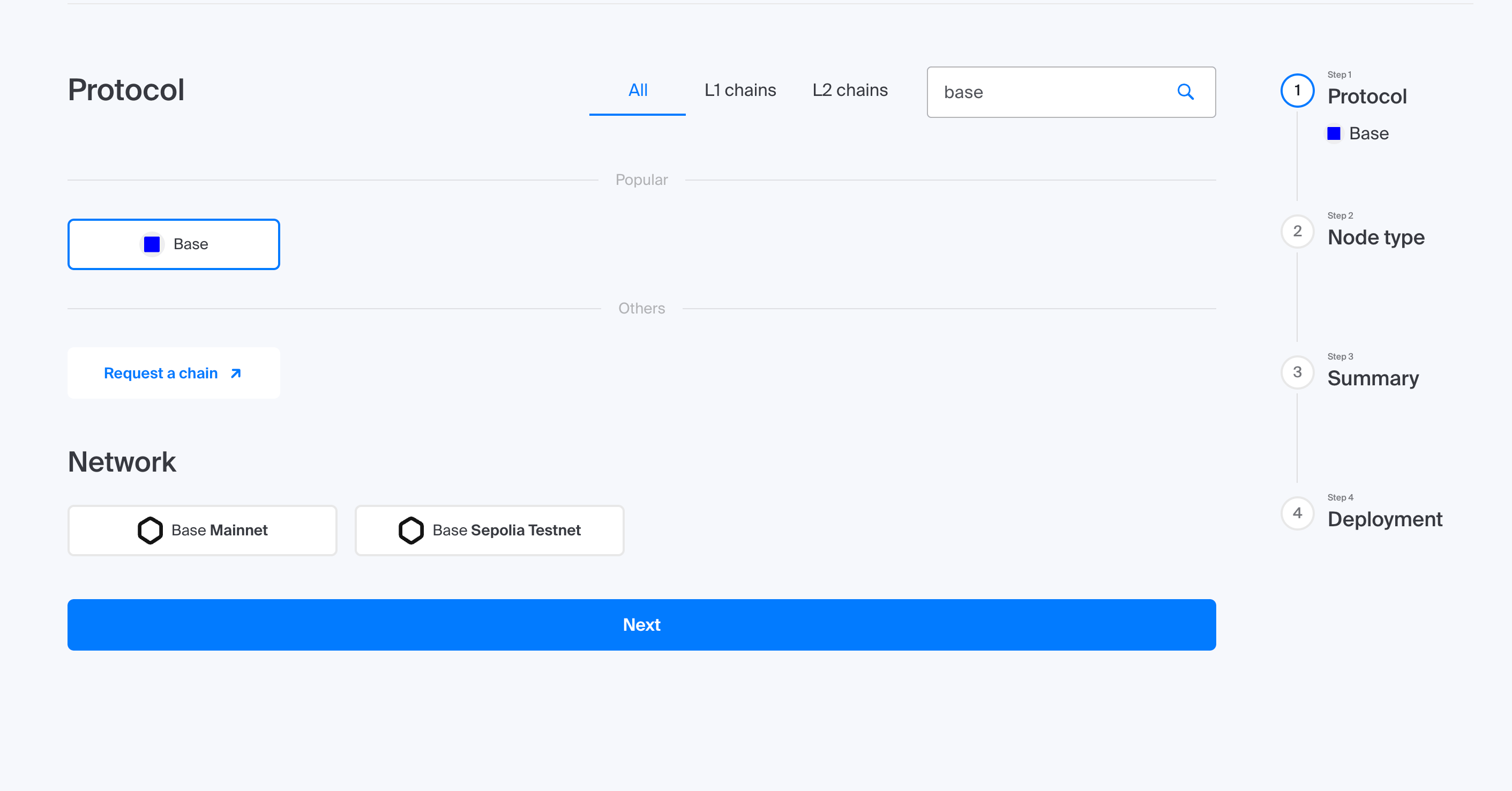
Here’s an example of a Chainstack Base endpoint:
https://base-mainnet.core.chainstack.com/<your-access-token>/
Authenticated access allows you to push traffic at scale and monitor every user interaction while ensuring a fast and stable user experience at all times.
When testing on Base Sepolia, you can deploy a Base RPC endpoint on Chainstack and request test ETH from the Chainstack Base faucet in the same platform, which simplifies development setup.
Chainstack pricing for Base RPC
Chainstack gives you several ways to run Base RPC depending on how much traffic and control your application needs.
- Developer plan: free entry point for testing and low-volume development
- Growth / Pro / Business: shared managed infrastructure for production workloads
- Unlimited Node: flat-fee RPS-tiered access when you want predictable cost under sustained traffic
- Dedicated nodes: isolated Base infrastructure for workloads that need more control, better consistency, or custom deployment
This matters because Base usage can scale quickly from simple wallet reads to payment rails, bots, analytics, and low-latency application logic. A pricing model that looks cheap on paper can become unpredictable if it depends on complex per-method weighting. Chainstack’s structure is easier to model operationally because it provides a clear upgrade path from free testing to dedicated production infrastructure.
Configure Base RPC in wallets
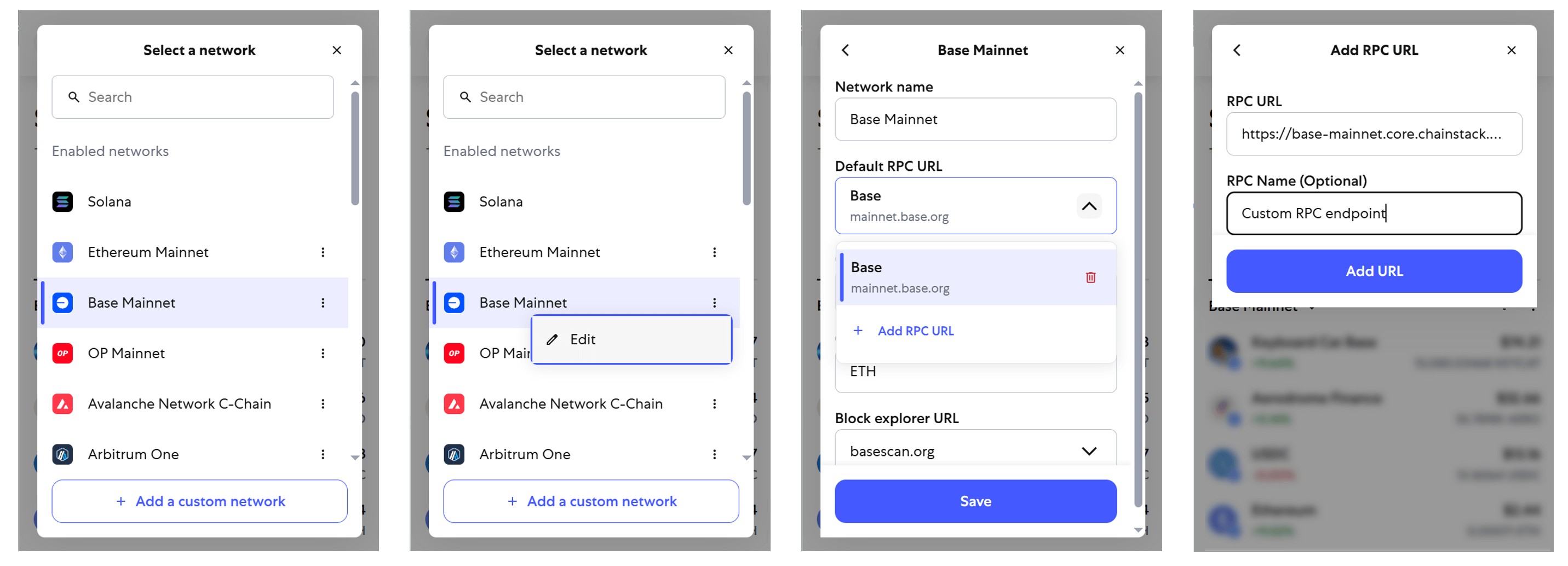
- Open the EVM wallet (Metamask, Rabby) and click the chain icon in the top left corner.
- Navigate to Base Mainnet and click the three-dot icon, then Edit.
- Select dropdown “Default RPC URL”.
- Click “+ Add RPC URL”
- In the “Add RPC URL” form specify your Public or Chainstack Base Mainnet RPC URL.

Troubleshooting common Base RPC issues
| Issue | What it usually means | Practical fix |
|---|---|---|
429 Too Many Requests | Public endpoint or low-tier plan is rate-limiting your traffic | Reduce burst traffic, add retry/backoff, or move to managed RPC |
| Wrong chain ID | Your app is pointed to the wrong Base network | Verify 8453 for mainnet and 84532 for Base Sepolia |
| WebSocket disconnects | Shared endpoint instability or too many active subscriptions | Reduce subscription load or use a production-grade provider |
| Slow reads during traffic spikes | Shared infrastructure is saturated | Move critical workloads to private or dedicated RPC |
| Missing historical data | You are querying a full node instead of an archive node | Use archive access for deep historical queries |
| Unexpected pending-state behavior | You are using Flashblocks-aware endpoints without handling preconfirmed data | Treat pending/preconfirmed state separately from finalized state |
Production readiness checklist
Before you rely on a Base RPC endpoint in production, confirm the following:
eth_chainIdreturns the expected network (8453for Base mainnet,84532for Base Sepolia)- Your app supports retry and backoff on transient failures
- You have a fallback RPC endpoint configured for failover
- WebSocket subscriptions remain stable under your expected load
- Archive access is available if your workload depends on historical state or backfills
- Monitoring is in place for latency, error rate, and request volume
- If you use Flashblocks-aware endpoints, your app treats preconfirmed state correctly
Conclusion
Public Base RPC endpoints are useful for interacting with the Base blockchain. They are most useful for early-stage projects, during testing, and in environments with low traffic. As your Web3 application grows, however, availability alone will not be sufficient; you will also require consistency, performance, and observability.
This is where private, reliable Base infrastructure, such as Chainstack, becomes useful. Whether you’re building a DeFi protocol, data indexer, or Web3 game, Chainstack provides you with scalable Base RPC access, real-time insights, secure authentication, and a growth-aligned pricing model.
Begin with a public endpoint, but have a transition plan ready to shift it to a private one.
FAQ
A Base RPC endpoint is a URL that lets your application send JSON-RPC requests to a node synced with the Base network.
For Base mainnet, the standard public RPC is https://mainnet.base.org. For Base Sepolia, it is https://sepolia.base.org.
No. Base documentation explicitly notes that the public RPC is rate-limited and not intended for production systems.
Standard Base RPC exposes normal block state. Flashblocks-aware RPC exposes preconfirmed pending-state data earlier for low-latency applications.
You need archive access for deep historical state queries, large-scale event backfills, tracing, and analytics-heavy workloads.
Yes. Base is EVM-compatible, so standard Ethereum tools such as MetaMask, ethers.js, viem, web3.py, and Foundry work with Base RPC endpoints.
Switch when your app starts depending on stable latency, subscriptions, production uptime, or historical-query reliability.
Base Mainnet: 8453; Base Sepolia: 84532