


The internet has a bad habit of turning infrastructure decisions into holy wars. Cloud wins. Self-hosted wins. Managed is for lazy teams. Bare metal is for serious engineers.
The reality is less satisfying: there is no universal winner. The right choice depends on your latency budget, your ops team size, your data compliance posture, and how close your nodes need to be to the rest of your stack. This guide lays out the trade-offs honestly, so you can make the call for your specific situation rather than someone else’s.
What this guide covers
- What cloud-managed nodes actually give you (and what they quietly take away)
- What self-hosted nodes actually give you (and what the ops burden really looks like)
- The five dimensions that should drive your decision
- Where Chainstack Self-Hosted fits — and why it changes the calculus for some teams
- A decision matrix you can apply today
Managed cloud nodes: the real trade-offs
Cloud-managed blockchain infrastructure — whether that’s Chainstack, Alchemy, Quicknode, or Infura — offloads the operational complexity of running nodes. You get an endpoint, you call it, someone else handles syncing, patching, client upgrades, and disk management.
That is genuinely valuable. The ops burden of a production blockchain node is non-trivial.
What cloud gives you
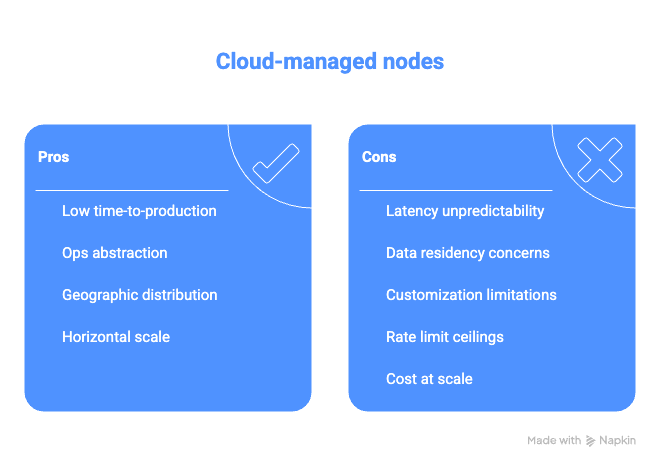
- Low time-to-production. You can have a working RPC endpoint in minutes. No server provisioning, no client configuration, no sync wait. For teams prototyping or running low-traffic workloads, this matters more than almost anything else.
- Ops abstraction. Client upgrades happen automatically. Hardforks don’t require a 2am maintenance window. Disk expansion isn’t your problem. The engineers who would otherwise be on-call for node health are free to build product instead.
- Geographic distribution. Good cloud providers serve requests from nodes close to the caller. Chainstack’s Global Nodes use geo-balanced routing across regions — meaning a user in Singapore gets routed to a node in Asia, not one in Frankfurt.
- Horizontal scale without pre-planning. Traffic spikes don’t require you to have provisioned the right hardware six weeks ago. Cloud RPC absorbs load without requiring ops intervention.

What cloud takes away
- Latency predictability. When your application and the node live on different infrastructure — potentially in different regions — you’re paying a network tax on every RPC call. For most applications this is acceptable. For MEV bots, high-frequency traders, and latency-sensitive DeFi strategies, shared cloud node overhead can be the difference between a profitable trade and a missed one.
- Data residency. When you call a cloud node, your transaction data, IP address, and call patterns leave your perimeter. For teams under GDPR, financial regulations, or enterprise data policies, this is not a theoretical concern — it’s a compliance requirement.
- Customization. You can’t choose your execution client. You can’t tune EVM parameters. You can’t attach custom indexers to the node process. What the provider configured is what you get.
- Rate limit ceilings. Most cloud plans have request-per-second limits that become real constraints at scale. Burst traffic requires plan upgrades or load-shedding logic in your application layer.
- Cost at scale. Cloud RPC pricing is roughly linear with call volume. At low traffic, it’s negligible. At production scale — millions of calls per day — the bill grows in ways that can surprise teams who didn’t model it upfront.
Self-managed nodes: the real trade-offs
Self-managed (self-hosted) means you own the machine, the client, and the responsibility for keeping everything running. That ownership is the point — and it’s also the burden.
What self-managed gives you
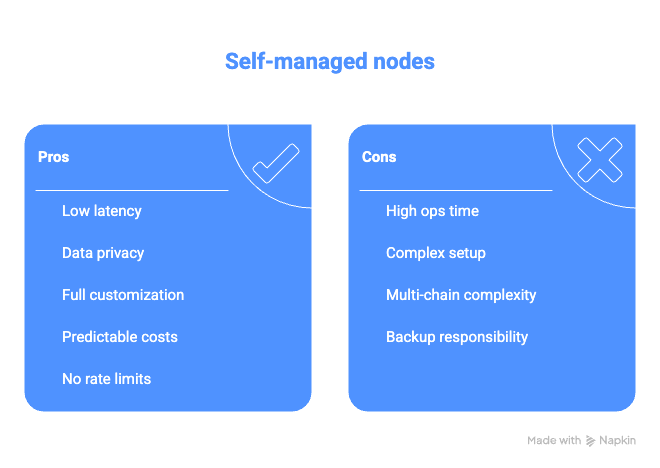
- Latency you control. When your application and your node run in the same datacenter — or on the same physical host — RPC latency drops to single-digit milliseconds. For latency-sensitive workloads, this isn’t a nice-to-have; it’s a hard requirement. A MEV searcher co-locating with validators has fundamentally different infrastructure needs than a portfolio tracker.
- Data stays in your perimeter. Nothing leaves your environment. Your transaction patterns, query volume, wallet data — all of it stays on infrastructure you control. This is the baseline requirement for serious institutional deployments, regulated fintech, or any team that’s been through a security review.
- Full customization. You choose the execution client (Geth, Nethermind, Erigon, Besu). You configure the archive depth. You run custom middleware. You attach Prometheus scrapers, custom log pipelines, or chain-specific indexers. The node is yours to configure.
- Predictable costs at scale. Hardware is a fixed cost. A server running a full Ethereum node doesn’t care whether you make 100,000 RPC calls or 10,000,000. At sufficient call volume, owning the hardware is substantially cheaper than paying per-request cloud rates.
- No rate limits. Your internal team can hammer the node without hitting plan ceilings or triggering throttling.
What self-managed takes away
- Ops time. This is the real cost teams underestimate. Client upgrades require coordination. Hardforks require maintenance windows. Disk fills up. A node that falls behind sync becomes a source of stale data. Someone on your team owns all of this, indefinitely.
- Initial setup complexity. Getting from a blank server to a healthy, synced, monitored node takes hours to days — longer for chains with large state. Every chain you add is another sync, another client pair, another monitoring configuration.
- Multi-chain ops multiply. Running nodes for two chains is roughly twice the work. Five chains is genuinely heavy ops unless you have tooling to standardize deployment, monitoring, and update workflows across clients.
- Backup and redundancy are your problem. A cloud provider handles failover. If your self-hosted node dies at a bad time, your application goes down until you restore it — unless you’ve built your own redundancy layer.
Five dimensions that should drive your decision
1. Latency budget
If your workload tolerates 20–80ms RPC overhead, cloud is fine. If it doesn’t — MEV, HFT, latency-sensitive DeFi, real-time price feeds — self-hosting co-located with your application is the only answer. There’s no cloud routing optimization that eliminates cross-datacenter latency.
Signal: self-hosted if you’ve ever blamed latency for a missed opportunity or degraded user experience.
2. Ops team capacity
Cloud-managed nodes effectively convert ops headcount into a subscription fee. If your engineering team is lean and blockchain infrastructure isn’t a core competency, paying that fee makes sense. If you have dedicated infrastructure engineers who want control, the ops burden becomes manageable.
Signal: cloud if every engineer who might own node ops is already fully allocated to product.
3. Data residency and compliance
This is binary. If your organization has data residency requirements, a compliance policy that prohibits data leaving your environment, or a security posture that can’t accommodate third-party infrastructure for transaction data — you self-host. Cloud RPC is not an option regardless of how good the provider’s SLA is.
Signal: self-hosted if you’ve had a legal or security review that touches RPC data.
4. Scale and cost trajectory
At what call volume does owning hardware become cheaper than paying per-request? For most teams, that inflection point is somewhere between 500,000 and 5,000,000 calls per day depending on chain and provider. Teams on the left side of that curve benefit from cloud. Teams on the right side should be running their own nodes.
Signal: self-hosted if your monthly cloud node bill is growing faster than the revenue from the product it serves.
5. Customization requirements
Most applications don’t need custom node configuration. But if you’re building an indexer, running a custom mempool analysis tool, operating a validator alongside your node, or need to expose non-standard APIs — cloud won’t give you what you need. You need root access to the node process.
Signal: self-hosted if your use case requires anything a standard RPC endpoint doesn’t expose.
The trade-off matrix
| Dimension | Cloud wins | Self-managed wins |
|---|---|---|
| Time to first endpoint | ✅ Minutes | ❌ Hours to days (sync time) |
| RPC latency | ❌ 20–80ms cross-region overhead | ✅ <5ms co-located |
| Ops burden | ✅ Near-zero | ❌ Ongoing — upgrades, disk, monitoring |
| Data residency | ❌ Data leaves your perimeter | ✅ Stays on your infrastructure |
| Cost at high call volume | ❌ Linear with calls | ✅ Fixed hardware cost |
| Customization | ❌ What the provider configured | ✅ Full client and config access |
| Multi-chain scaling | ✅ Add a chain in one click | ❌ Multiplies ops complexity |
| Failover and redundancy | ✅ Handled by provider | ❌ Your responsibility |
No column wins cleanly. That’s the point.
Where Chainstack Self-Hosted changes the calculus
The traditional framing of this decision treats cloud and self-hosted as the only two options. In 2026, that’s no longer the complete picture.
Chainstack Self-Hosted is a third path: you run nodes on infrastructure you own and control, but the deployment, configuration, self-healing, and lifecycle management are handled by Chainstack’s tooling. You get the data residency, latency, and customization benefits of self-hosted infrastructure — without inheriting the full ops burden.
What it actually delivers
- One-click deployment across all major protocols — select the protocol, network, and node type, and you’re live in minutes. Right-sized node configurations are applied automatically based on your hardware and protocol requirements. Snapshots significantly reduce initial sync time, cutting what used to take days down to hours.
- Self-healing and automated updates — nodes monitor themselves and recover automatically from failures. When client updates are available, you get notified and control when they’re applied. No manual coordination, no maintenance windows that turn into incidents.
- Configurable zero-downtime failover — set failover to a secondary node, the Chainstack high-performance cloud RPC endpoint, or any endpoint you specify. Your applications stay online during updates or unexpected failures.
- Integrated monitoring, alerts, and observability — real-time node performance data, without building a monitoring stack from scratch.
- Your data never leaves your environment — nodes run in secure, isolated environments with encryption and strict access controls. Chainstack Self-Hosted is SOC 2 and ISO certified.
How it compares to doing it yourself
| DIY self-hosting | Chainstack Self-Hosted | |
|---|---|---|
| Infrastructure ownership | User managed | User managed |
| Deployment | Manual setup and scripting | One-click, minutes to hours |
| Failure recovery | Manual intervention or custom tooling | Self-healing and automatic recovery |
| Failover | Custom implementation per setup | Configurable out of the box |
| Updates and maintenance | Manual upgrades and coordination | Automated update workflows |
| Monitoring and alerts | Self-built monitoring stack | Integrated monitoring and alerts |
| Time to production | Days to weeks | Minutes to hours |
Where you can run it
Chainstack Self-Hosted deploys onto any Linux server — cloud VPS, virtual machines, bare metal, or local environments. It also ships pre-installed on partner infrastructure:
- BreezeHost — Get 50% off servers for the first month with code
CHAINSTACK50 - Serverside.com — 10% off servers
- Velia — Get 80% off servers for the first month with code
CHAINSTACK80 - HOSTKEY — pre-installed
The partner server option reduces setup to the absolute minimum: pick a server, Chainstack Self-Hosted is already there.
The cost angle
Cloud managed RPC fees scale with call volume — at production scale, those fees are substantial. Chainstack Self-Hosted is a flat subscription on top of your own hardware costs. For teams crossing into high call volumes, the economics shift materially.
The headline numbers from the product page: 99.99% operational uptime, 5x faster path to production vs. DIY self-hosting, 24/7 automated operations.
Who should choose what
Choose cloud-managed nodes if:
- You’re in early development or running low-to-medium traffic
- Your team has no dedicated infrastructure capacity
- Latency in the 20–80ms range is acceptable for your use case
- Data residency isn’t a compliance requirement
- You need to add or drop chains quickly without ops overhead
Choose self-managed (DIY) nodes if:
- Latency is a hard competitive requirement and you have the ops team to match
- You have specific customization needs that cloud RPC can’t meet
- You have dedicated infrastructure engineers comfortable with blockchain client operations
- You want maximum control and are willing to own the full lifecycle indefinitely
Choose Chainstack Self-Hosted if:
- You need the data residency or latency benefits of self-hosting, but your team is too lean to absorb the full DIY ops burden
- You’re scaling to call volumes where cloud pricing becomes a significant cost line
- You want the flexibility to run on your own hardware, a partner server, or bare metal — with consistent tooling across all of it
- You’ve been putting off self-hosting because of the operational overhead
Conclusion
The cloud vs self-hosted debate is the wrong frame. The real question is: what does your workload actually require, and what’s your team capable of maintaining?
Cloud managed nodes are the right default for most early-stage and mid-traffic applications. They compress time-to-production and eliminate ops overhead at a cost that’s reasonable until scale becomes a factor.
Self-managed nodes are the right answer when latency, data residency, or customization requirements make cloud insufficient. The ops burden is real — but it scales with how much tooling you’re willing to invest in.
Chainstack Self-Hosted exists at the intersection: the data control and latency of self-hosted infrastructure, with ops overhead that doesn’t require a dedicated infrastructure team and a time-to-production measured in minutes, not weeks.
There’s no clear winner. There are trade-offs. Pick the one that fits where you actually are.
Run nodes on your own infrastructure — without the ops overhead.
FAQ
At low call volumes, cloud is usually cheaper when you factor in hardware, bandwidth, and engineer time. The break-even point varies by chain and provider, but typically sits somewhere between 500K and 5M daily RPC calls. Above that threshold, owning the hardware is often substantially cheaper.
Cloud nodes in the same geographic region typically add 20–80ms of round-trip overhead. A self-hosted node co-located with your application can deliver sub-5ms RPC latency. For MEV, HFT, and latency-sensitive DeFi, that gap is the difference between a competitive and non-competitive strategy.
The main ongoing costs are: client upgrades (especially around hardforks), disk management (archive nodes grow continuously), monitoring and alerting setup, and incident response when nodes fall behind sync. DIY self-managed typically takes days to weeks to reach production. Chainstack Self-Hosted compresses that to minutes to hours, with automated maintenance thereafter. See the full DIY vs Chainstack Self-Hosted comparison for a detailed breakdown.
Yes, and this is a common trajectory. Most teams start on managed cloud RPC, identify latency or cost pressure at scale, then migrate. The migration requires syncing nodes and updating endpoint configurations, but doesn’t require downtime if you switch endpoints atomically.
Yes — it deploys onto any Linux server: cloud VPS, virtual machines, bare metal, or local environments. It also ships pre-installed on partner providers including BreezeHost, Serverside.com, Velia, and HOSTKEY. See the installation guide for requirements and setup.
Check the Chainstack documentation for the current supported protocol list, as it expands regularly. The managed cloud offering covers 70+ chains.
Self-hosted nodes keep your data on infrastructure you control, which is a necessary precondition for most compliance frameworks. Chainstack Self-Hosted is SOC 2 and ISO certified. Whether it’s sufficient for your specific regulatory requirements depends on your overall architecture — self-hosting the node removes the third-party data processor concern from the node layer specifically.
Additional resources
- Chainstack Self-Hosted — product page
- Self-hosted blockchain node: challenges and solutions
- Self-hosted blockchain node: DIY vs Chainstack Self-Hosted
- Blockchain node hosting: how to choose the best setup in 2026
- Top 5 Ethereum node setup tools in 2026
- Top 5 easiest ways to run an Ethereum node in 2026
- Chainstack documentation — Self-Hosted quick start