


Running a Bitcoin node yourself has historically been a commitment. You provision the hardware, install Bitcoin Core, configure txindex, wait days for the initial block download, set up monitoring, and then run the same cycle every time Bitcoin Core ships a new release. Teams with production Bitcoin workloads did this because they had to — the value of full control over broadcast, mempool visibility, and independent verification justified the DevOps cost. Teams without those requirements didn’t.
The operational math has shifted. What made running a Bitcoin node hard was rarely Bitcoin itself — Bitcoin Core is stable, well-documented, and famously easier to operate than most Ethereum execution clients. The hard part was everything around the node: deployment, monitoring, self-healing, updates, failover. Chainstack Self-Hosted now supports Bitcoin Mainnet, which means that operational layer becomes software you consume rather than a stack you build.
This piece is about who actually benefits from a Bitcoin node on their own infrastructure, what running one looks like day-to-day, and how the newer answer compares to the older one.
Why running a Bitcoin node used to be a project
Bitcoin Core is the reference implementation of the Bitcoin protocol. It’s what mining pools, exchanges, custodians, block explorers, and Lightning nodes all run under the hood. When you run your own node, you get the same feature set they do:
- ZMQ subscriptions for real-time mempool and block push notifications — no polling, no lag on new state.
- Direct transaction broadcasting with full propagation control. Your transaction enters the gossip network from your own peer set; you can watch propagation, rebroadcast, react to network conditions.
- Full mempool access. Every unconfirmed transaction, every fee bucket, every RBF replacement.
estimatesmartfeeruns against the same live data. - Historical lookups via
txindex. Any transaction, any block, indexed and queryable without depending on a third-party archive.
Unlocking that feature set on your own infrastructure meant building the ops layer around Bitcoin Core yourself: procure hardware, install and configure the node, wait for the initial block download, stand up monitoring, hook up alerts, plan for updates, plan for failover. That’s the setup burden the article is really about. The teams that took it on did so for very specific reasons — worth naming, because they’re where the case for a self-hosted Bitcoin node actually lives.
Who actually runs their own Bitcoin node, and why
- Payment processors. BitPay, Strike, OpenNode, NOWPayments — every meaningful BTC payment company runs its own nodes. The reasons compound. Broadcasting from your own node means you control transaction propagation and can re-broadcast aggressively if needed. Watching the mempool from your own node means double-spend detection works in seconds, not minutes. Fee estimation from your own mempool is more accurate than any third-party fee oracle because you’re seeing the same data Bitcoin Core’s
estimatesmartfeeis seeing locally. When the entire business is “we accept BTC payments and confirm them reliably,” none of this can be outsourced. - Exchanges and custodians. Coinbase, Kraken, BitGo, Anchorage — every regulated entity holding customer Bitcoin runs its own nodes. Two reasons. First, regulatory: BitLicense, MiCA, and similar frameworks treat infrastructure control as part of operational risk management. An auditor asking “how do you independently verify your customer balances?” doesn’t accept “we trust BlockCypher’s API.” Second, scale: an exchange generating fresh deposit addresses for millions of users needs to derive addresses, watch them, and reconcile against the chain at a volume that breaks shared-RPC rate limits.
- Lightning Network operators. This one isn’t optional. A Lightning node — whether it’s LND, Core Lightning, or Eclair — requires a Bitcoin full node underneath. The LN client needs direct, low-latency access to a Bitcoin Core RPC, ZMQ feed, and (for many configurations)
txindexenabled. There’s no “Lightning-as-a-service” that lets you skip the Bitcoin node; routing nodes, channel managers, and LSPs all run Bitcoin Core locally. - Block explorers and analytics platforms. Mempool.space, blockstream.info, blockchain.com — these companies are in the business of serving Bitcoin data, which means they need full and direct access to it. They typically run multiple nodes for redundancy, plus indexed databases (Electrum servers, Esplora, custom indexers) on top. Same model applies to compliance analytics like Chainalysis and Elliptic.
- OTC desks and high-frequency trading firms. Latency on mempool data and transaction broadcast directly affects PnL. Watching a large transfer hit the mempool 200ms before competitors is enough edge to justify dedicated infrastructure.
- Corporate treasury and ETF custodians. The 2024–2025 wave of Bitcoin ETFs — IBIT, FBTC, ARKB — collectively custody hundreds of thousands of BTC. The custodians (Coinbase Custody, Fidelity Digital Assets, BitGo) verify balances against their own nodes. Same for corporate treasury holders: when you’re sitting on a billion dollars of BTC, “trust the block explorer” stops being a strategy.
At a glance:
| Audience | Use case | What your own node unlocks | Examples |
|---|---|---|---|
| Payment processors | Accept BTC payments reliably at scale | Controllable broadcast, real-time double-spend detection, mempool-accurate fee estimation | BitPay, Strike, OpenNode, NOWPayments |
| Exchanges & custodians | Custody customer BTC, generate fresh addresses at scale | Audit-grade infrastructure control, rate limits that hold at exchange scale | Coinbase, Kraken, BitGo, Anchorage |
| Lightning Network operators | Run production LN routing or channel nodes | Direct Bitcoin Core RPC, ZMQ feed, txindex enabled (required, not optional) | LND, Core Lightning, Eclair |
| Block explorers & analytics | Serve Bitcoin data as a product | Multi-node redundancy, custom indexer feeds, full historical access | Mempool.space, blockstream.info, Chainalysis |
| OTC desks & HFT | Latency-sensitive arbitrage and broadcast | Sub-100ms mempool propagation, controllable broadcast path | OTC desks, market makers, prop trading firms |
| Treasury & ETF custodians | Independent verification of large BTC holdings | Audit-defensible chain of trust without a third-party intermediary | Coinbase Custody, Fidelity Digital Assets, BitGo |
The pattern across all of these: when Bitcoin data is load-bearing for your business — payments, custody, settlement, trading — you don’t rent it.
What running your own actually costs
The operational reality is more pragmatic than the Bitcoin maximalist version. A Bitcoin full node is genuinely lighter than an Ethereum node in most ways. But it’s not free, and the costs are predictable enough to plan around.
- Initial sync. Bitcoin’s chain is around 750 GB as of mid-2026 and growing roughly 70–90 GB per year (about 6–7 GB per month). A clean initial block download from genesis takes several days even on good hardware — Bitcoin’s IBD is single-threaded for validation in important phases, and you can’t parallelize your way past the bottleneck. The mitigation is assumeUTXO snapshots: the
loadtxoutsetRPC was added in Bitcoin Core 26.0 and became usable on mainnet in 28.0, when AssumeUTXO mainnet parameters were added for height 840,000. You bootstrap from a recent verified state and sync the rest in hours instead of days. Most professional setups use snapshots now. - Storage growth. Predictable, roughly linear at ~70–90 GB per year. Plan for 1 TB if you’re comfortable resizing within a few months; 2 TB if you want to stop thinking about disk for several years. Pruned nodes (which discard old blocks) cut this dramatically, but pruning kills
txindex, which kills support for several use cases including most LN setups and any historical lookup workload. - Updates. Bitcoin Core moves slower than Ethereum clients — major releases land roughly twice a year, security patches more often. But “slower” doesn’t mean “ignorable.” Soft forks (Taproot, the next round of consensus changes), wallet format migrations, mempool policy updates, BIPs that affect address types — all require eventually running newer versions. The schedule is gentler than Ethereum’s twice-yearly hard forks, but the operational discipline is the same.
- Monitoring and reliability. Sync drift happens. So do reorgs (rare on Bitcoin, mostly 1–2 block depth, occasionally deeper). Disk fills up. Connections to peers degrade. Without monitoring, you find out something is wrong because an application breaks. With monitoring, you find out because an alert fires. The difference between those two modes is what separates a hobby setup from infrastructure you’re willing to put a business on.
- The “set it and forget it” myth. Plenty of Bitcoin Core nodes do run for years without intervention. They also drift out of sync silently, miss security patches, fall behind on mempool policy, and become slowly less useful without anyone noticing. The “set it and forget it” version of self-hosting is real for personal nodes; for production it’s a quiet path to a broken Saturday.
What changed: Chainstack Self-Hosted now supports Bitcoin

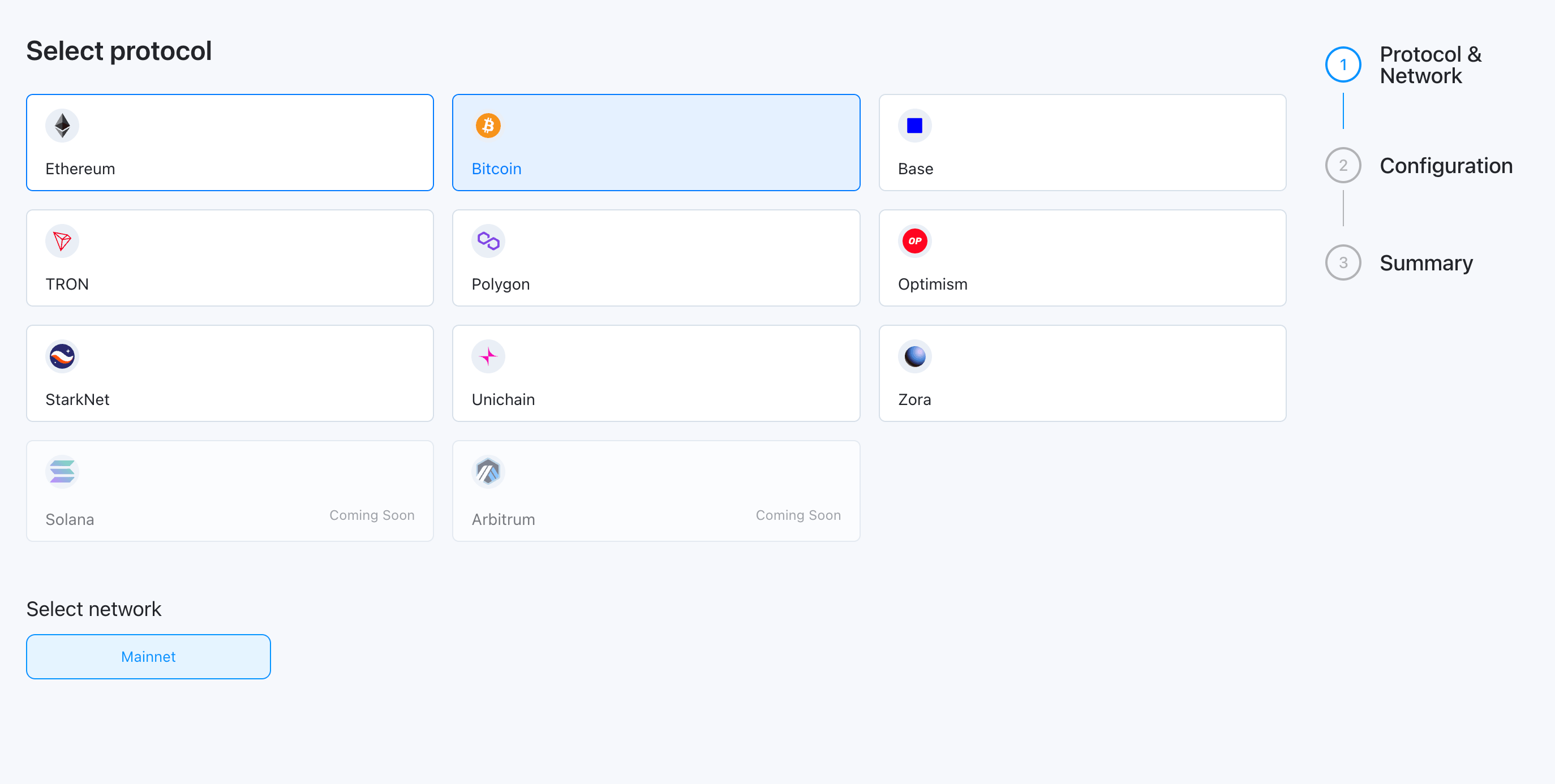
Historically, running your own Bitcoin node meant building the full operational stack yourself. That’s what Chainstack Self-Hosted changes.
Chainstack Self-Hosted is what happens when you separate “own the node” from “build the operational stack around it.” Self-Hosted now supports Bitcoin Mainnet on Bitcoin Core 31, with the same deployment workflow as the rest of the platform: pick the protocol, pick the network, deploy. You get the node running on hardware you own, with the control plane — deployment, snapshots that significantly reduce initial sync time, self-healing, auto-updates, monitoring through bundled Grafana and VictoriaMetrics — handled by Chainstack.
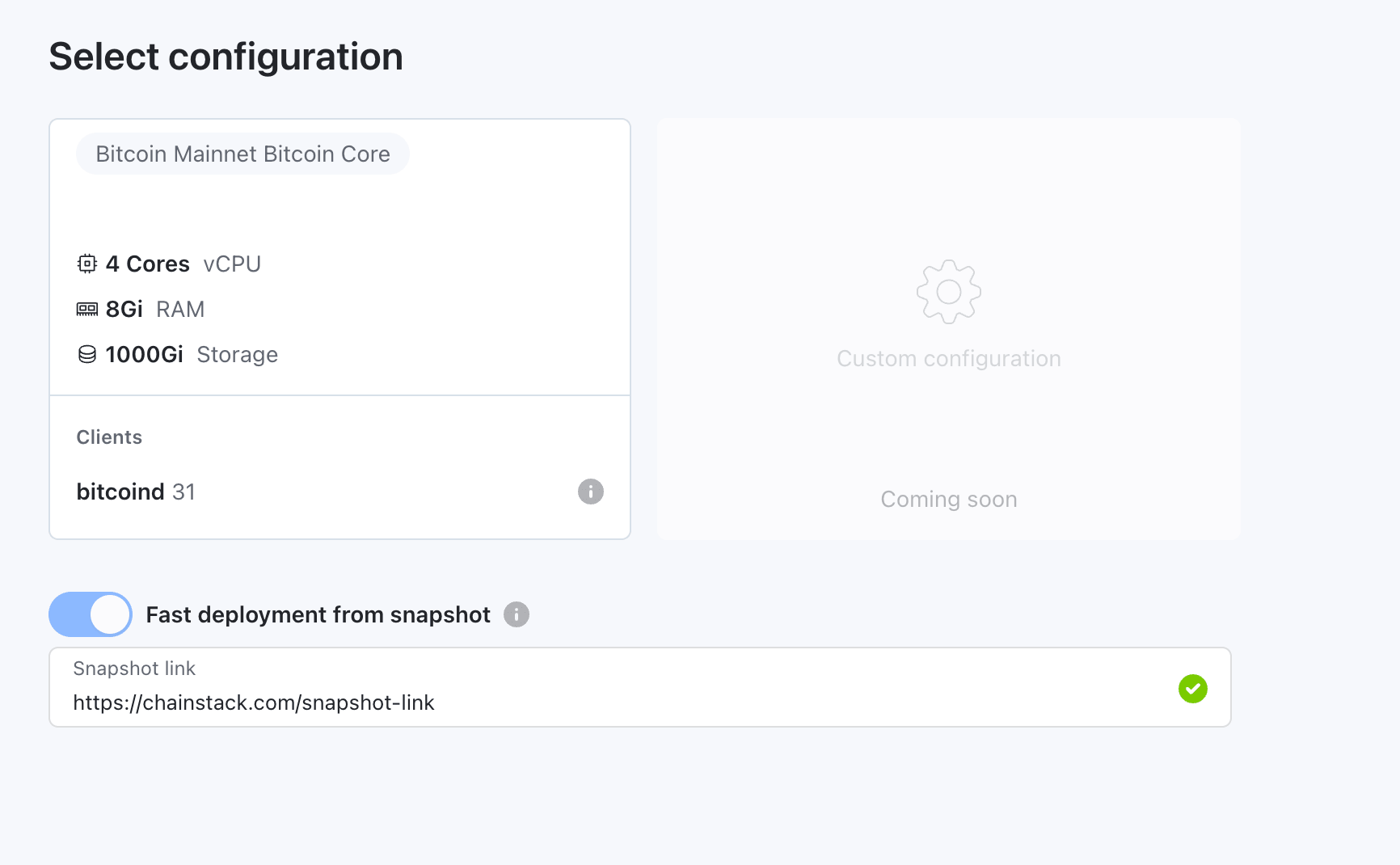
The Bitcoin deployment is the lightest of any chain on the platform. A Bitcoin full node fits comfortably on 4 vCPU and 8 GiB of RAM — Bitcoin Core’s resource appetite is genuinely modest compared to Ethereum execution clients. Plus a fast disk: NVMe is strongly preferred over SATA SSD, and rotational drives won’t keep up with IBD or mempool throughput. Plan for 1 TB+ of storage with growth headroom. See the system requirements page for the full sizing matrix.

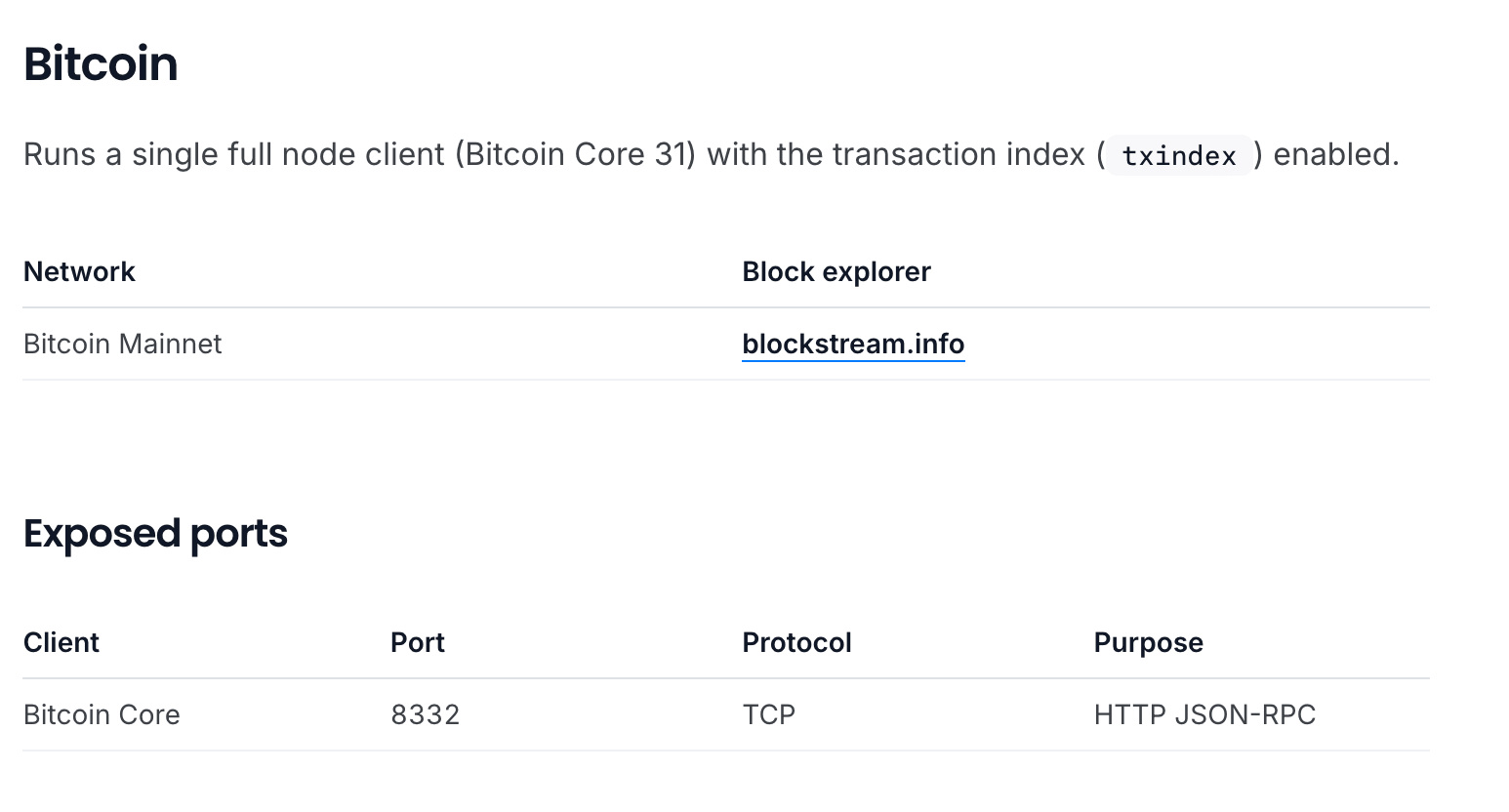
The node ships with txindex enabled by default — so historical transaction lookups, Lightning Network compatibility, and indexer integrations work out of the box without needing to reconfigure and resync. The exposed endpoint is Bitcoin Core’s HTTP JSON-RPC on port 8332. See the supported clients and protocols page for the current configuration.

Snapshot-assisted deployment significantly reduces the initial sync window — Chainstack’s Bolt is the patented snapshot tech behind the platform’s managed Bitcoin nodes, and the same operational thinking informs how Self-Hosted deployments come online quickly without genesis-up resyncs. The self-healing and auto-update layers handle the operational discipline most self-hosted setups quietly skip. Failover lets you route to a Chainstack-managed Bitcoin endpoint if your own node has issues, so you’re not choosing between “own infrastructure” and “production reliability” — you get both.
You still own the node. The data never leaves your perimeter. You can SSH into the box and run bitcoin-cli against it like any other Bitcoin Core install. The difference is you didn’t build the deployment and operational stack around it yourself.
When to self-host Bitcoin, and when not to
The decision isn’t religious. It’s a workload question.
Run your own Bitcoin node if:
- You’re accepting BTC payments in production. The fee estimation, double-spend detection, and broadcast reliability arguments compound until they’re decisive.
- You hold customer Bitcoin or BTC at corporate-treasury scale.
- You run a Lightning Network node of any meaningful size. (Required, not optional.)
- Your application makes more than a few hundred thousand RPC calls per day. Managed RPC pricing scales with call volume; your own node runs at a flat hardware cost regardless of throughput.
- You need ZMQ subscriptions, full mempool access, or
txindex-dependent features. - Compliance, audit, or regulatory frameworks require infrastructure control.
Reach for managed Chainstack Bitcoin instead if:
- You’re learning, prototyping, or running a low-volume side project. Chainstack Global Nodes with a free Developer tier covers most of that scale without the setup.
- You only need historical lookups (a single block explorer API call now and then). Pay-per-call access through Chainstack’s Bitcoin tier is cheaper than running a full node for that pattern.
- You’re doing read-only analytics and the data is non-critical.
The middle ground — production workloads that wanted their own Bitcoin node without committing to a full DIY setup — used to have no clean answer. DIY self-hosting worked, but the setup and monitoring stack around Bitcoin Core was itself a quarter of DevOps work. Chainstack Self-Hosted is what removes that barrier: your infrastructure, none of the setup marathon.
If your Bitcoin workload is heading toward “load-bearing for the business,” running your own node was always the right answer. What’s new is that the path from “I should probably do this” to “it’s deployed and monitored” doesn’t have to take a quarter anymore.
FAQ
From scratch — several days, even on good hardware. Bitcoin Core’s initial block download has single-threaded phases that you can’t parallelize past. With assumeUTXO snapshots (supported since Bitcoin Core 27), you bootstrap from a recent verified state and bring the node fully current in hours instead. Chainstack Self-Hosted uses snapshot-based sync by default.
Yes — Bitcoin Core supports pruning natively, and a pruned node keeps full validation while discarding old block data. The catch: pruning disables txindex, which kills several use cases. Lightning Network nodes need txindex on most configurations. Most analytics and historical lookups need it. Block explorers definitely need it. If you can live without those, pruning cuts storage to a few hundred GB. If you can’t, plan on a full node.
Yes, with a caveat. A Bitcoin Core full node is exactly what every Lightning implementation (LND, Core Lightning, Eclair) needs underneath it. You’d deploy your Bitcoin node through Chainstack Self-Hosted with txindex enabled, then run your LN daemon of choice on top of it as a separate service. Chainstack Self-Hosted handles the Bitcoin layer; the LN layer is yours. For interacting with the Bitcoin node from your application code, see the Bitcoin tooling docs.
Currently Bitcoin Mainnet only. Additional networks may be added in future releases — check the supported clients and protocols page for the current list.
Chainstack Self-Hosted ships with self-healing — most failures (sync drift, container restarts, transient peer issues) recover automatically. For harder failures, you can configure failover to a Chainstack-managed Bitcoin endpoint, so your application stays online while you investigate the box. You’re not choosing between “own infrastructure” and “production reliability.”
The current Self-Hosted lineup beyond Bitcoin spans Ethereum (Mainnet, Sepolia, Hoodi), the OP Stack family (Optimism, Base, Unichain, Zora), Starknet, and TRON. Solana Mainnet and Devnet with the Agave client are explicitly listed as coming soon on the supported clients and protocols page. The page is the canonical place to check what ships next.
The deployment exposes Bitcoin Core’s standard HTTP JSON-RPC on port 8332. That’s the same interface bitcoin-cli and every Bitcoin Core SDK speaks, and it covers the bulk of integration patterns — transaction broadcasting, mempool queries, fee estimation, block and transaction lookups (with txindex enabled by default). For workloads that depend on push-based notifications via ZMQ — typically lower-latency LN setups, mempool watchers, MEV-style monitoring — check the current exposure options against the supported clients and protocols page and reach out if your use case needs more than HTTP JSON-RPC.
Additional resources
Chainstack Self-Hosted documentation:
- Introduction to Chainstack Self-Hosted
- Supported clients and protocols
- System requirements
- Quick start
- Installation
- Deploying nodes
- Managing nodes
- Monitoring
- Self-Hosted FAQ
Chainstack Bitcoin products:
Background reading:
- Self-hosted blockchain node: challenges and solutions
- Deploy blockchain nodes on your own infra: introducing Chainstack Self-Hosted
External: