














Introduction
Monad is an EVM-compatible Layer 1 that rebuilds Ethereum’s execution stack from the base up — parallel optimistic execution, a custom asynchronous state database (MonadDB), and MonadBFT consensus with speculative finality in one slot and full finality in two slots (about 600ms per current Monad docs). Mainnet launched November 24, 2025, making Monad the youngest production L1 in this comparison and one of the fastest new L1s to pass $300M in TVL after launch — and the reason the best Monad RPC providers are already diverging sharply on archive depth and trace support.
The 2026 hook is that Monad has graduated from “interesting testnet” to a chain with institutional activity, including tokenized US equities trading via Monday Trade, major DeFi deployments (Uniswap, Morpho, Kuru DEX), and a 10,000 TPS architectural ceiling that most applications are nowhere near hitting yet. Network utilization currently sits well under 1% of that ceiling, which means RPC provider choice today is less about surviving peak load and more about positioning for the scale curve as liquidity and activity ramp toward the November 2026 unlock cliff. The chain’s eth_* method surface is fully EVM-compatible, so Solidity, ethers.js, Foundry, and Hardhat work without modification — but archive and trace support is where providers diverge sharply.
This guide compares the best RPC providers serving production Monad workloads in 2026, with a focus on what actually changes under load: archive depth, trace availability, WebSocket stability, and pricing that scales with parallel EVM call patterns.
📖 New to Monad? Start with the architecture first: Deep dive into Monad: Speed, performance, and architecture
Why RPC provider choice matters for Monad
Monad’s architecture puts specific demands on RPC infrastructure that don’t exist on slower chains. Sub-second block times, combined with parallel execution and sub-second finality, mean that any provider-side latency or queueing directly affects your application’s effective throughput. A 300ms p99 latency spike on Ethereum is annoying; on Monad, it’s a missed block. The trade-off between latest and finalized block tags also matters more here — Monad’s latest tag returns data from the latest proposed block, so applications that assumed finality semantics on Ethereum need to decide explicitly which tag to query.
The second concern is archive and trace access. Monad’s MonadDB is purpose-built for Merkle Trie state with parallel disk access, but running archive nodes with debug tracing enabled adds significant CPU and I/O overhead on the provider side. Not every provider offers archive mode for Monad yet, and among those that do, trace method support varies. This is the single biggest technical gap to verify before committing — for a full walk-through of the architecture, see the Chainstack deep dive into Monad.
The production-grade criteria that separate Monad RPC providers:
- Throughput stability under sub-second block times and parallel transaction flows
- WebSocket support for
eth_subscribeon new blocks, pending transactions, and contract events - Archive depth — full block, receipt and log history, and how far back state reads go, for audit trails
- Debug method support —
debug_traceTransaction,debug_traceCall, anddebug_traceBlockBy*(Monad does not serve the Parity-styletrace_*namespace) - Dedicated node availability — for teams where shared RPC contention is unacceptable
- SLA commitments and uptime — formal service credits, not just marketing claims
- Pricing transparency — method-weighted credit models can make trace-heavy workloads roughly 1.5–2x more expensive per call than standard calls
Comparison of the best Monad RPC providers (2026)
The table below summarizes public positioning as of October 2026.
| Provider | Pricing model | Free tier | Dedicated nodes | Archive & trace | SLA / Uptime |
|---|---|---|---|---|---|
| Chainstack | Request Units (1 RU standard, 2 RU archive/debug) | 3M RU/month, ~25 RPS | Yes, full-node mode, from the Pro plan (priced per node) | Yes (archive + debug/trace on Global Nodes, Growth plan and up) | 99.9% contractual SLA with service credits; 99.99%+ measured uptime |
| Dwellir | Credits (1 per response, no method weighting) | 20 responses/s, 100,000/day | Yes, Monad cluster $4,260/mo; Unlimited Nodes from $119/mo | Trace/debug on paid plans (confirm Monad coverage) | 99.99% on dedicated clusters (custom terms) |
| Triton One | Prepaid pay-as-you-go ($125 minimum deposit) | No free tier | Yes (bare-metal) | Yes (validator + RPC infrastructure) | Enterprise-grade |
| dRPC | Flat rate ($6/1M paid requests) | Public endpoints, rate-limited | Yes | Yes | No formal SLA on free tier |
| Alchemy | Compute Units (method-weighted) | 30M CUs/month | No standard dedicated | Debug API on mainnet; no Trace API listed | Enterprise-only formal SLA |
| Quicknode | Credits (method-weighted, 2x for debug/trace) | No permanent free plan; 30-day trial (10M credits) | Yes, higher-tier plans | Yes (archive + debug_trace*; 2x credit multiplier) | 99.99% stated uptime; contractual SLAs on Enterprise |
How to choose a Monad RPC provider
1. Shared RPC is fine for development and moderate traffic
If you’re deploying contracts, testing integrations, or running a mid-volume dApp with predictable load, a shared RPC endpoint from any of the top providers will work. Chainstack’s free tier (3M RU/month, 25 RPS) covers most early-stage workloads. Alchemy’s 30M CU free tier covers roughly 1.1M eth_call-sized requests, enough for testnet work. Dwellir’s free plan allows 100,000 responses a day. For development specifically, your choice matters less than for production.
2. When dedicated Monad infrastructure becomes non-negotiable
Three concrete scenarios push you out of shared infrastructure: sustained throughput above ~100 RPS, WebSocket connections that need to stay open for hours without drops, and any workload that depends on archive or trace methods running continuously. Monad’s 10,000 TPS ceiling means that as chain activity ramps, shared-pool contention gets worse faster than on lower-throughput chains. Dedicated Monad nodes from Chainstack isolate your traffic from other tenants and remove the shared-pool contention cliff.
3. Archive and trace access — the invisible dependency
Most teams don’t realize they need trace methods until they’re debugging a failed transaction in production or building a DeFi analytics pipeline. On Monad, debug_traceTransaction and the other debug_trace* methods (callTracer, prestateTracer) need an archive-capable node, which is expensive and therefore unevenly supported; the Parity-style trace_* namespace is not available. Chainstack’s December 2025 changelog formally enabled Monad archive mode with debug and trace on Global Nodes. Quicknode supports the debug methods with a 2x credit multiplier. Alchemy, Dwellir, and dRPC offer varying levels of support that require direct verification before committing. See the Monad tooling documentation for the current method surface.
4. Latency consistency beats average latency
Monad’s sub-second block times make tail latency (p95, p99) more important than average latency. A provider that averages 40ms but spikes to 800ms under load will cost you blocks; a provider that consistently delivers 80ms will not. Monad isn’t yet on Chainstack’s public performance dashboard, so benchmark before you commit — run Chainstack Compare or your own k6/curl test against the providers you’re shortlisting.
5. Enterprise support for regulated workloads
For teams building institutional products on Monad, SOC 2 Type II and ISO 27001 is table stakes for vendor procurement. Chainstack holds SOC 2 Type II (December 2025) and ISO 27001 (July 2026); Quicknode also holds both. Alchemy holds SOC 2 Type II but has not published ISO 27001. Dwellir publishes no SOC 2 or ISO 27001 attestation on its public pages, and the remaining providers either lack SOC 2 or hold only Type I (design audit, not operational). For regulated deployments, this narrows the field quickly.
Choose by Monad use case
For trading bots and high-frequency workloads

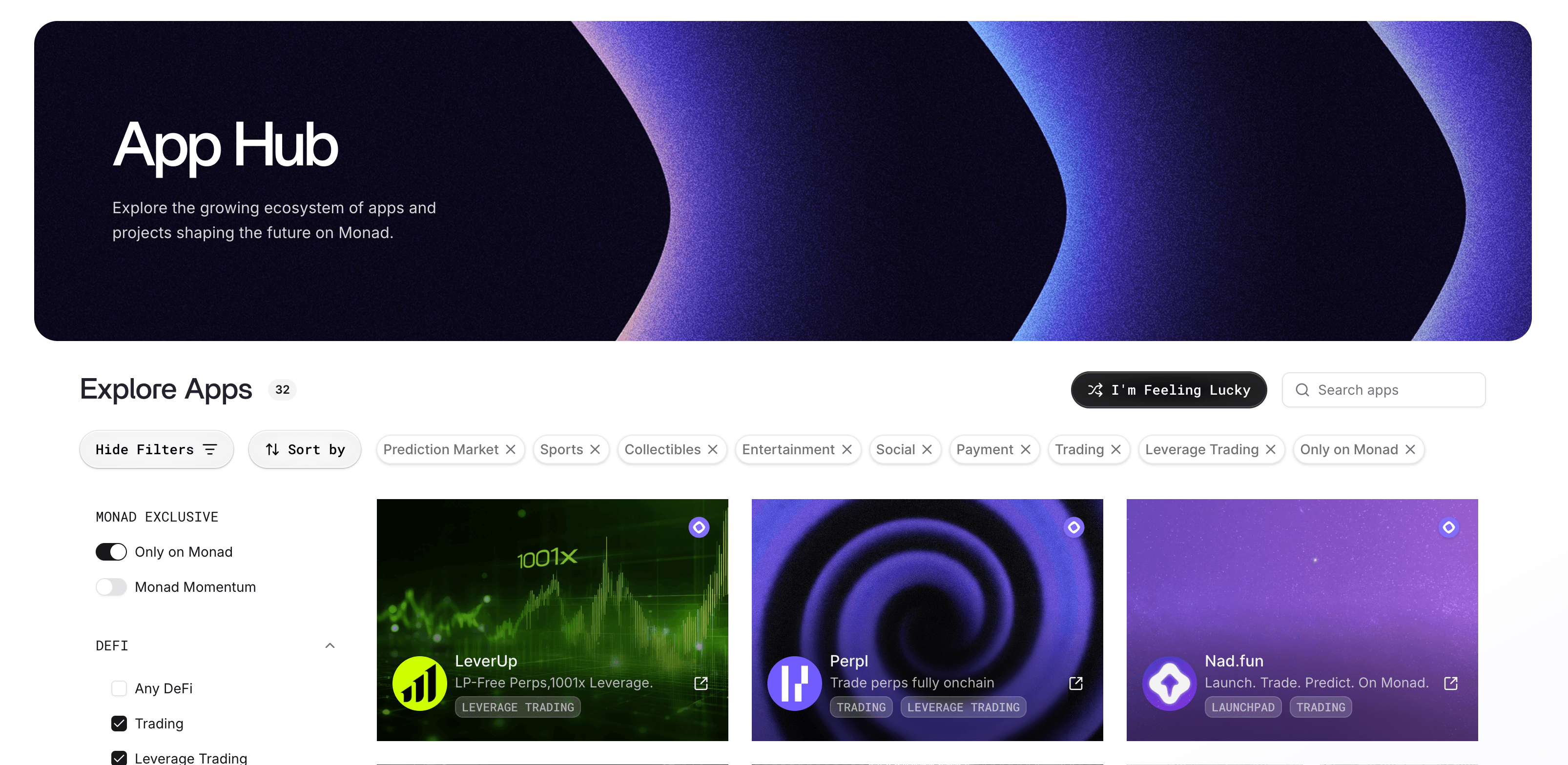
Monad is the first EVM chain where a single block produces enough state change for meaningful on-chain arbitrage strategies — 10,000 TPS ceiling with sub-second finality means the time window between a price-moving trade and its observable downstream effect is compressed to milliseconds rather than seconds. Trading bots, market makers, and arbitrageurs need a provider where WebSocket subscriptions never drop, mempool access is predictable, and tail latency is tightly controlled. Shared RPC tiers will not hold up at serious volume — the question isn’t whether you’ll need dedicated infrastructure, it’s when.
For this use case, Chainstack’s Dedicated Nodes are the strongest fit: isolated performance, full-node isolation (archive history and debug methods run on Global Nodes; state reads on Monad cover a rolling window of several days), and the Unlimited Node add-on for traffic that can’t be bounded in advance. Quicknode’s dedicated clusters are also strong if you need their Streams product for event pipelines. Triton One is a credible choice for teams already running Solana validator infrastructure who want the same operational pattern on Monad.
For DeFi protocols and stablecoin infrastructure

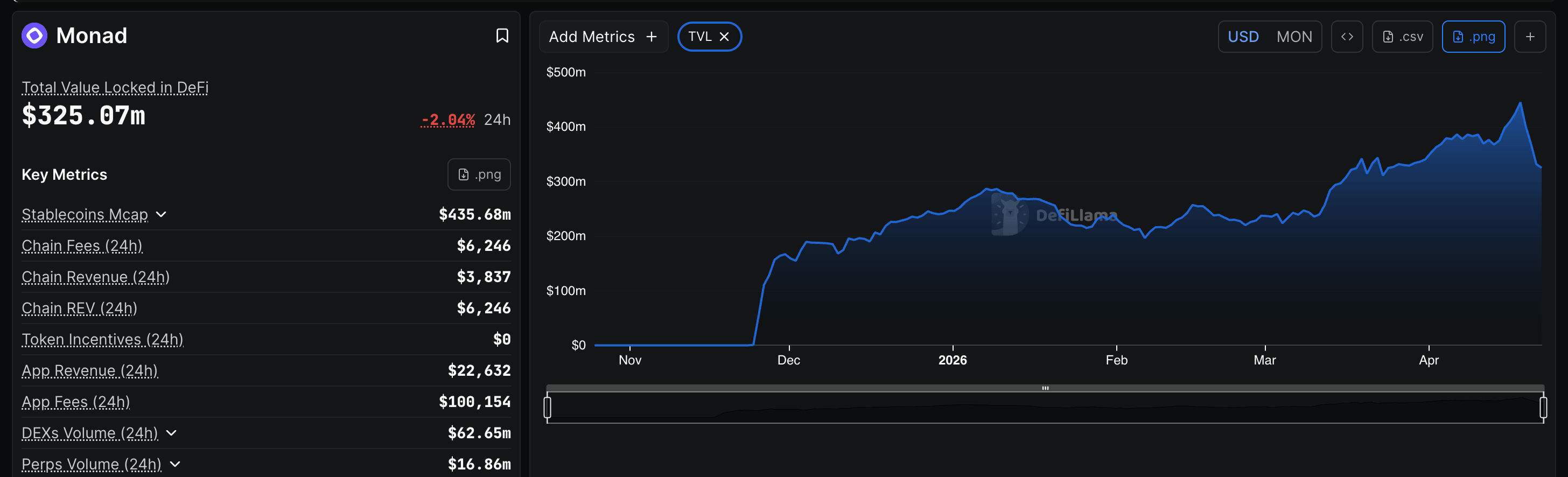
The DeFi story on Monad moved fast: Uniswap, Curvance, and Morpho live within months of mainnet, plus tokenized-stock trading and stablecoin activity. These workloads need deep archive access for position history, consistent eth_getLogs performance across wide block ranges, and trace methods for protocol debugging and reconciliation. Stablecoin flows in particular are sensitive to finality semantics — applications need to decide explicitly whether to query latest, safe, or finalized block tags, and providers need to surface the distinction correctly.
Chainstack’s method-agnostic billing (1 RU standard, 2 RU archive) is a significant cost advantage here — a debug_traceBlockByNumber sweep across a wide block range costs 2 RU per call, with no method-weight premium. Quicknode supports the debug methods with a 2x credit multiplier that compounds at scale. dRPC’s flat $6/1M pricing and Dwellir’s one-credit-per-response billing are also predictable for mixed workloads, though dRPC has weaker SLA coverage and Dwellir publishes no compliance attestation. For teams building on Kuru DEX specifically, there’s a Chainstack walkthrough of a Kuru copy trading bot that shows how the RPC pattern works end-to-end.
For gaming and high-throughput consumer apps

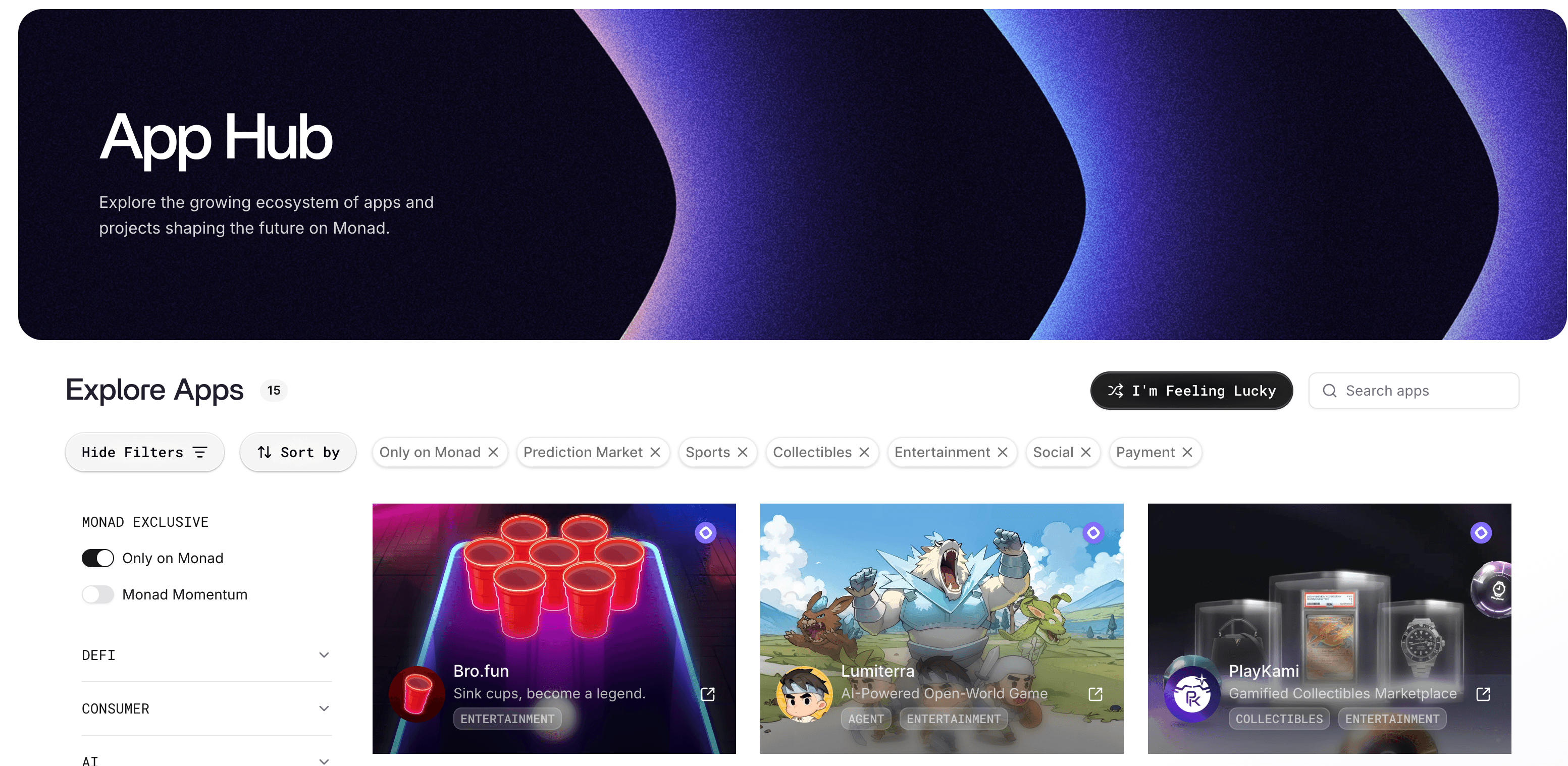
Monad’s block time and throughput headroom are what gaming teams have been asking EVM chains for since 2021 — sub-second confirmation with EVM tooling compatibility. The Monad Momentum incentive program has specifically funded gaming and NFT projects that demonstrate user retention, and Chainstack is already running infrastructure for several early-stage gaming deployments. The RPC demand profile here is different from DeFi: massive concurrent WebSocket connections for real-time state, batch transaction submission for mint drops, and burst tolerance during peak session windows.
Dedicated infrastructure matters less for gaming than for trading — the predictable daily usage patterns of a game make capacity planning easier — but WebSocket stability is critical. Chainstack’s Global Nodes with geo-routing keep latency consistent across regions for global player bases. Quicknode’s Streams product is useful for teams that want real-time event pipelines without running their own indexers.
In-depth Monad RPC providers analysis
Chainstack

Chainstack brought Monad mainnet and testnet into production and added archive mode with debug methods on Global Nodes, as confirmed in the Chainstack December 2025 changelog. The platform gives you private HTTP and WebSocket endpoints, one-click deployment for mainnet or testnet, archive-mode Global Nodes (full block, transaction, receipt and log history with callTracer; state reads cover a rolling window of several days), and Dedicated Nodes that isolate traffic from other tenants.
Pricing is on the Request Unit model: 1 RU per standard call, 2 RU per archive or debug/trace call, with no method-weight multipliers. For a DeFi analytics pipeline running debug_traceBlockByNumber across wide block ranges on Monad, the 2 RU rate stays flat per call, while credit-weighted competitors apply a multiplier (2x on Quicknode) on top of their base cost. The Developer tier starts at 3M RU/month free with 25 RPS; the Growth tier is $49/month at 20M RU and 250 RPS; the Pro tier is $199/month at 80M RU and 400 RPS; Business is $499/month at 200M RU and 600 RPS. Dedicated Nodes bill per node (compute plus storage) from the Pro plan. Chainstack also ships a Monad testnet faucet — grab MON directly from the Chainstack Monad faucet, no third-party tools needed.
Limitations: Fixed RPS caps per tier mean very high-frequency applications may need Dedicated Nodes or the Unlimited Node add-on; the free tier is tight for heavy indexing workloads.
🤖 You can also access Chainstack Monad RPC directly from Claude, Cursor, Codex, Windsurf, Gemini CLI, GitHub Copilot, Antigravity, Claude.ai, or ChatGPT using Chainstack MCP. Learn more about Chainstack MCP.
Fit by workload:
- Trading bots: Excellent — Dedicated Nodes for isolation, Unlimited Node add-on for unpredictable load
- DeFi protocols: Excellent — method-agnostic RU billing makes trace-heavy workloads cost-predictable
- Gaming applications: Strong — Global Nodes with geo-routing, WebSocket stability, faucet included
Dwellir

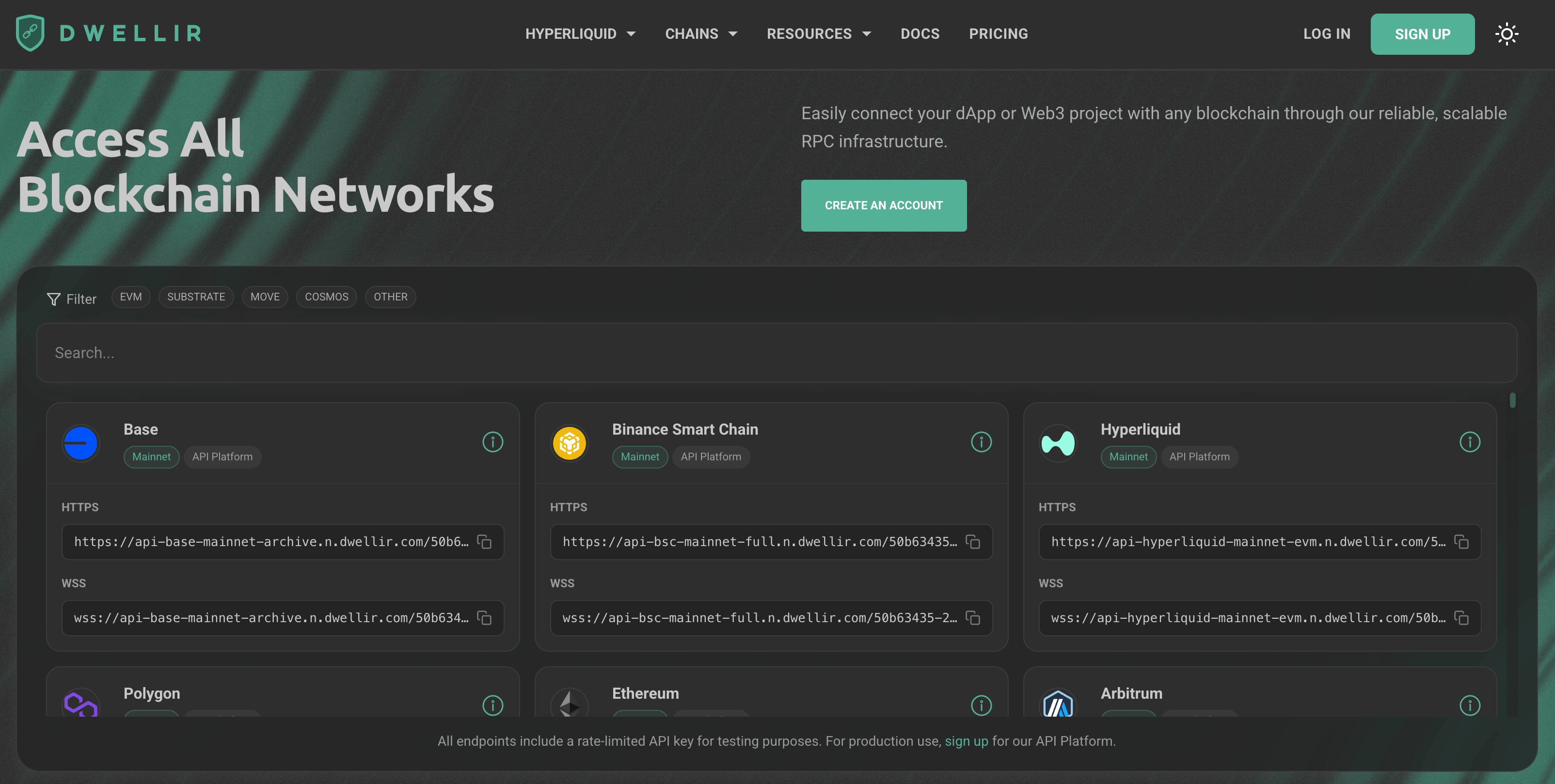
Dwellir is a Swedish RPC provider with a long Polkadot track record that now serves 150+ networks, Monad among them. Shared plans bill one credit per response with no compute-unit weighting, so a heavy call costs the same as a light one, and every plan includes HTTP and WebSocket access. Trace and debug APIs start on the paid Developer plan on the chains that support them, so confirm Monad coverage before you build on it.
Pricing runs from a free plan (20 responses per second, 100,000 responses per day) through Developer at $49/month (25M responses, 100 per second), Growth at $299/month (150M, 500 per second) and Scale at $999/month (500M, 5,000 per second). Unlimited Nodes start at $119/month flat for 25 to 1,000 RPS, and the dedicated Monad cluster is listed at $4,260/month, unmetered, with a 99.99% SLA on custom terms. You can pay in crypto. Pricing checked October 9, 2026.
Limitations: No SOC 2 or ISO 27001 attestation on its public pricing and dedicated-cluster pages; the free plan is capped at 100,000 responses per day; Its standard Monad endpoint is a full node, and archive depth and latency figures are not published, so verify them before relying on historical state.
Fit by workload:
- Trading bots: Good — an unmetered dedicated cluster or a flat-rate Unlimited Node removes request counting, but no Monad latency figures are published
- DeFi protocols: Good — one credit per response keeps analytics pipelines easy to forecast; request compliance documents directly if procurement needs them
- Gaming applications: Good — a free plan, WebSocket on every plan and flat per-response billing suit bursty player traffic
Triton One

Triton brings its Solana infrastructure DNA to Monad — the team has spent years (since 2021) operating high-performance Solana validator and RPC infrastructure, and applied that pattern to Monad at mainnet launch. The offering includes globally distributed shared RPC pools, dedicated bare-metal nodes, validator services, and full WebSocket API support for eth_subscribe.
This is an enterprise-first provider. Pricing is prepaid pay-as-you-go with a $125 minimum deposit plus dedicated and validator services, there is no free tier, and the positioning is explicitly production-grade rather than “start free and scale.” For teams that need guaranteed capacity, specific geographic placement, or bare-metal dedicated nodes, Triton is a serious contender. The Solana heritage means the team understands high-throughput chain operations at depth — something that matters as Monad activity ramps.
Limitations: No free tier; $125 minimum prepaid deposit; platform ecosystem is smaller than multi-chain generalist providers; less relevant for early-stage teams just starting on Monad.
Fit by workload:
- Trading bots: Excellent — bare-metal dedicated nodes, validator-adjacent infrastructure, production-grade from day one
- DeFi protocols: Strong — enterprise-grade infrastructure, dedicated capacity
- Gaming applications: Good — infrastructure quality is excellent but the enterprise engagement model fits gaming studios less naturally
dRPC

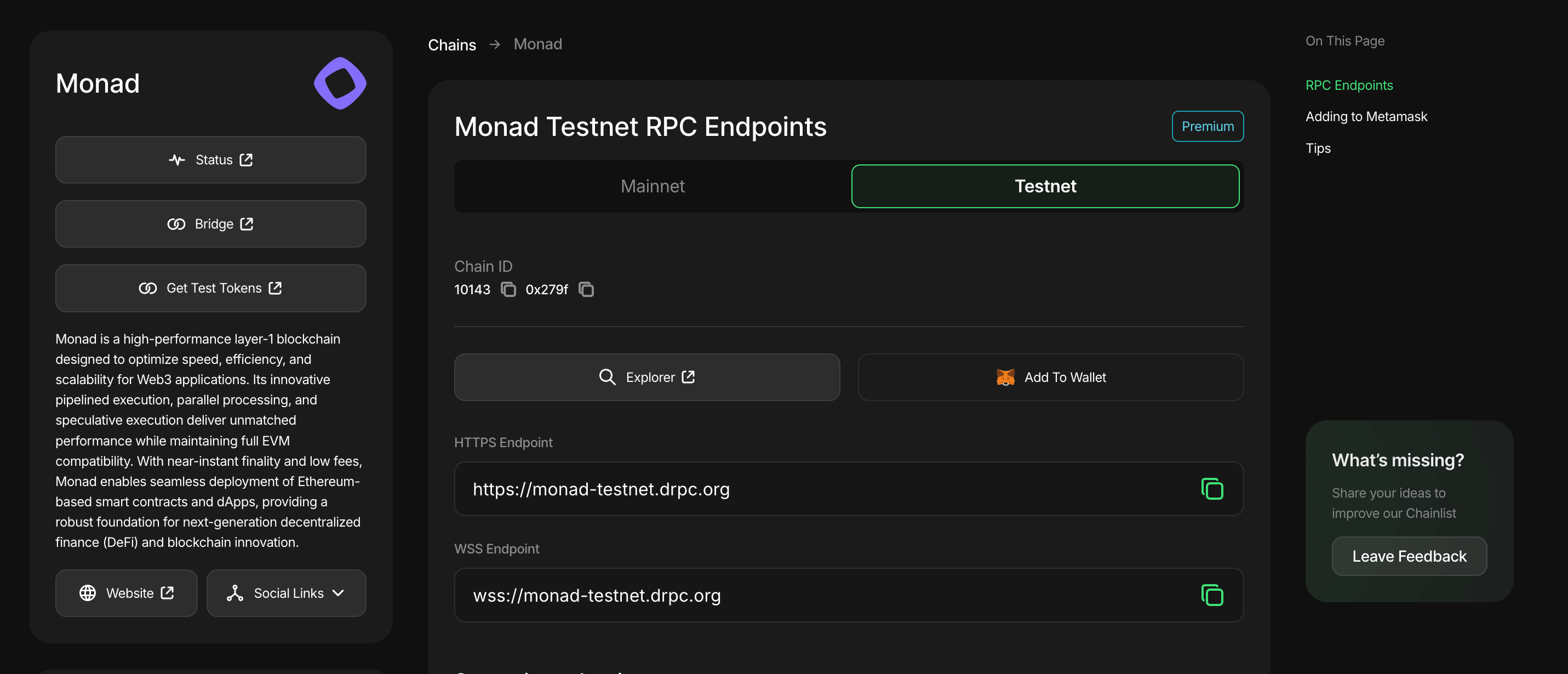
dRPC launched Monad mainnet support on day one through its NodeCloud platform, with both public and paid endpoints for mainnet and testnet. The positioning is flat-rate, method-agnostic pricing — $6 per 1 million paid requests across all methods, including archive and trace. For workloads with unpredictable method mixes or heavy trace usage, this pricing model is significantly more predictable than credit-weighted alternatives.
Technical capabilities cover standard JSON-RPC, WebSocket subscriptions, and archive access. dRPC’s routing intelligence directs requests through its NodeCloud layer to optimize for latency and reliability. The platform is newer than Chainstack or Quicknode and the free tier (public nodes) is rate-limited without SLA backing — fine for development, not production. No SOC 2 certification.
Limitations: No formal SOC 2; smaller team and platform maturity than top-tier providers; free tier is not production-grade; fewer platform extras (no Streams-equivalent or Enhanced APIs).
Fit by workload:
- Trading bots: Good — flat-rate pricing works for predictable call patterns, but compliance gap matters for institutional trading
- DeFi protocols: Strong — flat-rate model is excellent for trace-heavy DeFi analytics
- Gaming applications: Moderate — works for early-stage gaming, enterprise features limited
Alchemy

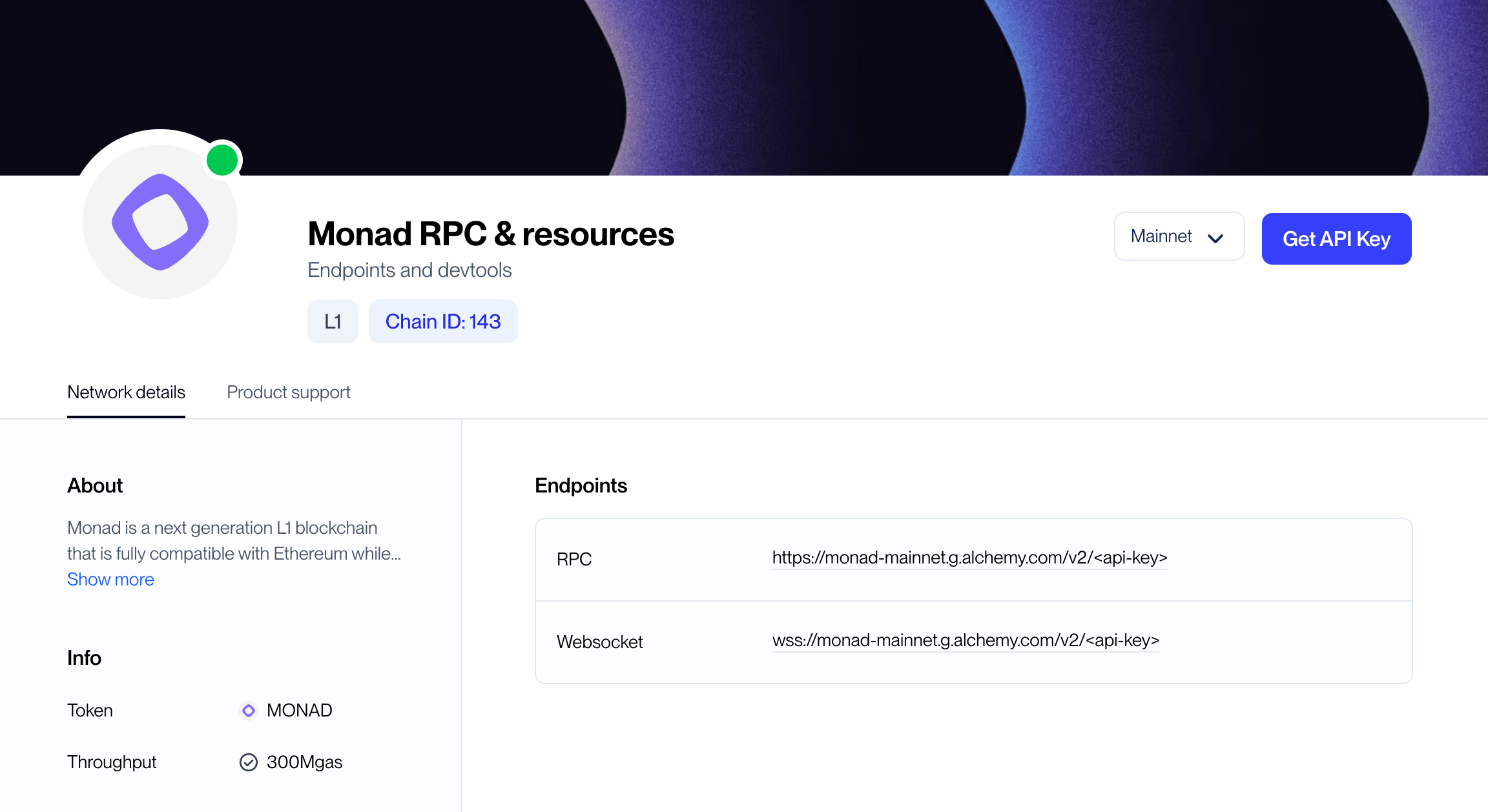
Alchemy rolled out Monad support shortly after mainnet with EVM-compatible RPC endpoints that plug into the existing Alchemy developer platform. Teams already using Alchemy for Ethereum tooling can continue using the same libraries — ethers.js, web3.py, the Alchemy SDK — and the overall workflow feels familiar. Monad support covers standard JSON-RPC with HTTP and WebSocket access.
The value-add is Alchemy’s broader developer tooling: Enhanced APIs (Transfers, Token, NFT, Prices), Webhooks, Gas Manager and Bundler. For teams building event-driven systems or monitoring-heavy applications on Monad, these features reduce the amount of custom indexing infrastructure needed. Free tier is 30M CUs/month with archive included, which works out to roughly 1.1M eth_call-sized requests. Pricing uses method-weighted Compute Units: eth_call costs 26 CU, eth_getLogs costs 60 CU, debug_traceTransaction costs 40 CU. At scale, this pricing model is harder to forecast than flat-rate alternatives.
Limitations: Method-weighted CU billing makes trace costs hard to predict; formal SLA is Enterprise-only; its Monad mainnet page lists the Debug API but not the Trace API; no published ISO 27001.
Fit by workload:
- Trading bots: Good — strong infrastructure, but formal SLA gap matters for production trading
- DeFi protocols: Strong — Enhanced APIs and developer tooling reduce custom indexing work
- Gaming applications: Strong — webhook infrastructure and NFT APIs useful for gaming-adjacent workloads
Quicknode

Quicknode added Monad support during testnet and rolled into mainnet on launch. The platform runs a globally distributed, auto-scaling network that routes traffic to the nearest region, which keeps latency tight across geographies. Monad support covers standard JSON-RPC, WebSocket subscriptions, and the debug method suite (debug_trace*) through Quicknode’s Core RPC API; the trace_* namespace is not available.
Pricing follows the API credits model with chain and method multipliers — debug_traceTransaction and the other debug methods run at 2x the standard rate (Monad’s base is 30 credits per call). For workloads dominated by standard eth_call and eth_getLogs, the math works out well; for trace-heavy analytics pipelines, costs escalate faster than on flat-rate providers. There is no permanent free plan — the entry point is a 30-day trial (10M credits) with archive access included (debug starts on the Build plan). Quicknode holds SOC 2 Type II, SOC 1 Type II, and ISO 27001:2022 — the strongest compliance posture in this comparison — and states 99.99% uptime on its security page, with contractual SLAs on Enterprise. Add-ons worth noting: Streams for real-time event pipelines, QuickAlerts for webhook-based monitoring, and the Quicknode Marketplace.
Limitations: Credit multipliers on trace and debug methods make tracing pipelines expensive at scale; the pricing page is JS-rendered which complicates cost modeling; Dedicated clusters require higher-tier plans.
Fit by workload:
- Trading bots: Strong — globally distributed network, stated 99.99% uptime, dedicated clusters on higher tiers
- DeFi protocols: Strong — debug tracing with credit multipliers, strong compliance for institutional DeFi
- Gaming applications: Strong — Streams for real-time pipelines, good regional coverage
Real-world performance benchmark
Monad isn’t yet on Chainstack’s public performance dashboard alongside the other high-throughput chains Chainstack tracks (Ethereum, Solana, BNB Smart Chain, Arbitrum, Base, Hyperliquid, Robinhood Chain, and Arc), so there’s no pre-computed p50 / p95 ranking to point to yet.
Two practical implications. First, Monad’s sub-second block time makes tail latency (p95, p99) more diagnostic than average latency — a provider with 40ms average but 800ms p99 will cost you blocks. Second, regional variation matters: a provider that’s fast from US-East may be slower from APAC, and Monad’s global user base makes geo-balanced routing a real differentiator. Monad isn’t yet on Chainstack’s public performance dashboard — use Chainstack Compare to run a live benchmark against your own endpoint before committing to a provider.
Getting started with Monad on Chainstack

- Log in to Chainstack (or create an account — takes about 30 seconds with GitHub, Google, or email)
- Create a new project or select an existing one
- Choose Monad Mainnet (Chain ID 143) or Monad Testnet (Chain ID 10143)
- Deploy a node with RPC access — Global Node for geo-balanced shared infrastructure, or Dedicated Node for isolated performance
- Copy the HTTP or WebSocket endpoint into your application
A basic eth_blockNumber call via cURL:
curl -X POST https://monad-mainnet.core.chainstack.com/YOUR_AUTH_KEY \
  -H "Content-Type: application/json" \
  -d '{
    "jsonrpc": "2.0",
    "id": 1,
    "method": "eth_blockNumber",
    "params": []
  }'
Or with ethers.js:
import { ethers } from 'ethers';

const provider = new ethers.JsonRpcProvider(
  'https://monad-mainnet.core.chainstack.com/YOUR_AUTH_KEY'
);

const blockNumber = await provider.getBlockNumber();
console.log('Latest block:', blockNumber);
📖 The Monad tooling documentation covers full SDK examples for Hardhat, Foundry, viem, web3.py, and wallet integrations for MetaMask, Phantom, Backpack, and Rabby. Need testnet MON? Grab some from the Chainstack Monad faucet — no third-party tools required.
Conclusion
Monad is a young chain with high architectural ceilings and real institutional tailwinds — RPC provider choice in 2026 is less about handling peak load and more about positioning for the ramp ahead of the November 2026 unlock cliff. The method-weighted pricing trap is the single biggest cost risk teams underestimate on high-throughput chains, and archive plus trace support is still unevenly distributed across providers.
- For trading bots and HFT workloads: Chainstack Dedicated Nodes, Triton One for enterprise-grade bare-metal, or Dwellir for a flat-rate dedicated cluster
- For DeFi protocols and stablecoin infrastructure: Chainstack for cost-predictable trace usage, Quicknode for strongest compliance posture
- For gaming and consumer apps: Chainstack Global Nodes with geo-routing, or Alchemy for teams leveraging Enhanced APIs
- For early-stage development: Alchemy’s or Dwellir’s free plan for headroom, or Chainstack Developer plan to train on the exact infrastructure you’ll use in production
FAQ
Yes. Monad is EVM-compatible at the bytecode level, so standard eth_* methods behave as expected. One nuance: latest block tag returns data from the latest proposed block (not finalized), which reduces query latency but changes finality semantics for applications migrating from Ethereum. Use safe or finalized tags where finality matters.
Alchemy’s 30M CUs/month is the biggest number on paper, but it works out to roughly 1.1M typical calls. Chainstack’s 3M RU/month at 25 RPS covers about 3M standard calls and maps directly to what you’d use in production — same infrastructure, same behavior. Dwellir’s free plan allows 100,000 responses a day, roughly the same monthly volume.
Yes. Chainstack formally enabled Monad mainnet archive mode with debug and trace methods on Global Nodes in the December 2025 platform update. Archive calls cost 2 RU per request with no additional method-weight multipliers. Archive nodes serve full block, transaction, receipt and log history, while state reads cover a rolling window of several days. That is a meaningful cost difference for trace-heavy workloads versus credit-weighted providers.
Current network utilization sits well under 1% of the theoretical ceiling, so TPS isn’t the binding constraint in 2026. What matters more is tail latency (p95, p99) under Monad’s sub-second block times — a provider that averages 40ms but spikes to 800ms will cost you blocks. Benchmark before committing using Chainstack Compare.
For consumer dApps, rarely. For regulated workloads — and Monad now hosts institution-oriented tokenization and stablecoin activity — SOC 2 Type II and ISO 27001 is often a hard vendor requirement. Chainstack and Quicknode are the two providers in this comparison that currently hold SOC 2 Type II and ISO 27001; Alchemy holds SOC 2 Type II but has not published ISO 27001, and Dwellir publishes neither.
The split is between method-agnostic models (Chainstack at 1 RU standard / 2 RU archive, Dwellir at one credit per response, dRPC at flat $6/1M) and method-weighted credit models (Quicknode with 2x debug/trace multipliers, Alchemy with per-method CU weights). For trace-heavy workloads, method-agnostic pricing is significantly more predictable at scale. For workloads dominated by standard eth_call and eth_getLogs, the difference is smaller.
Related reading
Monad deep-dive
- How to get a Monad RPC endpoint
- Monad tooling documentation — Chainstack Docs
- Deep dive into Monad: Speed, performance, and architecture
- Monad for builders 2026: A practical implementation guide
- Tutorials and guides for Monad on Chainstack
- How to get Monad testnet tokens with Chainstack faucet