


Hyperliquid RPC providers play a critical role for builders and traders using Hyperliquid in 2026. This guide compares the top Hyperliquid RPC providers and explains how to choose and set up the right one for trading bots, staking, and smart contracts.
Hyperliquid has become a popular choice thanks to its high throughput, EVM compatibility, and native order book design. The order book is directly tied to HyperEVM, meaning Solidity contracts execute against the same state as live trades. With sub-second finality via HyperBFT, negligible fees, and high throughput, Hyperliquid is well suited for high-speed trading bots, on-chain funds, and real-time applications.
Naturally, the free public Hyperliquid RPC is your first stop for testing, though limits vary by method, and some public endpoints are capped near ~100 requests/min. So, if you’re moving into production, you’d look for a private RPC provider. Yet performance across these providers is anything but consistent (and some proprietary HyperCore trading methods remain public-RPC-only, regardless of provider).
That’s why we lined up the main Hyperliquid RPC providers and put them side by side on speed, scale, and reliability so you can see which one matches your build.
Comparison of the best Hyperliquid RPC providers
Here’s a quick look at how the top Hyperliquid RPC providers stack up on rate limits, latency, pricing, and network coverage.
| # | 提供者 | 免费套餐 | 付费方案与定价 | Latency & uptime | 开发者体验 |
| 1 | Chainstack | 每月300万次请求,25次请求/秒 | 250–600 RPS by plan; subscription tiers with included quota + overage. Unlimited Nodes option for unmetered requests at a flat monthly rate | Low latency, global routing with 99.9%+ uptime | Comprehensive docs, MCP server, Access rules, Hyperliquid faucet, dashboard analytics, Node comparison tool, HyperEVM archive + HyperEVM WebSockets |
| 2 | Quicknode | 无免费层级;仅限1000万积分试用 | 50–500 RPS; credit-based monthly plans | Low latency, global routing with 99.99% uptime on paid plans | Streams, Webhooks, analytics dashboard |
| 3 | Alchemy | 300M credits/mo, ~300 RPS cap | Higher CU throughput by plan; pay-as-you-go credit tiers | 低延迟路由,更高层级可提供正常运行时间 | Transact & Notify APIs, simulation tools, analytics dashboards |
| 4 | dRPC | Available, ~40–250 RPS | Up to 5,000 RPS; flat $6 per 1 M requests | Latency-aware routing, uptime on paid plans | Analytics dashboard, unlimited API keys |
| 5 | HypeRPC | 10k requests/mo, 5 RPS | 50–300 RPS; tiered monthly plans, custom on request | Low, region-based, 99.99% uptime | Real-time metrics, trader-focused console |
| 6 | Dwellir | N/A | Up to 2,000 RPS on plans; custom on enterprise | Isolated on dedicated; rate-limited on shared; public status page available | HyperEVM JSON-RPC/WebSockets + Hyperliquid L1 gRPC |
Important: HyperCore proprietary methods
Critical for trading applications: Several HyperCore methods remain exclusive to
Hyperliquid’s public RPC and are not available through any private provider:
l2Book— Order book depthplaceOrder— Submit orderscancelOrder— Cancel ordersrecentTrades— Recent trade history
This means all trading bots must use the public RPC for order execution, regardless
of which private RPC provider you choose for HyperEVM and other HyperCore info methods.
Private RPC providers (including Chainstack) support:
✅ HyperEVM methods (smart contracts, events, archive)
✅ Non-proprietary HyperCore info methods (account data, fills, user state)
❌ Proprietary trading methods (order placement, cancellation, book queries)
Chainstack

Chainstack is a multi-chain infrastructure platform and one of the first providers to bring full Hyperliquid RPC support to production. By choosing Chainstack Hyperliquid RPC endpoints, you get private access to both HyperEVM (smart contracts) and HyperCore (the native order book) over HTTP and WebSocket, all backed by a guaranteed 99.9% uptime, with most HyperCore methods available privately and a few remaining public-only per Hyperliquid’s own setup.
What’s more, with Chainstack, you get a full set of tools that make building on Hyperliquid easier, all from the same platform, including:
- One of the first built-in Hyperliquid faucet to grab testnet HYPE.
- HyperEVM archive for historical reads, plus HyperEVM WebSockets for live contract events.
- A method table showing 100+ HyperEVM calls (with notes on which HyperCore methods are public-RPC-only), an API reference, MCP Server, and even a ready-to-clone trading bot repo.
- Access rules to set limits on keys, requests, and IPs directly from the dashboard.
Backed by a globally distributed, multi-cloud network, Chainstack delivers predictable performance for builders moving from test to production. And the setup takes just a few minutes in the console.
How much does Chainstack cost?
Chainstack has cost-effective plans, so infra costs are easy to track and estimate:
- Developer — free, 3M requests/month (~25 RPS), $20 per extra million.
- Growth — $49/month, 20M requests (~250 RPS), $15 per extra million.
- Pro — $199/month, 80M requests (~400 RPS), $12.5 per extra million.
- Business — $349/month, 140M requests (~600 RPS), $10 per extra million.
- Enterprise — from $990/month, 400M requests (custom RPS), extra from $5 per million.
- Unlimited Node Add-on — flat monthly fee for unmetered requests starting from $149.
- Dedicated — $0.50/hour + storage for exclusive ultra-high performance Hyperliquid nodes.
This setup offers one of the few providers that allow you to start for free and scale into predictable tiers as traffic grows.
Performance of Chainstack among Hyperliquid RPC providers
Chainstack’s entire stack is engineered to give you the competitive edge on Hyperliquid with:
- Global routing: Deploy nodes in the US, EU, or Asia regions to minimize latency.
- Uptime guarantee: 99.9%+ uptime on Hyperliquid nodes, with self-healing infra behind it.
- Performance: Low on EVM calls, upper tiers support ~400–600 RPS for heavy use.
- Monitoring: Built-in tools and compare benchmarks to validate endpoint performance against competitors.
Pros & cons of Chainstack
| 优点 | 缺点 |
| One provider for Hyperliquid plus 70+ other chains | Free plan (3M calls, 25 RPS) may be too limited for bots or indexers |
| Predictable pricing with flat monthly plans and high included quotas | Fixed RPS caps per plan; very latency-sensitive apps may need Unlimited or Dedicated |
| 99.9%+ uptime, SOC2 compliance, globally distributed nodes | Dedicated Nodes require at least a Pro/Business plan |
| Supports both elastic scaling and dedicated nodes. Can handle heavy load (hundreds of RPS) with an unlimited tier for nonstop throughput | |
| Clear docs, built-in Hyperliquid faucet, unified dashboard for metrics and logs |
You get everything you need for Hyperliquid on Chainstack: private HyperEVM and HyperCore endpoints, a faucet for testnet HYPE, HyperEVM archive + HyperEVM WebSockets, and monitoring in the same console. The pricing model is clear, nodes are distributed globally, and there’s a free tier to try it out, making it the strongest choice for anyone building on Hyperliquid.
Quicknode

QuickNode has recently added Hyperliquid to its lineup of supported chains. The provider runs on a globally distributed, auto-scaling network of RPC nodes, routing traffic to the closest region to keep latency low. Hyperliquid support covers the standard JSON-RPC methods for HyperEVM, with private endpoints over HTTP and WebSocket.
Unlike platforms that bundle in extras like a faucet or Hyperliquid-specific monitoring, QuickNode keeps its offer focused on RPC delivery. The additional tooling available — Streams, Webhooks, and analytics APIs — is broader but geared more toward other networks in its stack rather than Hyperliquid itself. WebSockets and archive refer to HyperEVM by default. Check QuickNode docs for any HyperCore stream coverage.
How much does Quicknode cost?
QuickNode runs on a credit system across its monthly plans. It gives flexibility, but once your quota burns through, you’ll need to watch usage to avoid extra costs.
With Quicknode, you get a free trial for one month, which includes 10 million credits at 15 RPS, but there’s no permanent free tier for Hyperliquid. Other paid plans available on the platform are:
- Build — $49/month, 80M credits, ~50 RPS
- Accelerate — $249/month, 450M credits, ~125 RPS
- Scale — $499/month, 950M credits, ~250 RPS
- Business — $999/month, 2B credits, ~500 RPS
Overage runs around $0.50–$0.62 per million requests, depending on plan. Every plan includes access to QuickNode’s wider multi-chain stack, Streams for WebSocket feeds, archived data, and the developer dashboard.
Performance on Hyperliquid with Quicknode
QuickNode focuses on speed and uptime for Hyperliquid. That said, request-per-second limits are enforced per plan, so scaling heavy workloads may mean upgrading or spreading the load across endpoints.
- Uptime: 99.99% uptime on paid plans, with billing tied to availability.
- Latency: Low response times because of global routing and caching.
- Throughput: Capped by plan (50–500 RPS), so higher loads need larger tiers or multiple endpoints.
- Scale: Network handles 400B+ requests monthly across all supported chains.
- Hyperliquid tooling: unlike some providers, QuickNode does not offer Hyperliquid-specific extras such as a faucet or dedicated monitoring tools.
Pros & cons of Quicknode
| 优点 | 缺点 |
| Global low-latency network with auto-routing to the nearest region | Credit-based pricing is complex, as some RPC methods consume more credits than others |
| 99.99% uptime on paid plans with 24/7 support channels | No permanent free tier; access after trial requires paid plan |
| Scales underlying infra during traffic spikes, up to ~400 RPS per endpoint on standard plans | RPS limits per plan (50–500) can throttle high-frequency bots unless on higher tiers or multiple endpoints |
QuickNode delivers fast, globally routed Hyperliquid RPC with an SLA suited for production use, though its credit-based pricing can add complexity. A solid choice if you need scale and multi-chain tooling, but for Hyperliquid-specific features like faucets or dedicated monitoring, other providers fit better.
Alchemy
Alchemy recently rolled out Hyperliquid support through HyperEVM endpoints, making it easy for developers already familiar with Ethereum tools to plug in. You can still use the same libraries, like ethers.js, web3.py, and the workflow feels the same.
The platform carries over much of what it’s known for on Ethereum and Polygon: APIs like Transact and Notify, detailed analytics dashboards, and debugging utilities such as transaction simulation. On Hyperliquid, this translates to full RPC access to chain data, along with the ability to trigger trading functions through HyperEVM. WebSockets and archive are for HyperEVM. Review Alchemy docs for any HyperCore stream support.
How much does Alchemy cost?
One thing to note is that Alchemy measures usage in Compute Units (CUs) rather than raw requests. For Hyperliquid teams making lots of lightweight, latency-sensitive calls, this can make costs less predictable than flat request-based models.
That said, Alchemy does offer a free tier: up to 300 million CUs per month with ~300 RPS throughput, enough for many small to mid-sized projects. Beyond that, the pricing options are:
- Pay-as-you-go — $5 per 11M CUs (~$0.45/M)
- Growth — $49/month for ~400M CUs
- Scale — $289/month for 1.5B CUs (~$0.19/M)
- Enterprise — custom pricing, with lower per-unit costs at very high volumes
Performance on Hyperliquid with Alchemy
Alchemy runs a solid global setup for performance and uptime, which you can see reflected across its platform. One thing to note, though: they don’t publish Hyperliquid-specific performance data, so it’s hard to judge how it stacks up in practice.
- Uptime: ~99.9% historical uptime.
- Latency: global routing for consistent response times.
- Throughput: up to 300 RPS on free, scales higher with paid plans.
- Architecture: “Supernode” tech handles parallel requests through caching and load balancing.
Pros & cons of Alchemy
| 优点 | 缺点 |
| Generous free tier with 300M monthly CUs | The compute unit system can be confusing, and the free tier still caps throughput at about 330 CUs per second |
| Low per-unit cost, around $0.40–$0.50 per million beyond the free tier | Lacks Hyperliquid-specific tooling like order book websockets or custom data streams, and advanced monitoring sits behind enterprise pricing |
| Solid developer experience | Limited regional control since endpoints are auto-routed rather than manually deployed by region |
While Alchemy doesn’t include Hyperliquid-specific tools, it’s still an easy way to get started and connect through a familiar setup. Pricing runs on compute units instead of raw requests, so costs can fluctuate if you’re sending a high number of simple calls.
dRPC

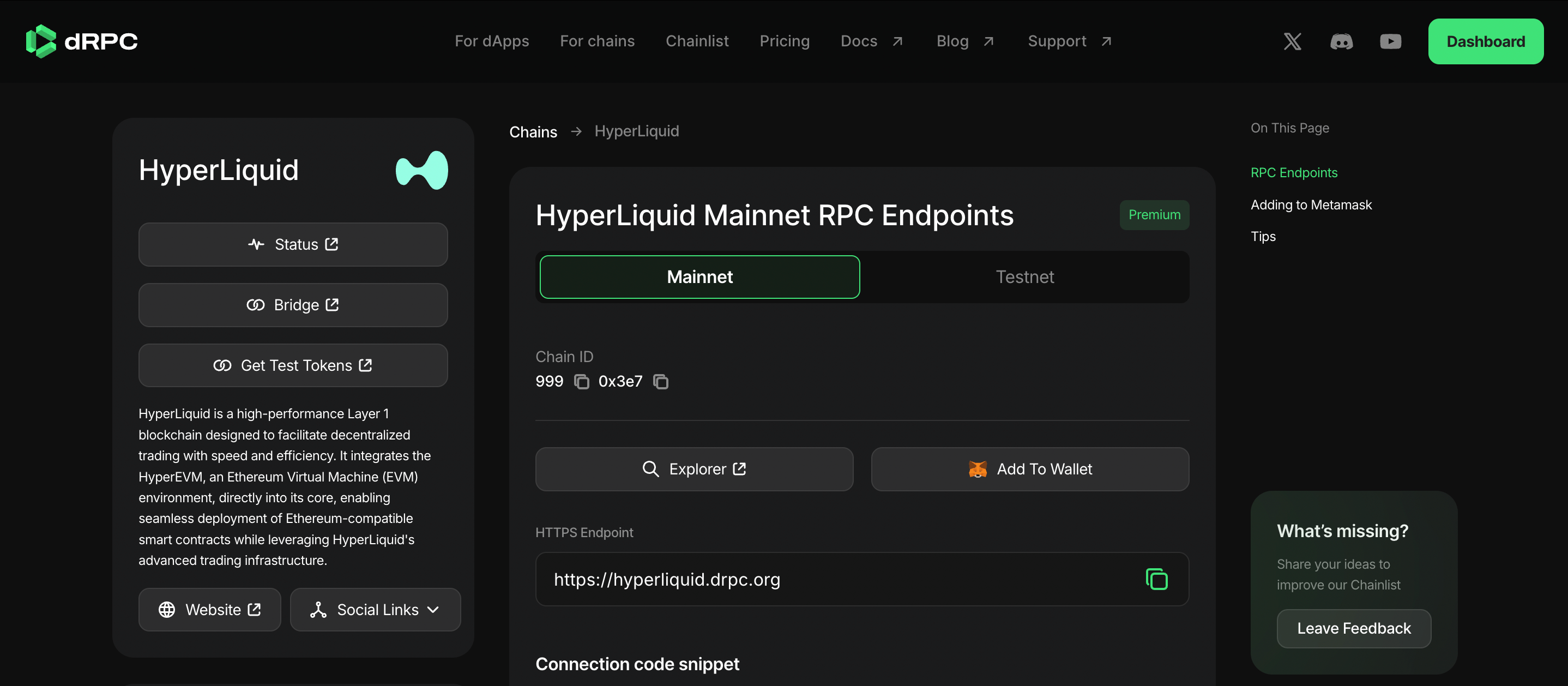
dRPC is one of the newer names in the industry, built around a decentralized model and supporting Hyperliquid from day one. Here, instead of a single backend, traffic is routed through a network of independent node operators, with an AI balancer deciding where each request goes.
With this setup, DRPC aims to combine redundancy with ease of use. That said, since the platform is still fairly new, there’s not a ton of long-term data yet on how it performs under constant production load. dRPC exposes HyperEVM archive and HyperEVM WebSockets; consult docs for any HyperCore streaming options.
How much does dRPC cost?
dRPC pricing is pretty simple, as you just pay for what you use.
- Free plan — $0/month, and runs between roughly 40 and 250 RPS, depending on network load.
- Premium plan — $6 per 1M requests, flat rate across all chains and methods.
- Volume discounts — Available for high-traffic users.
It’s a good setup if you’re testing or ramping up a smaller Hyperliquid project. However, teams already in production may prefer something with defined quotas and guaranteed support.
Performance on Hyperliquid with dRPC
dRPC’s setup moves traffic across seven regional clusters, sending each call to whichever node is both close and under-loaded. That system helps balance speed and consistency across a decentralized network. So you can generally expect:
- Throughput: Up to 5,000 RPS per endpoint on premium plan.
- Latency: Routing that automatically favors the fastest available node.
- Uptime: Uptime that’s strong in practice, though detailed SLAs aren’t public yet.
- Scalability: No fixed rate limits on premium, with unlimited API keys.
- Infrastructure: Built-in redundancy, so if one node stalls, another picks up the load.
Pros & cons of dRPC
| 优点 | 缺点 |
| Flat $6-per-million pricing that keeps billing simple | Still a new platform without long-term reliability data |
| Handles heavy loads (up to ~5K RPS) with no fixed quotas | No broader dev tools like webhooks or indexing |
| Decentralized routing provides automatic failover | Support is community-based, and Hyperliquid-specific docs are limited |
In short, dRPC is a flexible choice for builders who want raw RPC access and are open to using a newer service that’s still proving itself.
HypeRPC
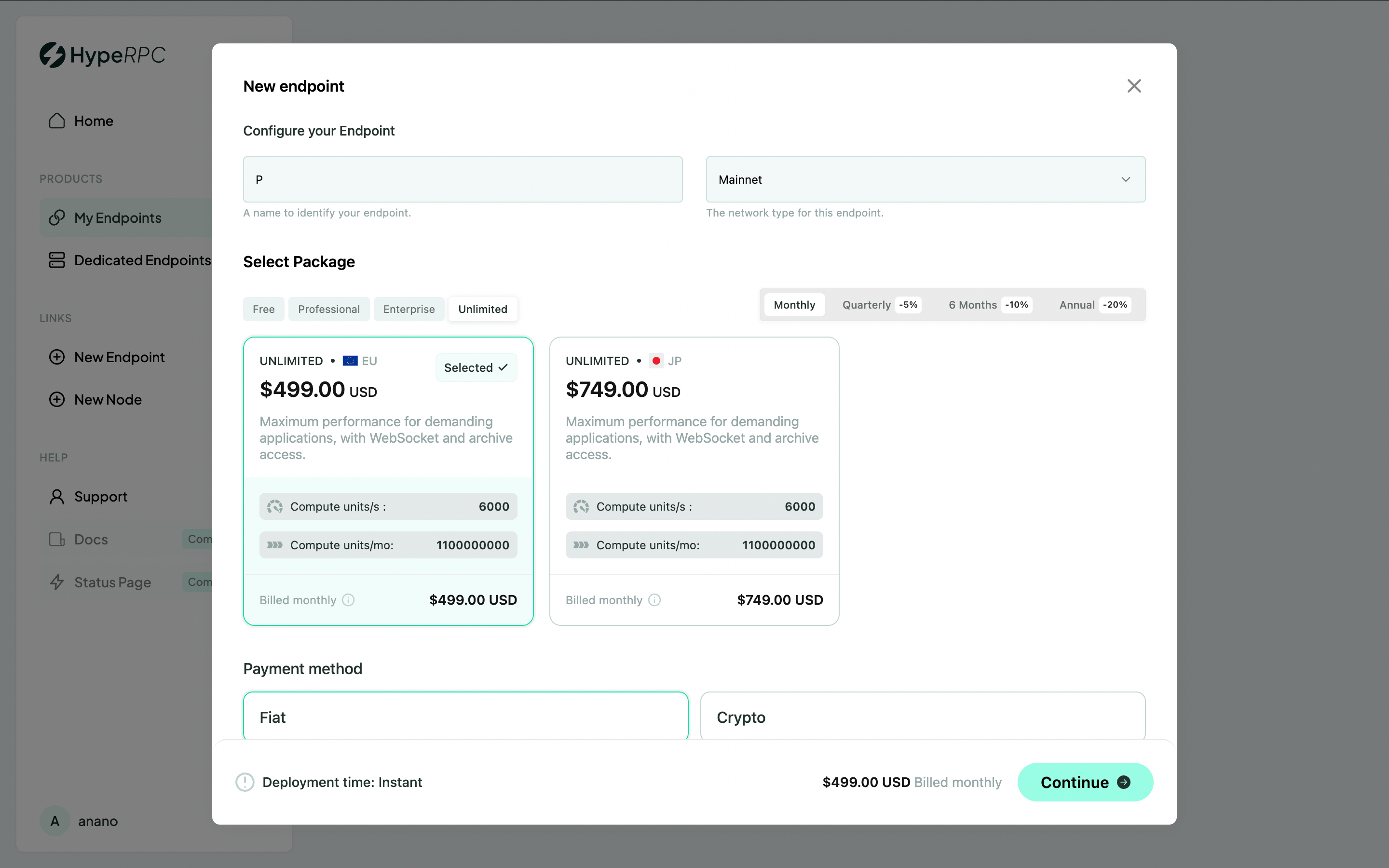
HypeRPC is a bit different from most RPC providers, as it’s built solely for Hyperliquid. Everything in its setup, from caching layers to where servers sit, is tuned around this one network. The team works closely with Hyperliquid’s core devs, which likely helps them stay ahead on updates and performance tweaks.
You can pick between shared global endpoints or a dedicated setup that’s fully isolated. That focus pays off in raw speed, though it ties you to a single ecosystem. Therefore, it’s a great fit if you are all-in on Hyperliquid, but less ideal if you’re managing a stack that spans multiple chains. By default, HypeRPC covers HyperEVM archive and HyperEVM WebSockets; review HypeRPC docs for current HyperCore stream availability.
How much does HypeRPC cost?
With HypeRPC you get plans that are focused on performance over high quotas and sit at the premium end of the market:
- Starter — Free, 10K requests/month, 5 RPS.
- Professional — $99/month, 1M requests, 50 RPS.
- Enterprise — $299/month, 3M requests, 150 RPS.
- Unlimited — $499/month, 5M requests, 300 RPS.
- Dedicated nodes — Custom pricing with no hard caps.
There are no public overage fees; once you reach your plan’s limit, you’ll likely need to upgrade. The cost is higher compared to general RPC providers, but it reflects HypeRPC’s focus on one network and its optimized setup for Hyperliquid.
Performance on Hyperliquid with HypeRPC
Since HypeRPC is built only for Hyperliquid, its servers sit close to the chain’s validators, trimming latency to almost nothing. It’s designed for fast, continuous trading workloads rather than casual testing so you’ll notice:
- Uptime: 99.99% uptime.
- Latency: Very low latency from regional nodes in Europe and Japan.
- Scalability: Enough headroom to handle short market spikes or steady high-frequency traffic.
- Visibility: A live dashboard that lets you watch latency and request counts in real time.
- Security: Enterprise-grade DDoS protection and routing safeguards for live trading environments.
Pros & cons of HypeRPC
| 优点 | 缺点 |
| Everything runs close to the network’s validators, so latency stays low and updates land fast | Plans start high for what’s included, with 1–5M monthly calls that can run out quickly on data-heavy bots or analytics pipelines |
| Solid uptime and smooth scaling during trading spikes | Only EU and JP regions are available for now, which can add latency for users in other parts of the world |
| WebSockets, archive data, and responsive support are available, making it easy to monitor and react in real time | It’s new and focused only on Hyperliquid, so teams running multi-chain systems might need another provider |
HypeRPC gives you exactly what you’d expect from a Hyperliquid-only provider: speed, uptime, and a setup tuned for trading workloads. It’s a strong pick if your whole stack runs on Hyperliquid and you care about every millisecond. But if you’re running multi-chain systems or want broader flexibility, pairing it with another provider might make more sense.
Dwellir

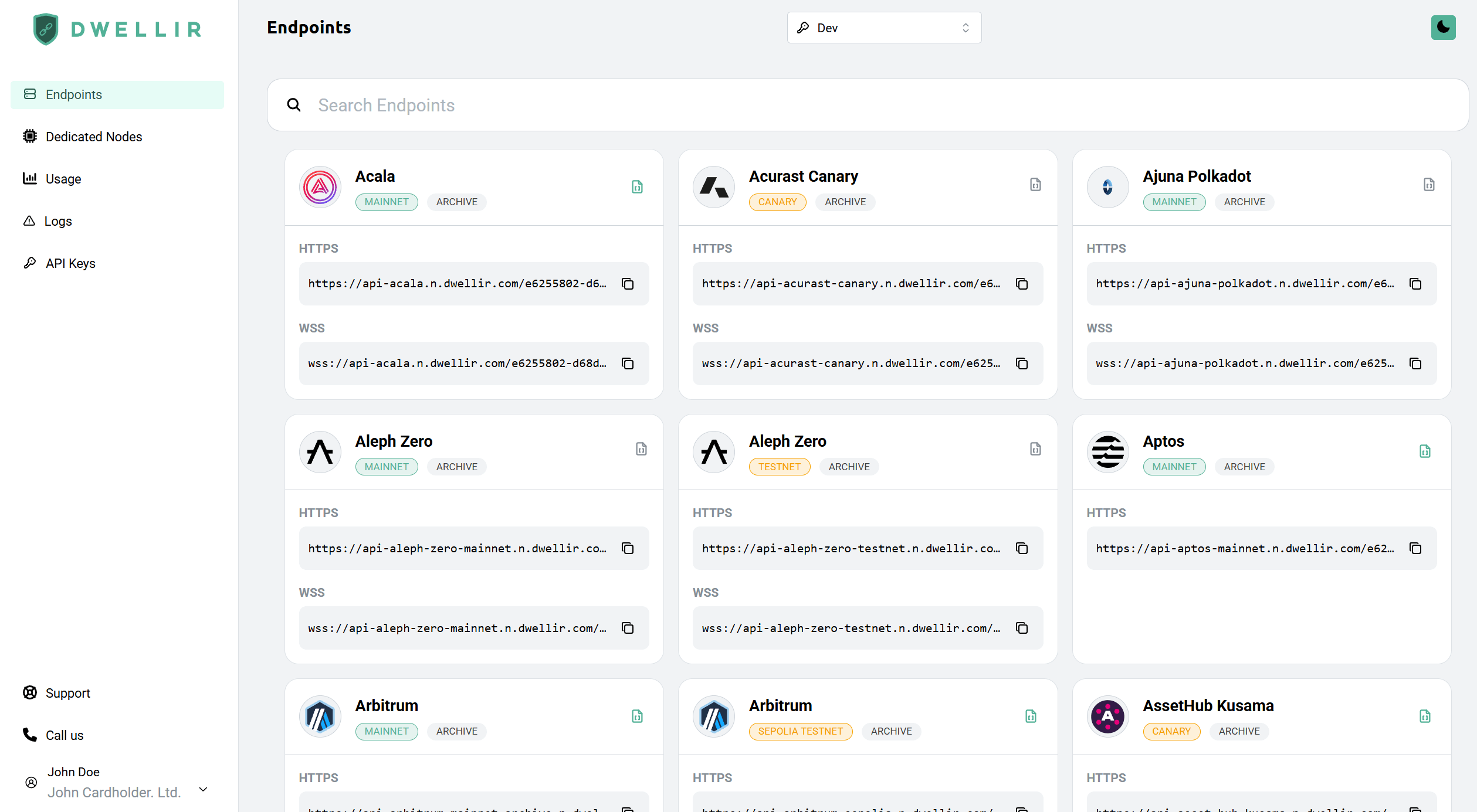
Dwellir, known for its work in the Polkadot ecosystem, offers both shared HyperEVM endpoints and dedicated Hyperliquid RPC nodes. Each user gets their own managed node by Dwellir’s team.
That setup means you’re not competing for bandwidth with anyone else, which helps keep performance the same. Additionally, you get shared endpoints for quick integration and gRPC for L1 data streaming. However, the trade-off comes on the pricing side as Dwellir does not offer a recurring free tier, its RPS limits are lower than some competitors at comparable price points, and if your stack needs advanced infrastructure features, that would be an extra lift.
How much does Dwellir cost?
With Dwellir, there’s no free monthly tier, though you can start on shared endpoints. Dedicated nodes are available as well when you need isolated infrastructure, so it’s a good pick if you’re prioritizing stable performance, predictable behavior, and higher throughput than what shared plans can usually handle.
- Starter — $5, 20 RPS, 500k/day cap.
- Developer — $49/mo, 100 RPS, 25M API responses/month.
- Growth — $299/mo, 500 RPS, 150M API responses/month.
- Scale — $999/mo, 2000 RPS, 500M API responses/month.
Performance on Hyperliquid with Dwellir
Dwellir supports shared endpoints for quick starts and dedicated nodes for isolated performance. On dedicated, your traffic is fully isolated; on shared, you run within plan rate limits.
- Throughput: Plan-based, scales up to 2,000 RPS, though higher limits are available on request.
- Latency: Solid on dedicated, though real-world response times may vary depending on your region.
- Real-time data: HyperCore gRPC streaming for order-book and trade events, plus HyperEVM WebSockets for contract events.
- Monitoring: A dashboard where you can check metrics and stats, plus a public status page.
Pros & cons of Dwellir
| 优点 | 缺点 |
| Shared and dedicated options available | No free or test tier |
| Usage/latency visibility in dashboard and public status page | Fewer built-in platform features |
| Includes gRPC streaming for order-book and trade data in real time | Pricing is quota & RPS based, unmetered-in-tier options unavailable |
If you need Hyperliquid with built-in gRPC L1 streaming and the option to move to a dedicated node for full isolation, Dwellir is a nice pick. Just be aware that there’s no free monthly tier, and RPS limits at the lower plan tiers are lower than what some competitors offer at the same price point.
How to get a Hyperliquid RPC
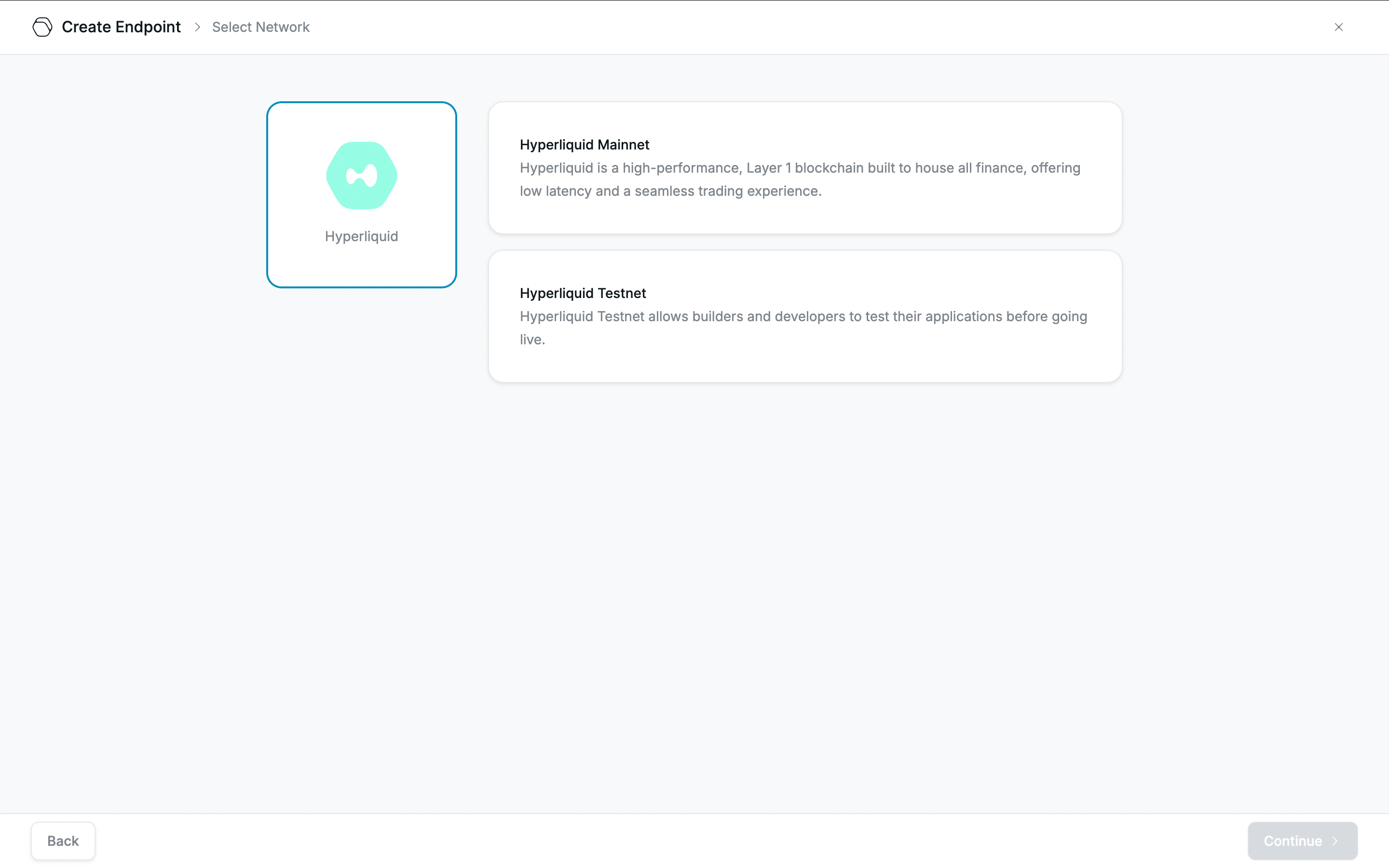
There are several ways to connect to Hyperliquid, and the right RPC setup depends on your workload and performance requirements. If you want something reliable, quick to set up, and with extras like a faucet and archive data, Chainstack is a good place to start. You can spin up a private Hyperliquid RPC in minutes and start building right away in a few clicks:
- Log in to your Chainstack account (or create one if you don’t have it yet).
- Create a new project or select an existing one.
- Pick Hyperliquid as the network and choose mainnet or testnet.
- Deploy a node configured for RPC access.
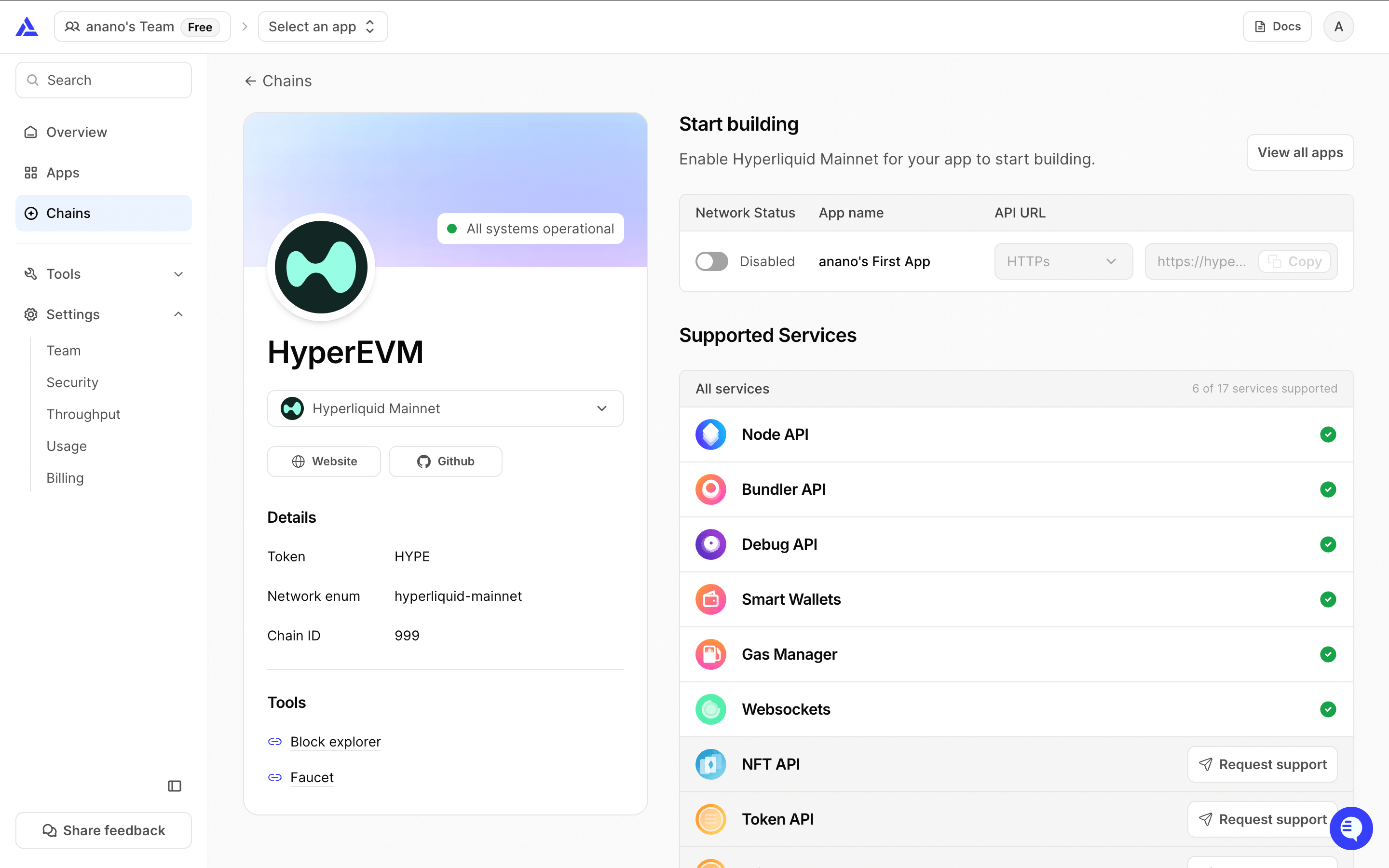
- Once deployed, you’ll find your private RPC URLs, including /evm and /info, in the dashboard.

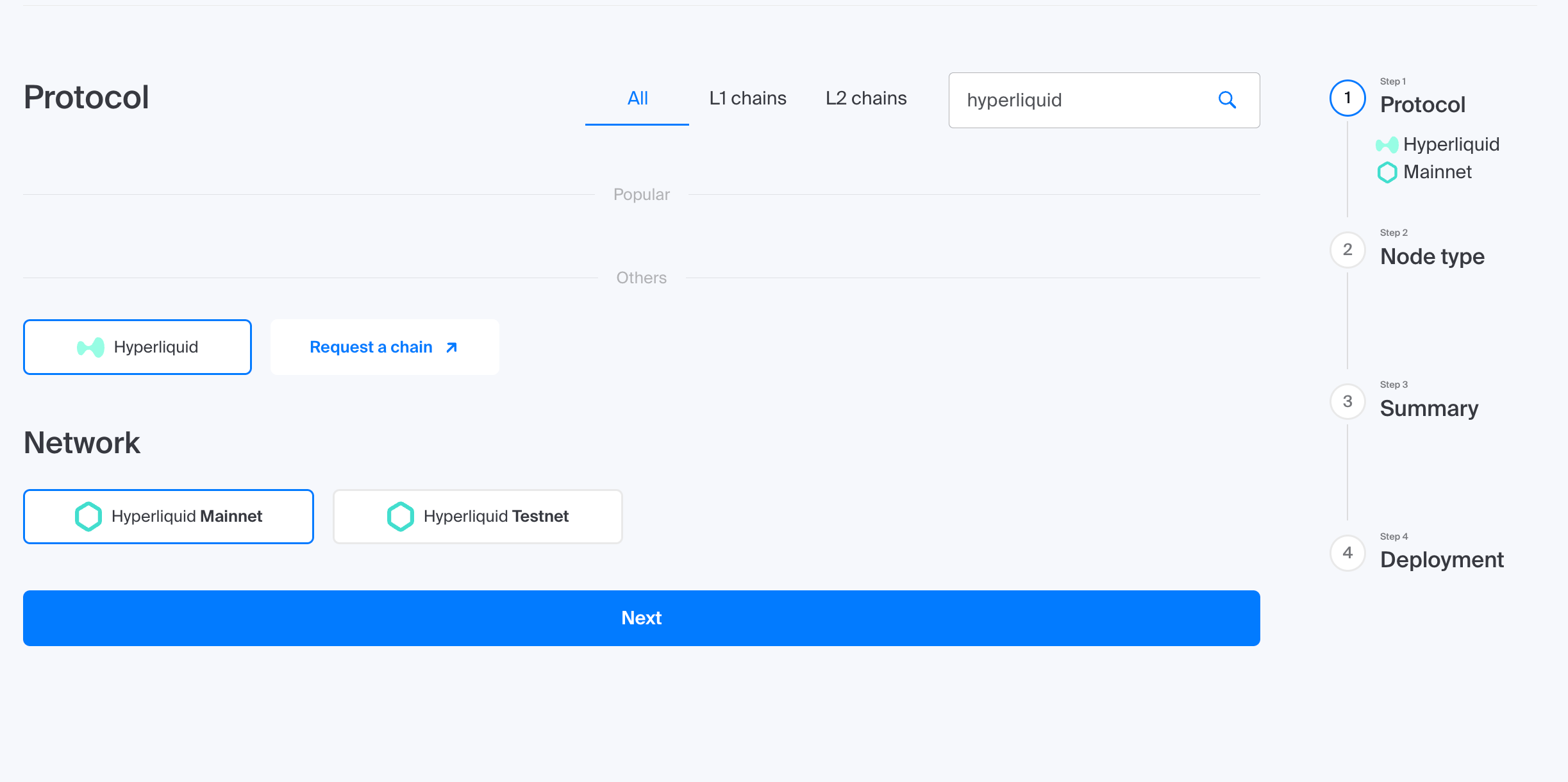
For more details, you can check our How to get a Hyperliquid RPC endpoint guide
Choosing the right Hyperliquid RPC provider
The Hyperliquid RPC landscape in 2026 has matured into a competitive space shaped by production trading, automated strategies, and latency-sensitive applications. As real volume and on-chain execution scale, RPC infrastructure becomes a defining factor not only for reliability and execution quality, but also for enterprise-grade requirements like predictable performance, isolation, and operational stability.
Chainstack offers the most balanced option overall, combining private HyperEVM and HyperCore access, predictable pricing, global and dedicated deployments, and a full set of Hyperliquid-specific tools. This makes it a strong fit for teams running trading bots, smart contracts, and production workloads that need consistent performance under sustained load.
HypeRPC stands out for teams fully committed to Hyperliquid, prioritizing ultra-low latency and proximity to validators for live trading environments. QuickNode and Alchemy provide solid multi-chain platforms with familiar tooling, while dRPC and Dwellir offer alternative approaches for teams optimizing around cost, decentralization, or dedicated infrastructure.
In 2026, choosing the right Hyperliquid RPC provider is less about basic connectivity and more about execution reliability at scale. Teams that invest early in stable, production-ready infrastructure are better positioned to operate as Hyperliquid continues to grow as a trading-first network.
Recommended reading
If you want to go deeper into the Hyperliquid ecosystem and start building production-ready trading systems, we also recommend checking out the following guides:
- What is Hyperliquid? — an overview of Hyperliquid’s architecture.
- How to build a Hyperliquid trading bot — a step-by-step guide to set up and wire a trading bot.
- Hyperliquid On-Chain Activity Tracker — build automated alerts with Hyperliquid RPC.
- Mastering Hyperliquid — guides to Hyperliquid APIs, authentication, and trading.
Reliable Hyperliquid RPC infrastructure

Getting started with Hyperliquid on Chainstack is fast and straightforward — deploy a reliable node in seconds through an intuitive console, no hardware or complex setup required.
- Private HyperEVM and HyperCore access
- Built-in faucet for testnet HYPE
- Archive data and WebSocket support
- 99.99% uptime SLA
常见问题解答
A Hyperliquid RPC endpoint lets your app, bot, or contract talk directly to the Hyperliquid blockchain. It’s how you read on-chain data, submit transactions, or listen to live events through HyperEVM or HyperCore.
Yes. Hyperliquid offers a free public RPC. Some methods — especially trading-related ones — are proprietary and available only there. Rate limits vary by method, with several capped near ~100 requests/min.
Public RPCs are shared and rate-limited. They also include proprietary HyperCore endpoints like l2Book, placeOrder, cancelOrder,以及 recentTrades that are not exposed by third-party providers. Private RPCs reserve bandwidth for you and cover HyperEVM plus non-proprietary HyperCore info, but they do not replace public-only DEX methods.
It depends on your use case. If you want a multi-chain platform with predictable pricing and extras like a faucet and archive data, Chainstack is a strong starting point. For specialized setups, other providers might fit specific workloads.
You can use Chainstack’s Hyperliquid faucet to grab HYPE tokens, deploy a testnet node, and connect through your private RPC URL in seconds, ideal for quick experiments before going live.
The best Hyperliquid RPC providers for trading bots offer low latency, predictable throughput, and stable WebSocket connections. Providers like Chainstack and HypeRPC are commonly chosen for production trading workloads in 2026.