


Hyperliquid has become one of the fastest-growing trading and execution environments in 2026. Its high throughput, native order book design, and HyperEVM compatibility make it attractive for trading bots, on-chain funds, and real-time applications.
But performance alone does not determine your infrastructure choice. As request volume grows, RPC costs can quickly become a material part of your operating budget. Credit-based pricing, overage fees, RPS caps, and archive access all impact your total cost of ownership.
The public Hyperliquid RPC works for testing, but rate limits and method restrictions make it unsuitable for sustained production workloads. Moving to a private provider improves reliability and performance, yet pricing models vary significantly—and small differences compound at scale.
This guide compares the most cost-effective Hyperliquid RPC providers in 2026. Instead of focusing only on speed and uptime, we analyze pricing structures, included quotas, scaling economics, and overage models to help you choose the right provider for your budget and workload.
What “Hyperliquid RPC” includes: HyperEVM vs HyperCore
In practice, Hyperliquid access involves two distinct layers that get conflated frequently:
HyperEVM
The EVM layer exposed through standard JSON-RPC (eth_* methods), with mainnet chain ID 999 and the official public endpoint at https://rpc.hyperliquid.xyz/evm. This is what most teams mean when they say “Hyperliquid RPC.”
HyperCore
The trading and market data layer, exposed through HTTP endpoints like /info for market state and /exchange for signed trading actions.
The distinction matters because some providers support only HyperEVM while others expose both. It also creates a common pattern where teams end up with a dual setup: one provider for HyperEVM RPC and a separate path — either the official Hyperliquid API or a specialized provider — for HyperCore trading endpoints.
⚠️ Worth noting: while Chainstack supports both HyperEVM and HyperCore, a small number of trading actions — such as
Place order— still require the official Hyperliquid API directly. For the full list of supported methods, see Chainstack’s Hyperliquid documentation.
Why is private Hyperliquid RPC required for production
The public Hyperliquid infrastructure is adequate for development and testing. For production, it has hard limits that quickly become blockers:
- WebSocket connection and subscription limits
- Message rate limits
- 100 requests/minute on the HyperEVM JSON-RPC endpoint
- No WebSocket JSON-RPC support on
rpc.hyperliquid.xyz/evm
Production bots, indexers, and anything latency-sensitive will need private infrastructure. The relevant questions then become: how much does private RPC cost at the volumes you actually need, which pricing models are predictable under load, and where do add-ons change the total cost of ownership significantly.
Hyperliquid RPC provider comparison
| 服务提供商 | Best fit | 定价模式 | Main pricing risk |
|---|---|---|---|
| Chainstack | Predictable high-throughput workloads with HyperEVM + HyperCore support | RU bundles + overage; optional flat-fee RPS | Archive requests cost more; high-RPS tiers can be expensive |
| QuickNode | Unified HyperEVM + HyperCore stack | Credits model | Advanced APIs and large calls multiply cost quickly |
| Alchemy | Moderate-volume teams using broader tooling | 计算单元 | Heavy methods like logs and trace increase CU burn |
| dRPC | Simple PAYG or backup routing | Flat $/1M requests | Free tier uses public nodes only |
| HypeRPC | Hyperliquid-specific niche workloads | 计算单元 | WebSocket billed by byte; regional price surcharges |
Hyperliquid RPC specs and pricing overview
| 服务提供商 | 免费套餐 | Overage / PAYG | Throughput | Protocols | Uptime SLA | Compliance |
|---|---|---|---|---|---|---|
| Chainstack | Yes — 3M RU | From $20/M RU (free tier); lower on paid plans | 25–600 RPS by plan; Unlimited Node 25–500 RPS | HTTP, WS, full + archive | ≥99.99% formal SLA; 99.99%+ claimed for dedicated Hyperliquid | SOC 2 第二类 |
| QuickNode | Trial only | Overage by credits | ~50–500 RPS by plan | HyperEVM + HyperCore; HTTP/WS/gRPC | 99.99% claimed | SOC 1 Type 2, SOC 2 Type 2, ISO/IEC 27001 |
| Alchemy | Yes — 30M CU | $0.45/M CU to 300M, then $0.40/M | Throughput in CU/s | HTTP, WS | 99.99% referenced | SOC 2 第二类 |
| dRPC | Yes — 210M CU on public nodes | $6 per 1M requests | Free 100 RPS; Growth 5K RPS | HTTP, WSS | 99.99% claimed on Growth | Not prominently published |
| HypeRPC | Yes — 2M CU | $0.50/M CU (EU); $0.75/M CU (JP) | 100–6000 CU/s by plan | WebSocket + archive | 99%–99.99% by plan | Not prominently published |
Cost per 1M requests: 100K vs 5M vs 200M workloads
The table below normalizes each provider to a comparable effective cost using each provider’s public documentation and consistent assumptions.
| 服务提供商 | 100k req/month | 5M req/month | 200M req/month |
|---|---|---|---|
| Chainstack | $0 / $0.00 per 1M | $49 / $9.80 per 1M | $990 / $4.95 per 1M |
| QuickNode | $49 / $490.00 per 1M | $61.25 / $12.25 per 1M | $1,999 / $10.00 per 1M |
| Alchemy | $0 / $0.00 per 1M | $56.25 / $11.25 per 1M | $2,015 / $10.08 per 1M |
| dRPC | $0 / $0.00 per 1M | $0 / $0.00 per 1M | $1,200 / $6.00 per 1M |
| HypeRPC | $0.25 / $2.50 per 1M | $61.50 / $12.30 per 1M | $2,449 / $12.25 per 1M |
How to read these numbers
A $0 result means the workload fits inside a free tier — not that it is production-ready. Free tiers typically come with public nodes, no SLA, and no operational guarantees. They are appropriate for development, not for live trading infrastructure.
For CU/credit-based models, actual cost depends heavily on your method mix. The figures above assume average workloads. A logs-heavy or trace-heavy pipeline will cost materially more with CU-weighted providers. At high volume, flat-fee and simple-billing models become meaningfully easier to forecast and budget.
❓ Compare plans and providers using Chainstack’s interactive pricing calculator: chainstack.com/pricing
Visual cost comparison

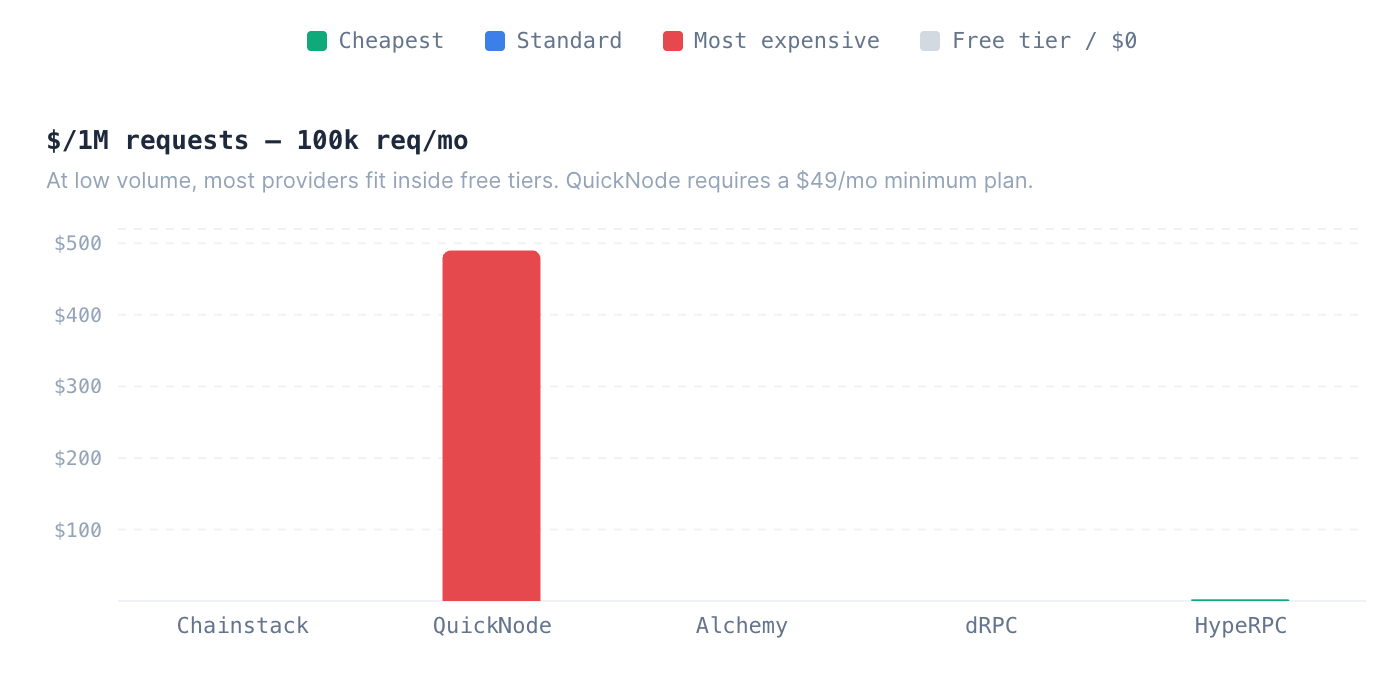
QuickNode requires a paid plan even at minimal volume — $490/1M effective cost vs $0 for everyone else.

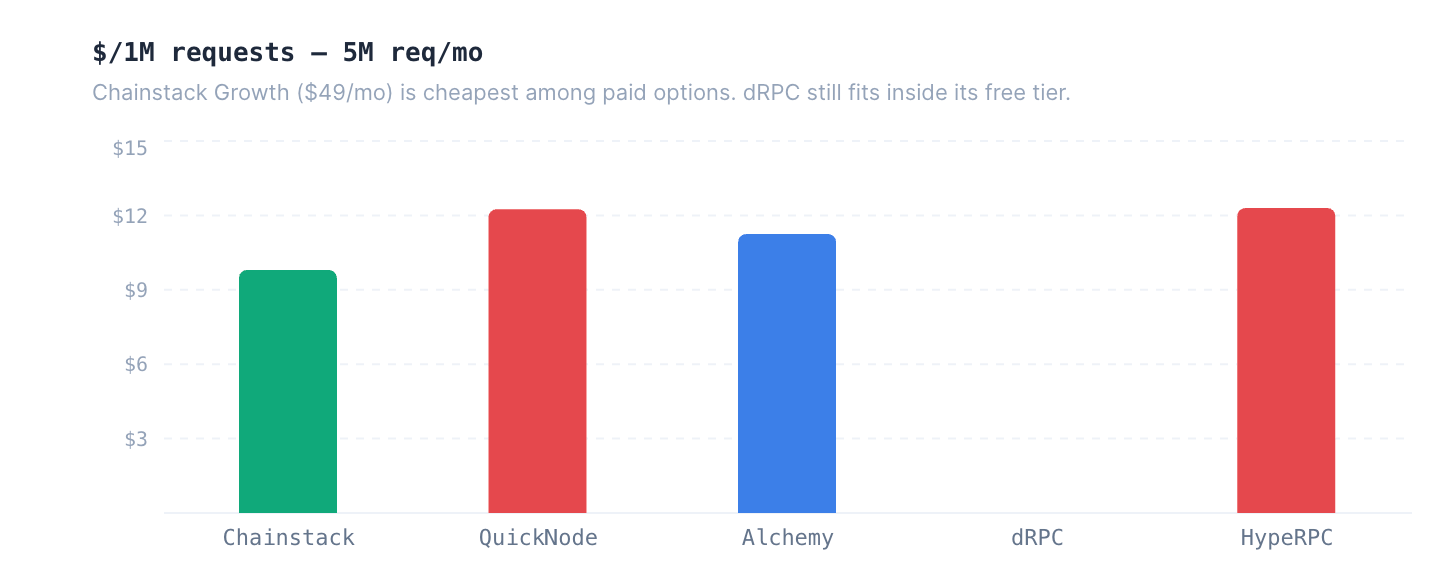
At 5M requests/month, Chainstack at $9.80/1M is the only production-grade option with a formal SLA. dRPC’s $0 uses public nodes — no uptime guarantees.

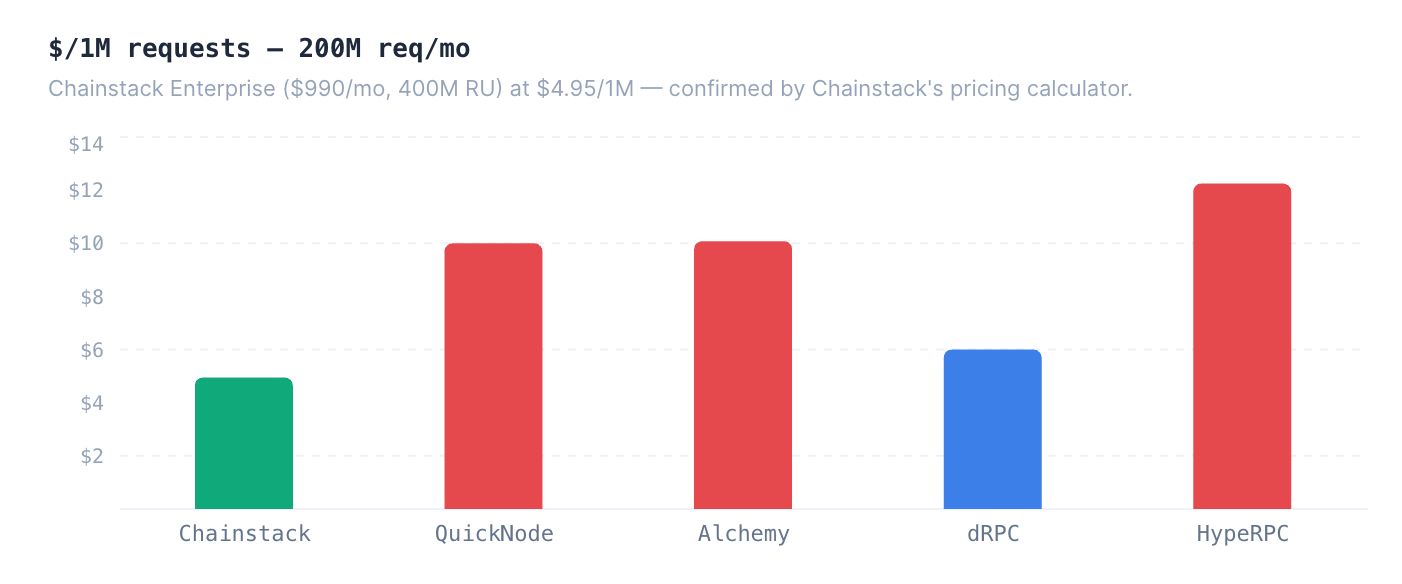
Chainstack at $4.95/1M is the clear cost leader. HypeRPC at $12.25/1M is the most expensive option.
服务商分类
Chainstack

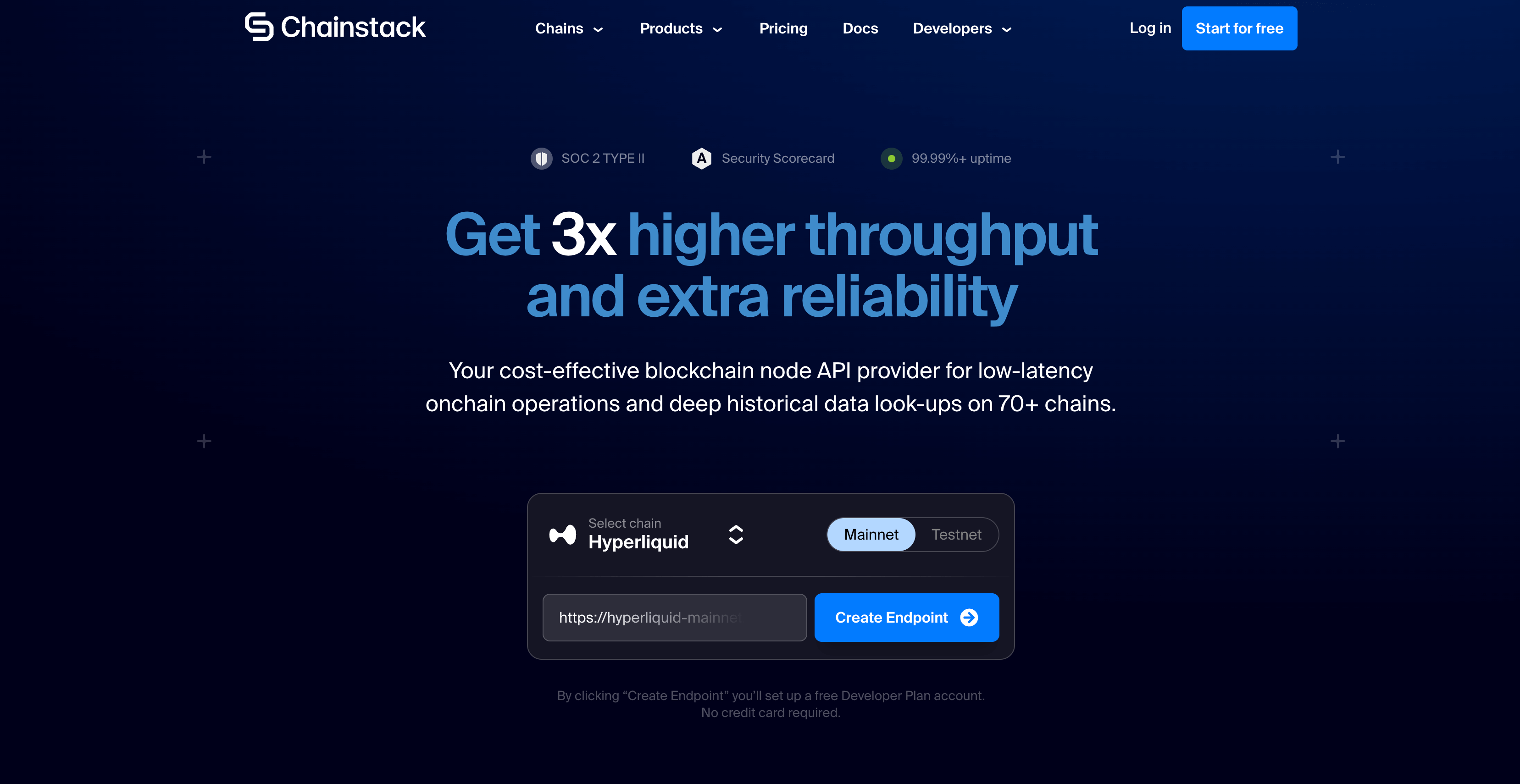
Chainstack supports both HyperEVM and HyperCore. It is one of the strongest options for teams that need predictable pricing under sustained load.
Billing uses request units (RUs): 1 RU per full-node request, 2 RU per archive. The plan ladder runs from Developer (free, 3M RU) through Growth ($49/mo, 20M RU), Pro ($199/mo, 80M RU), and Business ($499/mo, 200M RU) up to Enterprise ($990/mo, 400M RU). Overage rates drop as you scale — from $20/M RU on Developer down to $5/M RU on Enterprise. For 200M requests/month, Enterprise at $990 flat is the best-value option — 400M RU included, no overage needed, and the $4.95/1M effective rate is confirmed by Chainstack’s own pricing calculator.
The SLA is formal and documented — 99.99% baseline, with 99.99%+ claimed for dedicated Hyperliquid nodes. SOC 2 Type II compliance is published, which matters for teams with procurement requirements.
⚠️ Worth knowing: Chainstack supports both HyperEVM and HyperCore. A small number of trading actions — such as
Place order— still require the official Hyperliquid API directly. For the complete list of supported methods and endpoints, see Chainstack’s Hyperliquid documentation.
Best fit: production workloads that need stable throughput, predictable invoices, and a formal compliance posture.
QuickNode


QuickNode’s strength is breadth. It has strong coverage across both layers HyperEVM and HyperCore, with HTTP, WebSocket, and gRPC protocols supported and Hyperliquid-specific streaming endpoints available.
The cost trade-off is real, though. Standard Hyperliquid requests count at 20 credits each, which means the effective request capacity of each plan is lower than it looks. Advanced APIs and large call responses apply 2x to 4x multipliers on top. At scale, QuickNode is noticeably more expensive per 1M requests than Chainstack.
Best fit: teams that want a single vendor for the full Hyperliquid stack and where that consolidation genuinely offsets the higher per-request cost.
Alchemy

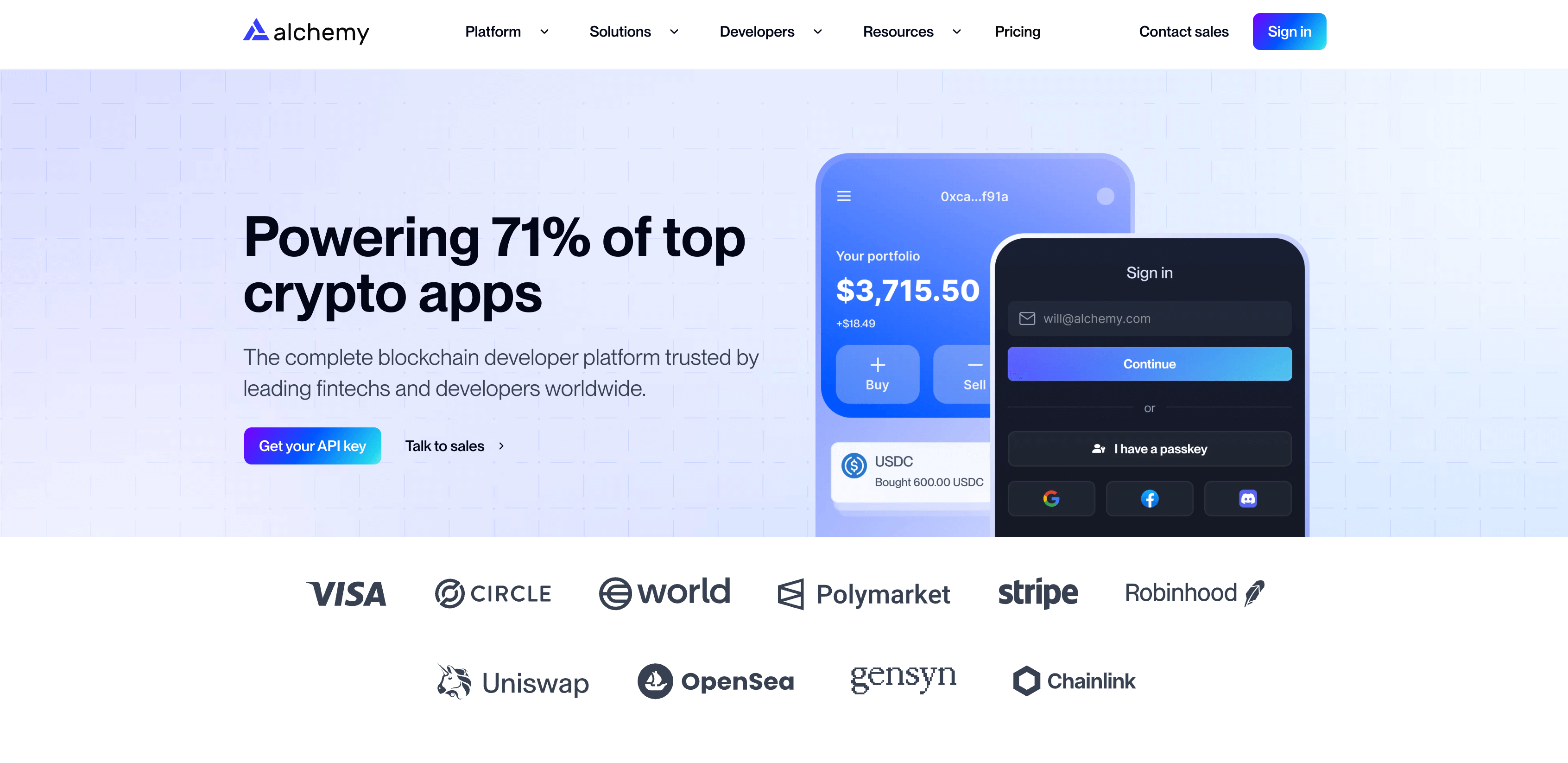
Alchemy is the familiar choice for teams that already use it for other EVM chains. Its tooling is mature and its plan tiers are clearly structured.
The pricing risk is method weighting. Alchemy explicitly states that one API request averages around 25 CUs, but specific methods vary considerably — eth_blockNumber costs 10 CU while eth_getLogs costs 60 CU. A workload heavy on log queries or debug/trace methods can burn through CUs much faster than headline pricing suggests.
Best fit: teams already embedded in the Alchemy ecosystem at moderate scale where the broader platform (enhanced APIs, webhooks, NFT tools) provides additional value.
⚠️ Understanding credit-based pricing
Some providers, including Alchemy and QuickNode, charge per credit or compute unit (CU) rather than per request.
A single JSON-RPC call may consume multiple credits depending on complexity. Archive reads, tracing, and WebSocket usage typically consume more than simple calls.
As a result, cost per million requests is variable and depends on method mix and workload profile. Flat per-request pricing models are generally more predictable for high-volume systems.
dRPC

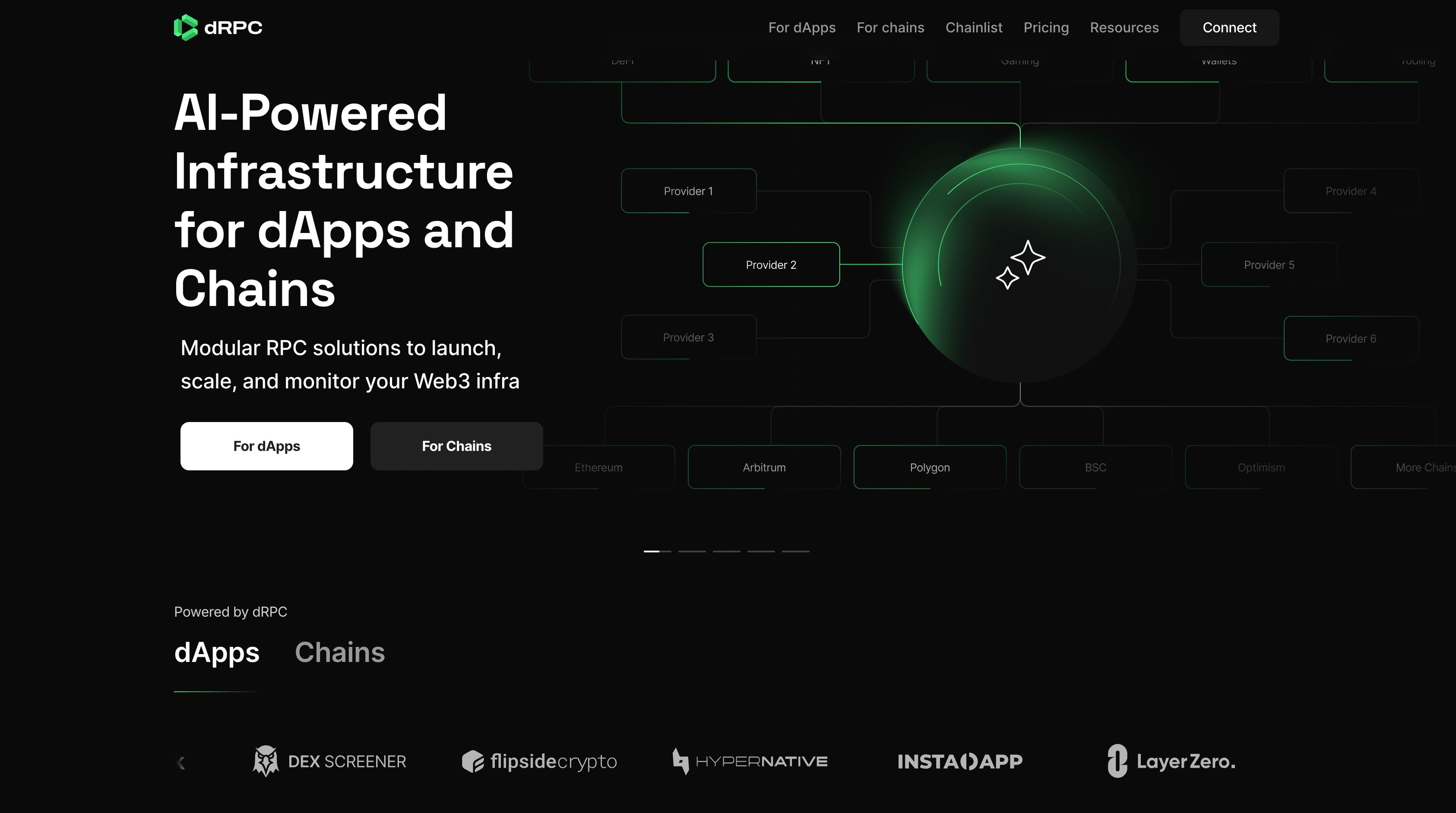
dRPC offers the simplest pricing model in this comparison: a flat $6 per 1M requests. There is no CU math, no method multipliers, and no credit translation required.
The caveat at the free tier is meaningful — it routes through public nodes, which is unsuitable for production. The Growth tier offers up to 5,000 RPS, which covers most scaling scenarios. Compliance documentation is not prominently published on the pricing page, so it requires direct validation if that matters for your procurement process.
Best fit: PAYG use cases, backup provider setups, and teams that prioritize billing simplicity over the absolute lowest unit cost.
HypeRPC

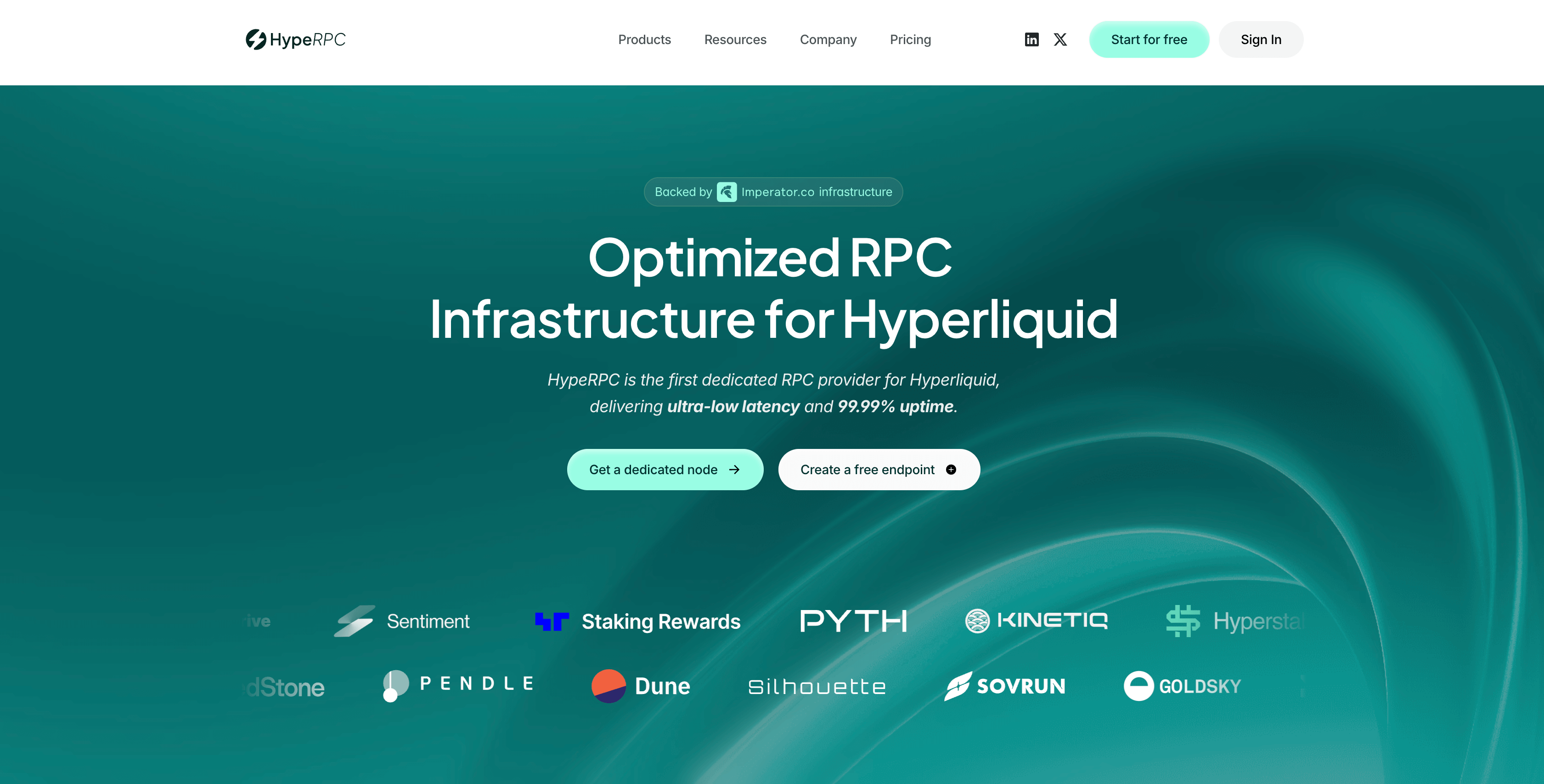
HypeRPC is positioned as a Hyperliquid-specialist provider. That specialization has a cost premium under published pricing — it is the most expensive option in this comparison at the 200M request/month tier.
Two pricing complications set it apart from other CU-based models. First, the Japan region carries a 50% pricing surcharge relative to EU. Second, WebSocket traffic is billed at 0.02 CU per byte, which can be material for real-time systems handling frequent snapshots or large order book updates.
Best fit: teams for whom Hyperliquid-specific expertise or geographic positioning is worth a higher per-request cost. Not recommended as a primary cost-optimization path.
Hidden cost factors in Hyperliquid RPC pricing
The headline pricing table is a starting point. These factors frequently change the real number in production.
- Method weighting — Logs, trace, debug, and large response calls can increase effective cost by 2–6× compared to a reads-only workload at the same raw request count. This is the biggest wildcard for CU-based models.
- Archive multipliers — Some providers charge more for historical state requests. At Chainstack, archive requests cost 2 RU instead of 1 RU — predictable, but worth factoring in for archive-heavy pipelines.
- Throughput ceilings — A provider that looks cheap at your request volume may push you into a significantly more expensive tier once your required RPS is factored in.
- WebSocket billing — Most providers bundle WebSocket usage inside broader plans. HypeRPC bills by byte — 0.02 CU/byte — which can create significant variability for streaming-intensive systems.
- HyperCore add-ons — Order book data, trading endpoints, and streaming market data are separate products at several providers and should be evaluated as explicit line items.
- Free-tier realism — Free tiers usually come with public nodes, no SLA, and throughput limits that make them unsuitable for live systems.
Best Hyperliquid RPC provider by use case
- Predictable high-throughput pricing → Chainstack. The Enterprise plan at $990/mo covers 400M RU with no overage risk — the most predictable cost structure at scale. The formal SLA and SOC 2 compliance also make it the most defensible choice for teams with compliance requirements.
- Simple PAYG → dRPC. No CU math, flat rate, high advertised throughput on paid tiers. The cleanest option for teams that want straightforward invoicing.
- Unified HyperEVM + HyperCore platform → Chainstack or QuickNode. Chainstack supports both layers with a formal SLA and SOC 2 compliance. QuickNode is also a strong option if you need gRPC or Hyperliquid-specific streaming endpoints and are willing to pay a higher per-request cost.
- Ecosystem tooling at moderate scale → Alchemy. Best for teams already using Alchemy across other chains where the broader platform value is real.
- Hyperliquid specialization → HypeRPC. Niche choice for teams where that focus is the priority. Not a cost-optimization path.
决策框架
A practical way to narrow your choice:
- Determine which layers you need. HyperEVM only, HyperCore only, or both? The answer immediately filters several providers.
- If you need HyperCore, validate the exact endpoint coverage for each provider before committing. Some trading actions require the official Hyperliquid API regardless of your primary RPC provider.
- Estimate your request volume and method mix. CU-weighted pricing can be 2–6x more expensive for logs-heavy workloads than for simple reads. Always model your actual method distribution.
- Check your required RPS. A provider that looks cheap at your request count may push you into a significantly more expensive plan tier once throughput constraints are applied.
- At 100M+ requests/month, prioritize providers with flat-fee RPS models, low overage rates, or simple per-request billing. Compute-based models become harder to forecast and more expensive at scale.
- Validate compliance requirements early. Not all providers publish SOC 2 or ISO certifications prominently. If this matters for procurement, confirm it directly and do not rely on marketing pages.
结论
At high volume with predictable billing and a formal compliance posture, Chainstack is the strongest option — the Enterprise plan at $4.95/1M locks in predictable costs without overage exposure.
For simple pay-as-you-go economics without compute math, dRPC is the cleanest option. For teams that need the full Hyperliquid stack in a single platform, QuickNode can justify higher per-request cost. Alchemy remains viable for teams already using it across other chains, while HypeRPC is best treated as a specialist option rather than a cost leader.
One point holds across all scenarios: the public Hyperliquid RPC is a development tool, not a production one. Once volume, latency sensitivity, or operational requirements increase, provider economics matter fast — and the differences between these options at scale are large enough to be worth modeling before you commit.
可靠的Hyperliquid 基础设施

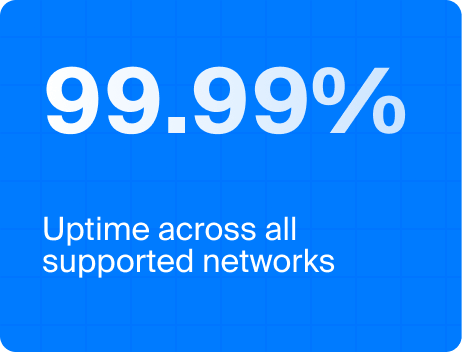
Getting started with Hyperliquid on Chainstack is fast and straightforward — deploy a reliable node in seconds through an intuitive console, no hardware or complex setup required.
- Private HyperEVM and HyperCore access
- 测试网 HYPE 的内置水龙头
- 存档数据和 WebSocket 支持
- 99.99% 正常运行时间服务水平协议 (SLA)
常见问题解答
根据已公布的自助服务定价,在每月2亿次请求的额度下,Chainstack 每100万次请求实际成本最低。
根据您优先考虑的是正式的SLA和合规性、最低成本的扩展能力,还是简单的按量付费(PAYG)计费模式,Chainstack 或 dRPC 都是最佳选择。两者均提供具备明确吞吐量保证的私有基础设施。
不适用于大多数生产环境的工作负载。官方 HyperEVM 端点的请求速率限制为每分钟 100 次,且不支持 WebSocket 和 JSON-RPC,因此不适合用于机器人、索引器或任何对延迟敏感的应用程序。
将其换算为每 100 万次请求的有效成本,然后根据您实际的方法分布进行调整。对于依赖日志、跟踪或调试方法的工作负载,在原始请求数量相同的情况下,基于计算单元 (CU) 的定价可能比简单的读取工作负载高出 3 到 5 倍。
Chainstack and QuickNode all support both layers. Chainstack explicitly documents HyperCore and HyperEVM support. QuickNode adds gRPC and streaming-specific endpoints. In all cases, validate exact endpoint coverage against current documentation — some trading actions, such as Place order, may still require the official Hyperliquid API.
推荐阅读
如果您希望更深入地了解Hyperliquid ,并开始构建可用于生产环境的交易系统,我们还建议您参考以下指南:
- What is Hyperliquid? — an overview of Hyperliquid’s architecture
- How to build a Hyperliquid trading bot — a step-by-step guide to set up and wire a trading bot
- Hyperliquid On-Chain Activity Tracker — build automated alerts with Hyperliquid RPC
- Mastering Hyperliquid — guides to Hyperliquid APIs, authentication, and trading
- Best Hyperliquid RPC providers — general comparison RPC providers by use cases