


Send sui_getLatestCheckpointSequenceNumber to the public Sui Foundation full node today and the reply is error -32601: JSON-RPC on public full nodes has been deprecated, migrate to gRPC or GraphQL. We ran that exact call against fullnode.mainnet.sui.io while writing this piece.
So what is Sui in October 2026? It is a Layer 1 that dropped the account-based state model, the EVM, and now its own first RPC interface, and in exchange got object-level parallelism, a language designed around assets, and a path where transactions touching only owned objects skip consensus. This guide covers how that design works, who built it, what is running on it, and what to know before pointing production traffic at it.
Short answer: Sui is a Layer 1 blockchain built by Mysten Labs that stores state as objects instead of accounts and runs smart contracts written in Move. Transactions declare their input objects up front, so those touching different objects run in parallel, and owned-object transactions skip consensus. Mainnet launched on May 3, 2023.
⏭ Skip ahead: if you are here for the infrastructure angle, jump to Getting RPC access to Sui.
What is Sui?
Sui is a Layer 1 blockchain that runs on delegated proof-of-stake and was built by Mysten Labs. The mainnet went live on May 3, 2023, as The Block reported at the time. The Sui architecture docs sum up the design in one sentence: every resource, asset, or piece of data onchain is an object.
Sui is not EVM-compatible, so there are no eth_* methods and no Solidity. Smart contracts are written in Move, and the mainnet is identified by the chain identifier 4btiuiMPvEENsttpZC7CZ53DruC3MAgfznDbASZ7DR6S, which every Sui node reports (we confirmed it against the public GraphQL endpoint). The supply of SUI is capped at 10 billion, and the token pays gas, backs staking, and carries governance votes, per the tokenomics docs.
How does the Sui object model work?
Ethereum keeps balances and contract storage under accounts. Sui stores state as objects instead, each with a unique ID, an owner, a version number that increases on every change, and the digest of the last transaction that touched it. The object model docs define the ownership types that matter in practice:
- Address-owned objects belong to one address and only its owner can use them. Coins and NFTs are typically owned this way.
- Shared objects are accessible to everyone and need ordering when several transactions touch them, such as a liquidity pool.
- Immutable objects are owned by no one and can never change, like a published package.
The payoff is in how transactions are declared. A Sui transaction lists every input object up front, so the network can run transactions with non-overlapping inputs in parallel, as the Sui Move docs explain. Programmable transaction blocks (PTBs) add composition on top: one transaction can chain up to 1,024 operations, later commands can consume earlier results, and if any command fails none of the effects apply. There are no loops inside a PTB; that logic lives in a published Move package.
Here is what an object looks like in Move. The key ability marks a struct as an object type, and the first field must be a UID:
module examples::box {
    public struct Box has key, store {
        id: UID,
        value: u64,
    }

    public fun new(value: u64, ctx: &mut TxContext): Box {
        Box { id: object::new(ctx), value }
    }
}
Move itself predates Sui: it ran on Meta’s Diem blockchain, where it used a 16-byte address type and global storage. Sui removed global storage and gave every object a never-reused identifier, and its bytecode verifier makes sure a new object always gets a fresh UID, according to the same docs page.
How does Sui consensus work? Mysticeti and the fast path
Transactions that touch only owned objects use a fast path and are finalized without going through consensus. Anything involving a shared object needs a global order, and that is the job of Mysticeti, a DAG-based consensus protocol in which multiple validators propose blocks in parallel. The consensus docs say it needs three rounds of messages to commit blocks, and report whitepaper benchmarks of about 0.5 seconds to commit at a sustained 200,000 TPS, with the caveat that these come from controlled tests and are not production metrics.
The current version is Mysticeti v2, described in a November 2025 post. It moves transaction validation into the consensus process, removing a pre-consensus step, and swaps the old Quorum Driver for a Transaction Driver that sends each transaction to one chosen validator instead of all of them. It became the default from Sui node v1.60. The post reports latency on Mysten and partner full nodes dropping about 35% in Asia (roughly 1.00s to 0.65s) and 25% in Europe (roughly 0.55s to 0.40s).

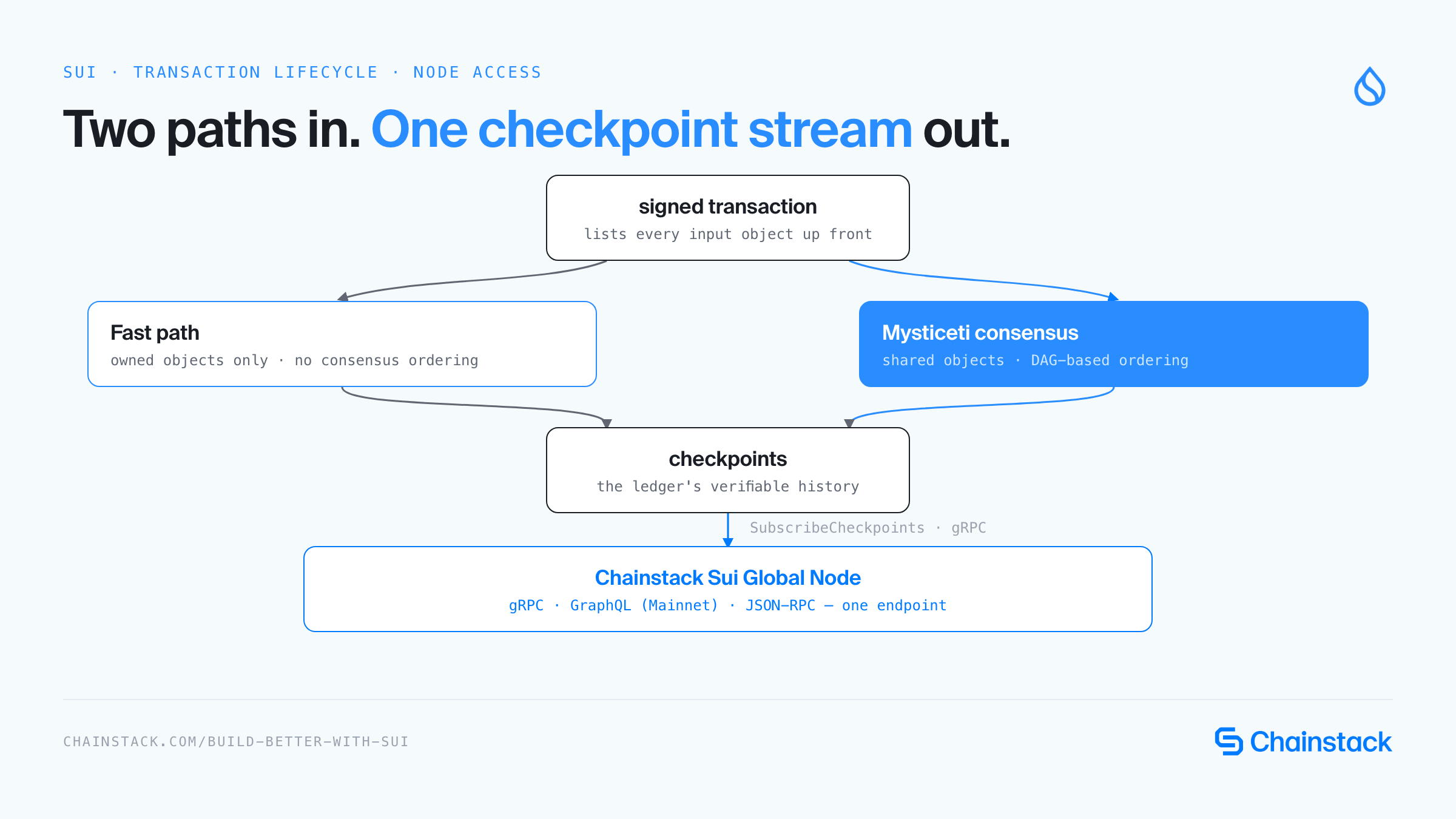
Time on Sui is divided into epochs of 24 hours, during which the validator set stays fixed, per the architecture and tokenomics docs. We checked the live state through the public GraphQL endpoint (rate-limited and meant for development, per Sui’s docs) on October 16, 2026: epoch 1282 had started at 00:05 UTC, 125 validators were active, and voting power summed to 10,000 with the largest validator holding 310 (3.1%) and the top ten together holding 2,158 (21.58%). This is the query behind the chain identifier, checkpoint, and gas price:
curl -s -X POST https://graphql.mainnet.sui.io/graphql \
  -H 'Content-Type: application/json' \
  -d '{"query":"{ chainIdentifier checkpoint { sequenceNumber timestamp } epoch { epochId referenceGasPrice } }"}'

# {"data":{"chainIdentifier":"4btiuiMPvEENsttpZC7CZ53DruC3MAgfznDbASZ7DR6S",
#   "checkpoint":{"sequenceNumber":334529345,"timestamp":"2026-10-16T04:26:32.814Z"},
#   "epoch":{"epochId":1282,"referenceGasPrice":"100"}}}
How fast is Sui? Throughput claims explained
On July 4, 2026, Sui ran a public livestream experiment where AI agents and users played games, paid each other, and chatted. The Sui write-up reports a peak of 6,086,766 TPS at about 12:30 p.m. ET. The load ran through programmable tunnels: offchain payment and state channels that settle to Sui mainnet when closed. Participants used a test token with sponsored gas, and the 297,000 TPS record it was compared against came from a controlled benchmark, so the two numbers were not measured under the same conditions.
At Sui Basecamp in October, the network reported a tunnels test above 40 million TPS. A press release dated October 7 gave 40,614,180, and a later Sui post says CertiK certified a peak of 40.68 million.
Read these as the capacity of an offchain layer that settles to Sui, not as base-layer transactions landing in checkpoints at that rate. The tunnels design is interesting in its own right for agent payments and games, but the throughput you get from RPC calls against a node is governed by the base chain.
How is Sui different from Ethereum?
| Ethereum | Sui | |
|---|---|---|
| State model | Accounts and contract storage | Objects with an ID, owner, version, and digest |
| Smart contract language | Solidity on the EVM | Move |
| Transaction inputs | Discovered during execution | All input objects declared up front |
| Ordering | Every transaction is globally ordered | Consensus only for shared objects; owned-object transactions take the fast path |
| Batching | One top-level call per transaction; batching needs a contract | Programmable transaction blocks with up to 1,024 operations |
| Storage cost | One-time execution gas | Computation gas plus a storage fee, partly refunded when data is deleted |
| Time structure | Blocks and slots | Checkpoints, grouped into 24-hour epochs with a fixed validator set |
| Login | Keypair wallet | Keypair wallet or zkLogin with an OAuth account |
| Node API | JSON-RPC (eth_*) | gRPC and GraphQL; JSON-RPC is being removed |
How does Sui compare to Aptos and Solana?
Sui and Aptos both run Move, but Sui declares inputs up front like Solana does, while Aptos executes transactions speculatively and re-runs the ones that conflict. Solana differs most in language and state: Rust programs compiled to sBPF, with data held in program-owned accounts.
| Sui | Aptos | Solana | |
|---|---|---|---|
| Contract language | Move | Move | Rust programs (native Rust, Anchor, or Pinocchio) compiled to sBPF |
| State model | Objects with an ID, owner, and version | Resources and modules stored under account and object addresses | Accounts that hold data and are owned by a program |
| Parallel execution | Transactions declare their input objects up front; non-overlapping ones run in parallel | Block-STM: speculative execution, with conflicting transactions re-executed and no access lists | Transactions list their accounts up front; read-only accounts run in parallel, writable ones are serialized |
| Consensus | Mysticeti v2 (DAG-based); owned-object transactions skip consensus | Jolteon-based BFT with Quorum Store; Baby Raptr, the first production part of Raptr, live since June 2025 | TowerBFT today; Alpenglow is scheduled for October 21, 2026 and targets about 150 ms finality, against about 12.8 seconds now |
| Fees | Computation gas plus a storage fee, partly refunded on deletion | Gas units times a gas unit price, plus a fixed APT storage fee that is refundable | 5,000 lamports per signature, plus an optional priority fee |
| Node API | gRPC and GraphQL; JSON-RPC is being removed | REST API | JSON-RPC (see the Chainstack client list) |
The consensus row describes October 16, 2026. Per its upgrade page, Solana switches to Alpenglow around 15:00 UTC on October 21, so that cell changes within days. Chainstack serves all three chains on Global Nodes: Sui, Aptos, and Solana.
🚀 Sui Global Nodes on Chainstack serve gRPC and JSON-RPC from one endpoint, and GraphQL on Mainnet. Start on the free Developer plan and build on Sui with Chainstack →
Who created Sui and who backs it?
The Mysten Labs About page lists four co-founders: Evan Cheng (CEO), Adeniyi Abiodun (Chief Product Officer), Kostas Chalkias (Chief Cryptographer), and George Danezis (Chief Scientist). The company grew out of Meta’s blockchain work. The Block’s 2022 funding report describes five former Meta executives, including Sam Blackshear as CTO, credited with creating Move. Blackshear does not appear in the founder list on the current About page, so that attribution rests on the 2022 coverage.
Mysten raised a $300 million Series B on September 8, 2022 at a valuation above $2 billion, led by FTX Ventures with a16z crypto, Jump Crypto, Apollo, Binance Labs, Franklin Templeton, Coinbase Ventures, and Circle Ventures, among others. Per the same report, investors received equity plus token warrants. The About page also names investors such as Electric Capital, Lightspeed, and Redpoint. It keeps partners (exchanges, wallets, an oracle, and game studios) in a separate list, and this article treats those as relationships, not funding.
The Sui Foundation is a separate body: it runs the official Sui X account and published the post-quantum plan cited below.
The ecosystem, so far
Mysten Labs lists Sui, Move, Seal, Walrus, DeepBook, and Enoki as its platforms and protocols. A few are worth knowing in detail:
- Walrus is decentralized storage, live on mainnet since March 27, 2025. Its launch post calls it the second major protocol from Mysten Labs after Sui, built on Sui smart contracts but chain agnostic, with over 100 independent node operators. The separate Walrus Foundation raised $140 million in a private token sale led by Standard Crypto.
- DeepBook is Sui’s native central limit order book. Version 3 emits
OrderPlacedevents you can pull by type through GraphQL, as the Chainstack GraphQL docs show. - zkLogin lets a user sign in with an existing OpenID Connect account such as Google instead of managing a private key. Validators verify a zero-knowledge proof, and by default the OAuth identity is not linked to the Sui address onchain. Losing access to the OAuth account means losing access to the address unless a multisig backup signer is set up, as the zkLogin docs spell out.
Payments are the current push. On May 20, 2026, Sui launched gasless stablecoin transfers at the protocol level, powered by a new account-style balance system called Address Balances. Seven stablecoins are supported: USDsui, suiUSDe, AUSD, FDUSD, USDB, USDC, and USDY, with Fireblocks supporting Address Balances at launch. Adeniyi Abiodun, Mysten Labs co-founder and CPO, said: “Payments should feel simple, predictable, and accessible to anyone using digital dollars onchain.” Sui also says it has passed $1 trillion in stablecoin transfer volume since August 2025, a company figure we could not verify independently. On October 8, Sui announced USDC on Sui support in Samsung Wallet on 82 million U.S. Galaxy devices, per the announcement.
📖 Want to learn more about other stablecoin chains? Read our deep dives on Arc and Stable.
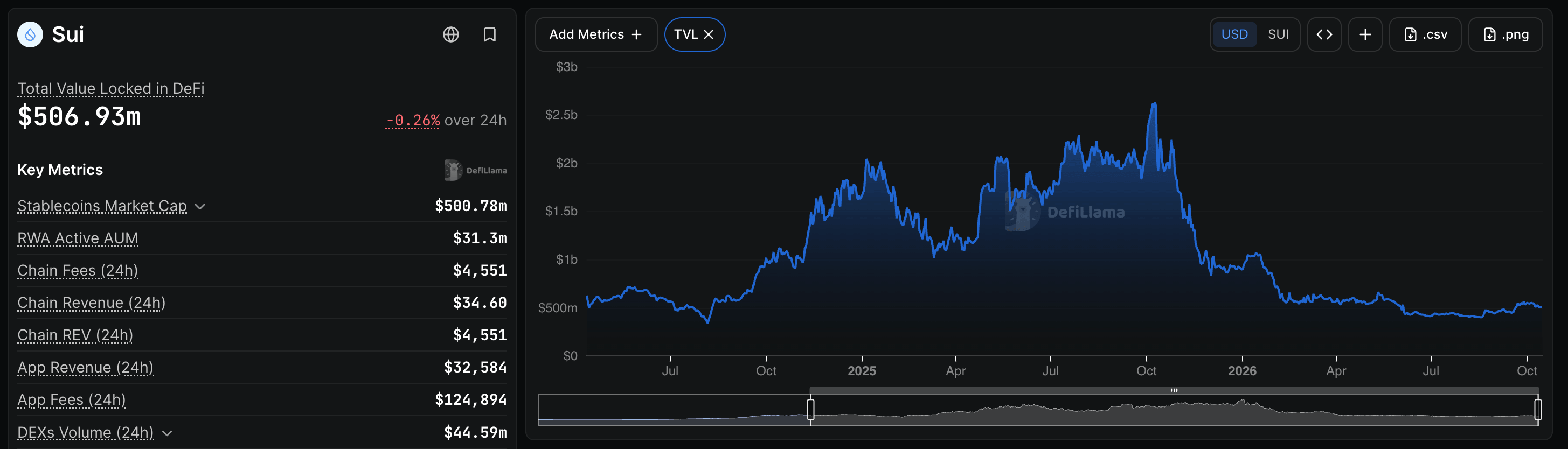
DeFi on Sui is modest next to the throughput headlines. On October 16, 2026, DefiLlama showed about $507 million in TVL and about $501 million in stablecoin market cap on Sui. These numbers move daily, so check the live page.

Is Sui decentralized?
Sui has 125 active validators (epoch 1282, October 16, 2026), and one incident shows what they can do together. After the roughly $223 million Cetus exploit in May 2025, validators chose to ignore transactions from the attacker’s addresses, freezing about $162 million, and a governance vote then approved moving those funds to a recovery multisig. Supporters saw a fast response to theft; critics saw a censorship risk.
What’s next: post-quantum signatures
In an August 2026 post, the Sui Foundation laid out the plan: ML-DSA-65 (FIPS 204) as a native signature scheme for everyday accounts and SLH-DSA-SHA2-128s (FIPS 205) inside Move contracts for high-value vaults. Native account authentication on Mainnet is targeted for Q1 2027, and the post says timelines remain open while audits and Testnet feedback continue. Post-quantum accounts are opt-in, and address aliases let an existing account switch its authorization key without changing its address or moving assets. Signatures and public keys are larger, which increases transaction size.
Getting RPC access to Sui
Sui is moving to a new set of node interfaces, and the timeline matters for anyone with existing integrations. Per Sui’s migration guide as summarized in the Chainstack migration docs:
| Milestone | Date |
|---|---|
| JSON-RPC disabled on Sui Foundation’s Mainnet full nodes | Week of Jul 27, 2026 |
| Sui stops publishing JSON-RPC snapshots | End of Aug 2026 |
| Implicit fallback to the archival service disconnected | End of Sep 2026 |
| Full decommission of JSON-RPC from full nodes, including code removal | Mid-Oct 2026 |
The Chainstack endpoint serves JSON-RPC and gRPC on the same node, and Mainnet also serves GraphQL, so you can port call by call without switching providers, according to the gRPC endpoint docs (checked October 16, 2026). Check the current state of the JSON-RPC removal in Sui’s guide before relying on it for anything new.
| Interface | Use it for | Notes |
|---|---|---|
| gRPC | Backends, indexers, transaction submission, checkpoint streaming | sui-mainnet.core.chainstack.com:443, auth with an x-token header |
| GraphQL (Mainnet) | Filtered, paginated reads: transactions by address, events by type, objects by owner and type | Filtered transactions and events cover roughly the last 90 days; not available on Testnet |
| JSON-RPC | Calls you have not ported yet | Being removed by Sui; see the timeline above |
Sui Global Nodes are Extended: they hold a window of checkpoints from lowestAvailableCheckpoint to the tip, not the full ledger from genesis. On September 27, 2026 that window spanned about 89.7 million checkpoints, and the floor can change, so read it at runtime. For older data, Sui points to its archival service. Every Sui request, whether gRPC, GraphQL, or JSON-RPC, costs 1 request unit, and the Developer plan is free with 3 million request units per month at 25 requests per second; paid plans start at $49 a month with 20 million. Besides the shared Global Node, Sui full nodes can also run on your own infrastructure with Self-Hosted.
How to get a Sui RPC endpoint on Chainstack

- Log in to the Chainstack console, or create an account.
- Create a new project.
- Select Sui as the blockchain protocol.
- Choose Sui Mainnet or Testnet.
- Deploy the node.
- Open Access and credentials, then copy your HTTPS endpoint and x-token.
Then confirm the connection with the official TypeScript SDK, which works against the endpoint over gRPC-Web. The Sui tooling docs recommend @mysten/sui 2.16 or later:
// npm install @mysten/sui
import { SuiGrpcClient } from '@mysten/sui/grpc';

const client = new SuiGrpcClient({
  network: 'mainnet',
  baseUrl: 'YOUR_CHAINSTACK_SUI_HTTPS_ENDPOINT',
});

const gasPrice = await client.core.getReferenceGasPrice();
console.log(gasPrice.referenceGasPrice);
📖 Related reads: Sui GraphQL vs gRPC and the best Sui RPC providers in 2026.
🚀 Porting off public JSON-RPC? Keep the old calls running while you move them to gRPC and GraphQL on the same Chainstack node, no re-sync needed. Get a Sui endpoint →
Conclusion
Sui bets that most of what people do onchain does not need to be ordered against everyone else, and builds the whole stack around that idea: objects instead of accounts, a language that treats assets as first-class values, and consensus reserved for the cases that need it. The results so far are a chain pushing hard on stablecoin payments, an ecosystem with real protocols like Walrus and DeepBook, and throughput claims that need careful reading.
For builders, the practical lesson is the interface change. Plan your move to gRPC and GraphQL now, pick an endpoint provider that serves all three interfaces on one node, and check history windows against your use case before you depend on them.
FAQs
Sui was built by Mysten Labs. The Mysten Labs About page lists four co-founders: Evan Cheng (CEO), Adeniyi Abiodun (Chief Product Officer), Kostas Chalkias (Chief Cryptographer), and George Danezis (Chief Scientist). Sam Blackshear, credited with creating the Move language, is named CTO in The Block’s 2022 funding report. The mainnet launched on May 3, 2023.
Sui smart contracts are written in Move, a language that originally ran on Meta’s Diem blockchain. Sui adapted it to an object model: it dropped global storage, and any type with the key ability must start with an id: UID field.
No. Sui does not run the EVM, so there are no eth_* methods and no Solidity contracts. Contracts are written in Move, and node access goes through gRPC and GraphQL, with JSON-RPC being removed.
Both declare the accounts or objects a transaction touches up front, which lets the runtime run non-conflicting transactions in parallel. Sui uses Move and an object model, while Solana programs are written in Rust, compile to sBPF, and keep data in program-owned accounts. Consensus differs too: Sui uses Mysticeti, and Solana runs TowerBFT, with Alpenglow scheduled for October 21, 2026.
Mysticeti is the DAG-based consensus protocol of Sui, in which multiple validators propose blocks in parallel and blocks commit after three rounds of messages. Mysticeti v2, the default since Sui node v1.60, moves transaction validation into consensus. Transactions touching only owned objects skip consensus through the fast path.
The mainnet chain identifier is 4btiuiMPvEENsttpZC7CZ53DruC3MAgfznDbASZ7DR6S. Nodes report it through gRPC GetServiceInfo and through the GraphQL chainIdentifier field. Sui does not use an EVM chain ID.
Not on the public Sui Foundation full nodes, where JSON-RPC calls return error -32601. Sui’s migration guide schedules the full removal from full node code for mid-October 2026, so new integrations should use gRPC and GraphQL. Check the guide for the current status.
On October 16, 2026, the public GraphQL endpoint listed 125 active validators in epoch 1282. Epochs last 24 hours, and the set stays fixed within one.
No. Sui Global Nodes on Chainstack are Extended: they hold a window of checkpoints from lowestAvailableCheckpoint to the tip, not the ledger from genesis. Read the floor from gRPC GetServiceInfo, and use an archival service for older data.