


Stellar Development Foundation’s own dashboard right now shows the network closing a ledger every 5.7 seconds on average — a small, unremarkable number, until you remember its creator had already tried to solve exactly this problem once before. Jed McCaleb co-created the XRP Ledger in 2012, left the company that became Ripple in 2013, and by July 2014 had launched a second attempt at the same idea: fast, cheap cross-border payments settled by a set of trusted validators rather than miners. Twelve years and one smart-contract platform later, Stellar settles native USDC, a regulated tokenized money-market fund, PayPal’s stablecoin, and MoneyGram’s remittance rails — run not by a company but by a nonprofit foundation with, as of this writing, no publicly stated titles for most of its own leadership team.
This piece covers how Stellar’s consensus protocol actually reaches agreement without mining or staking, what Soroban does and doesn’t change about that design, where the real stablecoin and tokenization adoption stands, and how to get a production RPC endpoint against the network.
🚀 Want to skip ahead? Chainstack runs Stellar Mainnet and Testnet as Global Nodes and Dedicated Nodes — get an endpoint or jump to Getting RPC access to Stellar below.
A nonprofit-run network, not a company’s product
Stellar is the open network — validators, the ledger, the consensus protocol. The Stellar Development Foundation (SDF) is the nonprofit that funds and coordinates its development, comparable in role to the XRP Ledger Foundation but structured differently: there’s no separate for-profit company sitting alongside it the way Ripple sits alongside XRPL. XLM (lumens) is the network’s native asset, used to pay transaction fees and to hold minimum account balances.
Jed McCaleb co-founded SDF in 2014 with Joyce Kim; the network publicly launched on July 31, 2014. Kim has since moved on — she’s absent from the foundation’s current team listing entirely. McCaleb himself is a more nuanced case: he still appears on the board and leadership list today, but that team page (unusually) gives no titles at all for anyone in those two groups, and recent SDF posts describe him only as “co-founder,” with his public attention having shifted to an aerospace company and an AI research lab. Worth noting precisely rather than assuming he still holds an active operating title. Denelle Dixon has been CEO and Executive Director since 2019, a role confirmed both on the current leadership listing and in recent press releases.
Consensus by quorum slices, not mining or staking
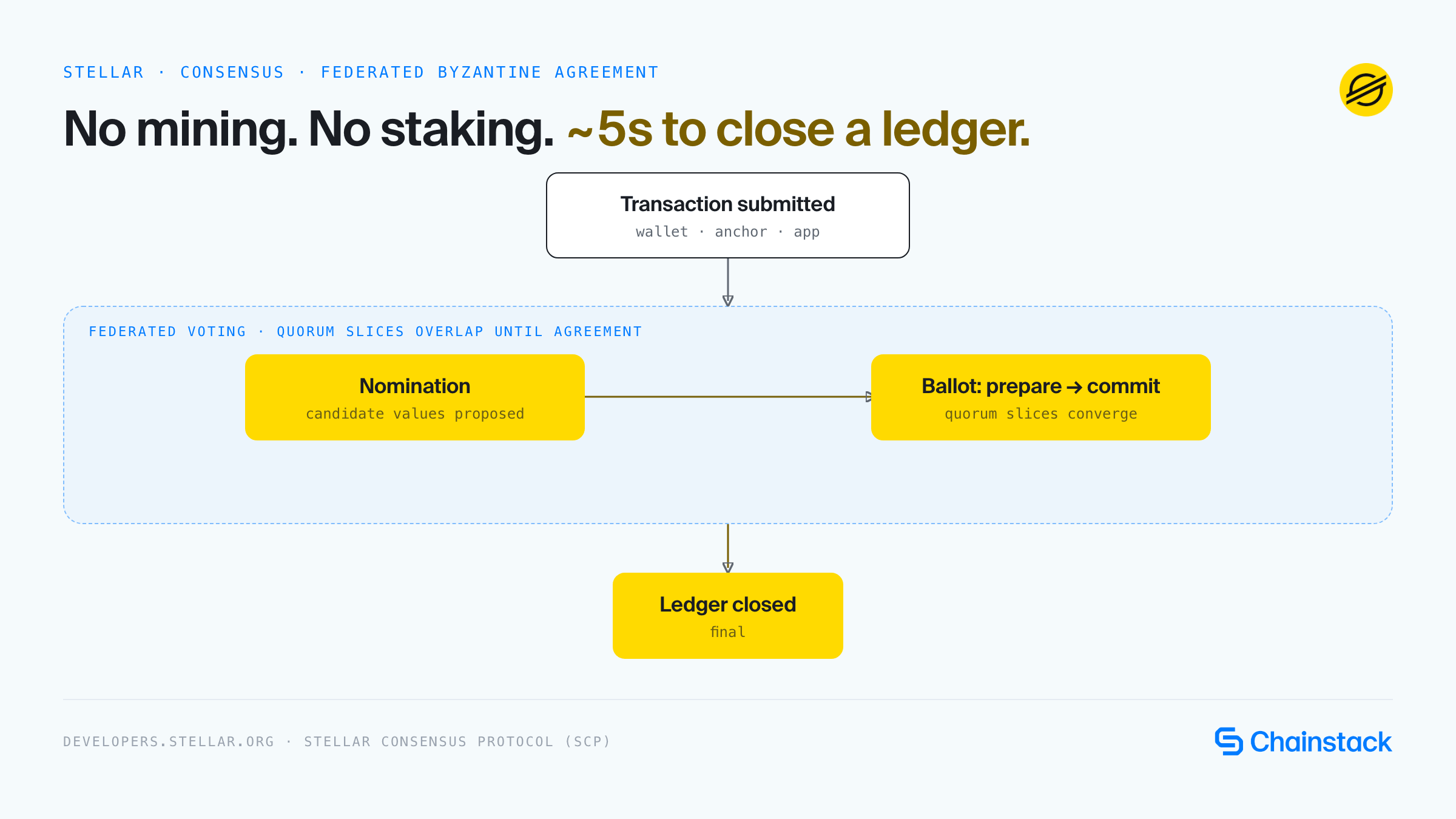
Stellar’s Stellar Consensus Protocol (SCP) is a construction of Federated Byzantine Agreement (FBA) — a different trust model from both XRPL’s UNL scheme and classical BFT. Every validator picks its own quorum set — the other validators it trusts — and a quorum slice is any subset of that quorum set big enough to convince the node of agreement. Nothing central assigns trust: becoming a “Tier 1” validator that others widely choose to trust is, in SDF’s own words, “not a unilateral decision by SDF — it depends on the quorum set choices of all existing Tier 1 organizations.” Nodes then run federated voting in two phases — nomination, where candidate transaction sets circulate, and ballot, which moves through prepare and commit steps — until enough overlapping quorum slices agree and the ledger closes. No block reward, no stake at risk, no hashes to grind.
The foundation’s own validator documentation states a 3-5 second range, though live averages have drifted a touch past that ceiling: pulling a real transaction while writing this, ledger 64114765 on the public network closed at 2026-08-25T07:41:57Z, and both the SDF dashboard and the community explorer stellar.expert independently report a current average close time around 5.7 seconds — worth knowing if you’re building around the documented number rather than checking it live.

XLM, fees, and the inflation operation nobody uses anymore
XLM carries seven decimal places of precision; the smallest unit, 0.0000001 XLM, is called a stroop. The network-minimum base fee is 100 stroops per operation — currently 0.00001 XLM, live-checkable on stellar.expert. Total supply sits just above 50 billion XLM, per the foundation’s own dashboard, and isn’t growing: validators voted to end Stellar’s legacy 1%-per-year inflation mechanism on October 28, 2019. That’s a separate event from a supply burn six days later, on November 4, 2019, when roughly 55 billion XLM held by SDF itself came out of circulation — two distinct decisions that get blurred together in casual write-ups.
Soroban: smart contracts on the same ledger, not a sidechain
Unlike XRPL — where Hooks never activated on mainnet and ended up shipping on a separate forked chain, Xahau — Stellar’s smart-contract platform runs natively on the same mainnet ledger. Soroban contracts are written in Rust and compiled to WebAssembly, and SDF is explicit that it “seamlessly integrates with and works alongside the existing Stellar blockchain” rather than living elsewhere. It went live on Mainnet with Protocol 20 in February 2024, backed by a $100 million adoption fund SDF announced alongside the launch.
Adoption is still small relative to established smart-contract chains — third-party trackers (not SDF’s own data, so treat as directional) put active Soroban contract counts in the low thousands and total value locked in the low hundreds of millions of dollars; check a live tracker like DeFiLlama’s Stellar page rather than trusting a number printed here. The more recent protocol work has leaned toward privacy primitives — SDF announced native BN254 and Poseidon support for Soroban at Meridian in November 2025, and it activated on Mainnet on January 22, 2026, aimed at making zero-knowledge applications cheaper to build on the network.
Anchors: the part that makes this a payments network
Stellar’s payments focus shows up most clearly in anchors — SDF’s own term for the fiat on- and off-ramps that connect the network to bank accounts and mobile money. Anchors implement standard protocols called SEPs: SEP-24 defines a hosted, interactive deposit/withdrawal flow where the anchor handles KYC through a webview, and SEP-31 defines a direct, API-based anchor-to-anchor payment rail for cross-border transfers with no end-user-facing flow at all. That second one is closer to what a remittance company actually needs, and it’s the standard underneath Stellar’s largest real-world deployment.
| Question | Answer |
|---|---|
| Consensus | Federated Byzantine Agreement (SCP) — quorum slices, no mining, no staking |
| Ledger close / finality | ~3-5 seconds, effectively final on close |
| Base transaction fee | 100 stroops (0.00001 XLM) per operation, network minimum |
| Native asset issuance | Any account can issue an asset natively; no contract deployment needed |
| Smart contracts | Soroban — Rust/WASM, native to the same mainnet ledger, live since Feb 2024 |
| Fiat on/off-ramps | Native concept (“anchors”) via SEP-24 (hosted) and SEP-31 (API-based, bank-to-bank) |
| Governance | Peer-granted validator trust (Tier 1 status), not a company or single foundation vote |
Who’s actually settling real money on Stellar
Circle issues USDC natively on Stellar — not bridged, not wrapped — since February 2021, and rolled out its cross-chain transfer protocol (CCTP) to the network in 2026, connecting Stellar-native USDC to more than a dozen other chains without a wrapped intermediary. Franklin Templeton’s tokenized money-market fund, branded BENJI, launched on Stellar in 2021 and is described by SDF as the first U.S.-registered tokenized money market fund — the two marked five years of it running in 2026. PayPal’s PYUSD went live on Stellar in September 2025, reaching users through PayPal, Venmo, and third-party Stellar wallets.
The largest real-world deployment, though, is the MoneyGram partnership: live since 2021, extended again in April 2026, it built what SDF describes as the largest fiat cash on- and off-ramp for digital assets anywhere, the MoneyGram Ramps API, and a stablecoin balance feature already running in Colombia and, as of the extension announcement, El Salvador. That’s a five-year production relationship, not a pilot.
One more name worth adding precisely rather than lumping in with the rest: DTCC — the clearing house behind the bulk of U.S. securities settlement — is featured on stellar.org as a case study exploring real-world-asset tokenization on the network. That’s a different kind of engagement from the live payment rails above, earlier-stage and not itself a stablecoin deployment, but a named, sourced relationship rather than a marketing logo.
Who’s building on it
Beyond the institutional issuers, Stellar’s application layer runs through a handful of established pieces: Blend is the network’s main permissionless lending protocol built on Soroban; wallets like Lobstr and Vibrant (built by SDF itself, aimed at first-time users in emerging markets) sit on top of the anchor network to move fiat in and out; and community explorers like stellar.expert and Stellarbeat track live network and validator-quorum data respectively — the latter is the place to actually see the quorum-slice trust graph described above, not just read about it.
Getting RPC access to Stellar
Stellar has two separate server APIs, and mixing them up is the most common integration mistake: Stellar RPC (served by stellar-rpc) is the JSON-RPC interface for reading ledger data, simulating Soroban contract calls, and submitting transactions; Horizon is a completely separate REST service with deep historical queries (full payment/effect history, trade aggregations) that Chainstack does not serve today. If your integration needs Horizon-style historical queries rather than recent ledger data and contract calls, that’s a gap to plan around, not a Chainstack limitation to work around quietly.
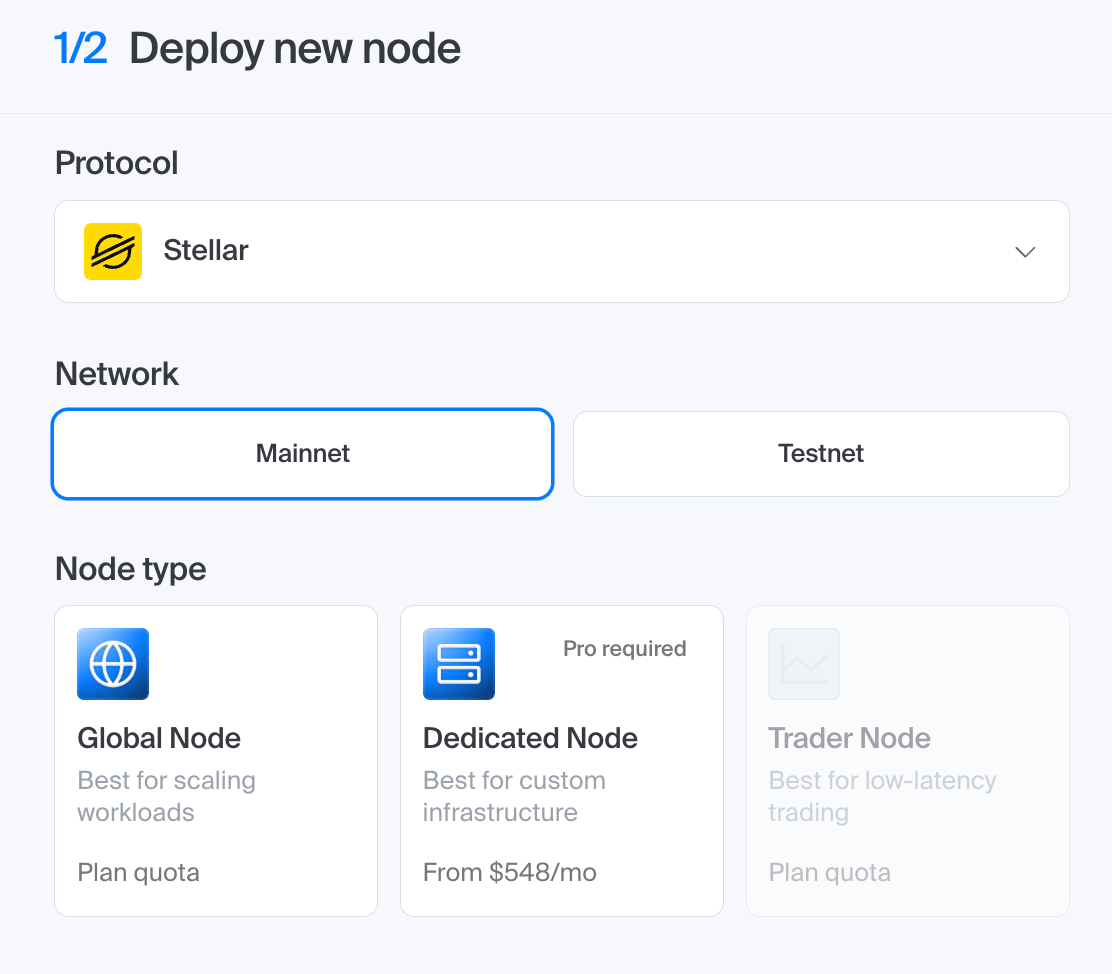
Chainstack added Stellar support — Global Nodes and Dedicated Nodes for both Mainnet and Testnet, also noted in the platform’s own August 20, 2026 changelog entry. Both run in full mode: JSON-RPC over HTTPS only, no WebSocket endpoint — which matches how stellar-rpc itself is exposed, not a Chainstack-specific gap. Dedicated Nodes are currently listed from $547.50/month (2 vCPU, 16 GB RAM, 500 GB storage) across seven regions, and Build better with Stellar is the product page covering both.
Nodes keep a rolling retention window rather than full history — call getHealth and read oldestLedger to see exactly how far back your specific node can currently serve, rather than assuming a fixed number; a request for anything older returns error -32600 naming the range the node actually holds.
How to get a Stellar RPC endpoint on Chainstack

- Create a free account at console.chainstack.com/sign-up — no credit card required.
- Create a new project from the console.
- Select Stellar as the protocol.
- Choose Mainnet or Testnet, and Global Node or Dedicated Node.
- Deploy the node — Global Nodes are ready immediately.
- Copy the HTTPS endpoint from the node’s dashboard page.
A minimal read against a live endpoint, using the official Python SDK:
# pip install stellar-sdk
from stellar_sdk import SorobanServer
server = SorobanServer("YOUR_CHAINSTACK_ENDPOINT")
health = server.get_health()
print("status:", health.status, "| latest:", health.latest_ledger, "| oldest:", health.oldest_ledger)
network = server.get_network()
print("network:", network.passphrase, "| protocol:", network.protocol_version)
ledger = server.get_latest_ledger()
print("sequence:", ledger.sequence)
Querying a public Stellar RPC endpoint while writing this returned ledger sequence 64114765, protocol version 27, and network passphrase Public Global Stellar Network ; September 2015 — real values, not placeholders. The full walkthrough, including JavaScript examples, is in Chainstack’s Stellar tooling docs.
🚀 Free tier, no card needed: spin up a Stellar Mainnet or Testnet endpoint on Chainstack’s Developer plan at console.chainstack.com/sign-up — a working endpoint takes a couple of minutes.
Conclusion
Stellar’s thesis has held steady since 2014 — payments infrastructure first, everything else second — and the last few years of real deployments back it up more than the last few years of most chains’ roadmap slides do: a regulated tokenized fund running five years, a remittance partnership running five years and still expanding, and a major payments company’s own stablecoin choosing the network for distribution. Soroban gives it a smart-contract layer without forking off a separate chain to get one, which is a cleaner path than XRPL took with Hooks and Xahau — though adoption there is still measured in low hundreds of millions, not billions. The open question worth watching is less technical than organizational: a foundation whose own team page won’t say who holds which title is an unusual amount of opacity for a network this institutionally adopted.
FAQs
Is Stellar related to Ripple/XRP?
Historically, yes. Jed McCaleb co-created the XRP Ledger in 2012, left the company that became Ripple in 2013, and founded Stellar in 2014. The two networks are otherwise independent today, with different consensus designs, governance, and organizations behind them.
Does Stellar use mining or staking?
No. Stellar reaches consensus through the Stellar Consensus Protocol, a form of Federated Byzantine Agreement where validators vote based on quorum slices — subsets of validators they individually trust — rather than computational power or staked capital.
What is Soroban?
Soroban is Stellar’s smart-contract platform — contracts are written in Rust and compiled to WebAssembly, and they run natively on the same mainnet ledger rather than a separate chain. It went live in February 2024.
Who runs Stellar?
No single company. The Stellar Development Foundation, a nonprofit, funds and coordinates development, but validator trust is peer-granted rather than assigned by SDF, and anyone can run a validator.
What stablecoins and tokenized assets run on Stellar?
Circle’s USDC has issued natively on Stellar since February 2021. PayPal’s PYUSD launched on Stellar in September 2025. Franklin Templeton’s BENJI tokenized money-market fund has run on Stellar since 2021.
Additional resources
- Stellar Consensus Protocol documentation
- Soroban — Stellar’s smart-contracts platform
- Stellar Dashboard — SDF’s own live network stats
- stellar.expert — community network explorer
- Chainstack’s Stellar tooling docs
- Chainstack introduces Stellar support
- Build better with Stellar
- Stellar Development Foundation team