Jito explained: bundles, tips, and how MEV works on Solana
Utkarshini Arora
This guide covers how MEV works structurally on Solana, what Jito provides at each layer, and how to plug into that infrastructure with real tooling.
TL;DR
By mid-2026, the Jito-Solana client runs on more than 95% of active stake, and Jito tips account for over 60% of all priority-fee volume on the network. Most developers building on Solana encounter MEV before they understand it. Jito is the dominant MEV infrastructure layer on Solana.
For builders, Jito exposes four operational surfaces:
Jito-Solana: modified validator client running on ~95%+ of staked SOL
Block Engine: off-chain auction system for MEV-maximizing transaction bundles
Bundles: groups of 1–5 transactions executed atomically with tip-based ordering
ShredStream: direct shred delivery from Jito-connected validators for sub-slot latency (discontinued September 5, 2026)
The typical MEV flow: searcher detects opportunity → assembles bundle → submits to block engine with tip → block engine runs auction → winning bundle lands atomically in validator block.
Prerequisites
Before working through this guide, it is recommended to go through:
MEV (Maximal Extractable Value) is the value captured by influencing the order, insertion, or exclusion of transactions within a block. On Solana, this surfaces as arbitrage across AMMs (like Raydium or Orca), liquidations on lending protocols (like Project 0 (ex-Marginfi) or Kamino), and back-runs after large swaps.
Solana’s architecture makes MEV structurally different from Ethereum:
Solana
Ethereum
Block time
~400ms
~12s
Mempool
Shared gossip network
Public mempool
Ordering control
Leader-based
Builder/proposer separation
MEV layer
Jito Block Engine
MEV-Boost relays
Atomic execution
Bundles (max 5 txns)
Bundles (flashbots-style)
On Solana, a leader validator controls block ordering for their assigned slot. Jito extends this by running an off-chain auction layer, the block engine, that determines the highest-value bundle ordering before passing it to the validator. The validator earns tips, the searcher gets guaranteed execution order.
What is Jito?
Jito Labs builds and maintains high-performance MEV infrastructure for Solana. The system operates across four components:
Block Engine: the off-chain auction and bundle routing service
Bundle API: the JSON-RPC and gRPC interface for searchers
ShredStream: low-latency shred delivery for downstream consumers (discontinued September 5, 2026)
Each component is independently useful. Together, they form the production MEV stack for Solana.
Jito Architecture
Validators run Jito-Solana, a modified Agave client. This client connects to the Jito Block Engine and accepts profitable bundle submissions in addition to normal transactions.
Searchers, dApps, and Telegram bots connect to the block engine and submit transactions and bundles over gRPC or JSON-RPC.
The block engine simulates submitted bundles, runs parallel auctions at 50ms ticks, and determines the highest-value combination to pass to the validator.
The validator executes the winning bundles atomically and collects the tips.
Tip revenue flows back to validators and their stakers, including JitoSOL liquid staking holders.
⚠️ Pick the endpoint geographically closest to your submission infrastructure. Latency between your searcher and the block engine directly affects auction competitiveness.
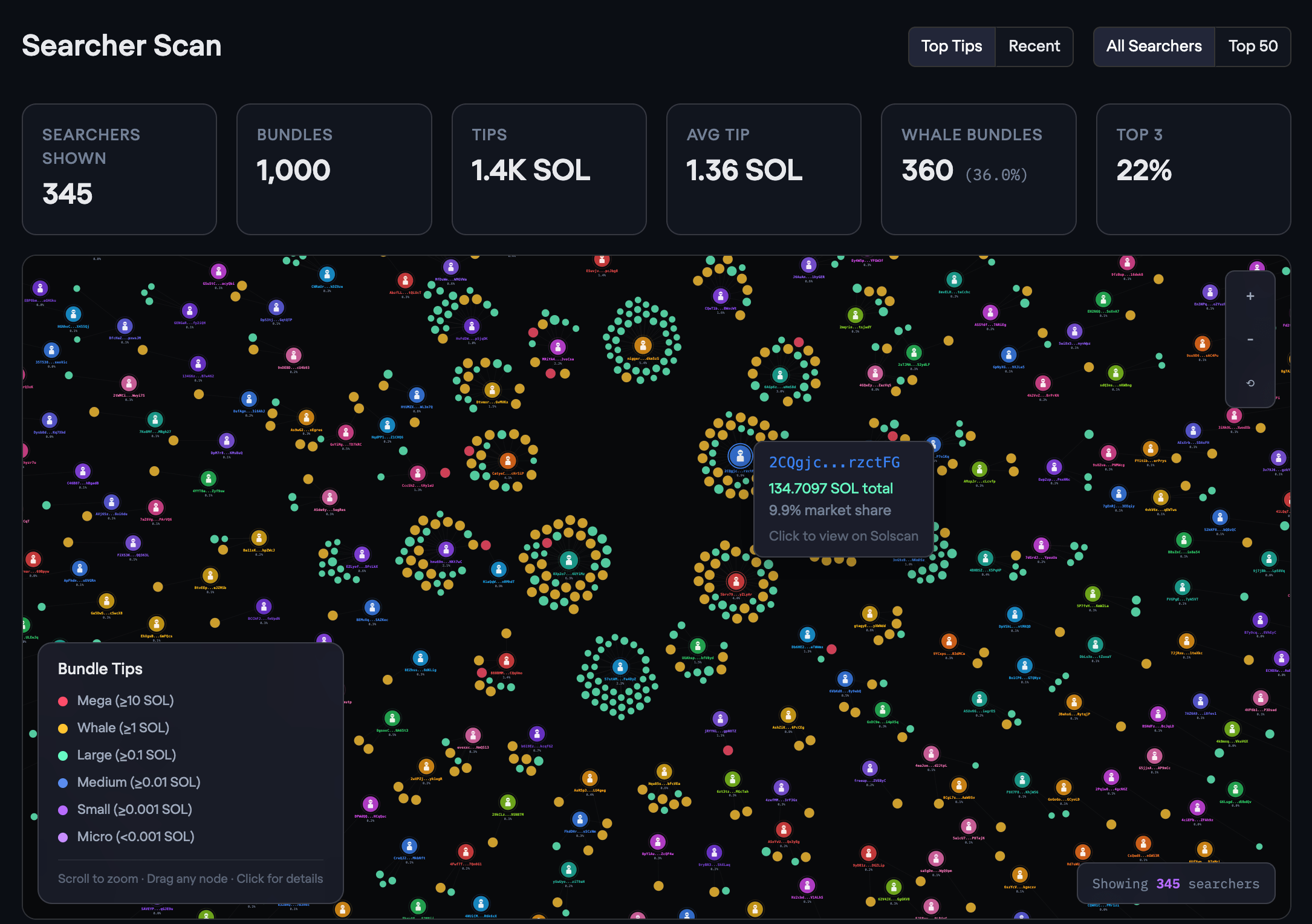
Searcher Scan visualizing 345 active searchers, 1,000 recent bundles, 1.4K SOL in tips, and the distribution of whale and retail bundle activity across the network.
Standard transactions submitted via gossip are visible to other network participants before they land. A searcher running an arbitrage between Raydium and Orca needs to ensure that their two-leg trade executes in order, without any transaction slipping between the legs. Bundles guarantee this.
Max 5 transactions per bundle
Executed sequentially in the specified order
Atomically, all succeed or all fail
Compete against other bundles via tip auctions at the block engine
Minimum tip: 1,000 lamports per bundle
If any transaction in the bundle fails or is invalidated, the entire bundle reverts — no partial execution.
The block engine runs parallel auctions at 50ms ticks. Bundles with intersecting account lock patterns (write-write or read-write on the same account) compete in the same auction. Bundles that touch completely separate accounts run in independent auctions, parallelism is exploited where possible. Within a single auction, bundles are ordered by tip-per-compute-unit efficiency.
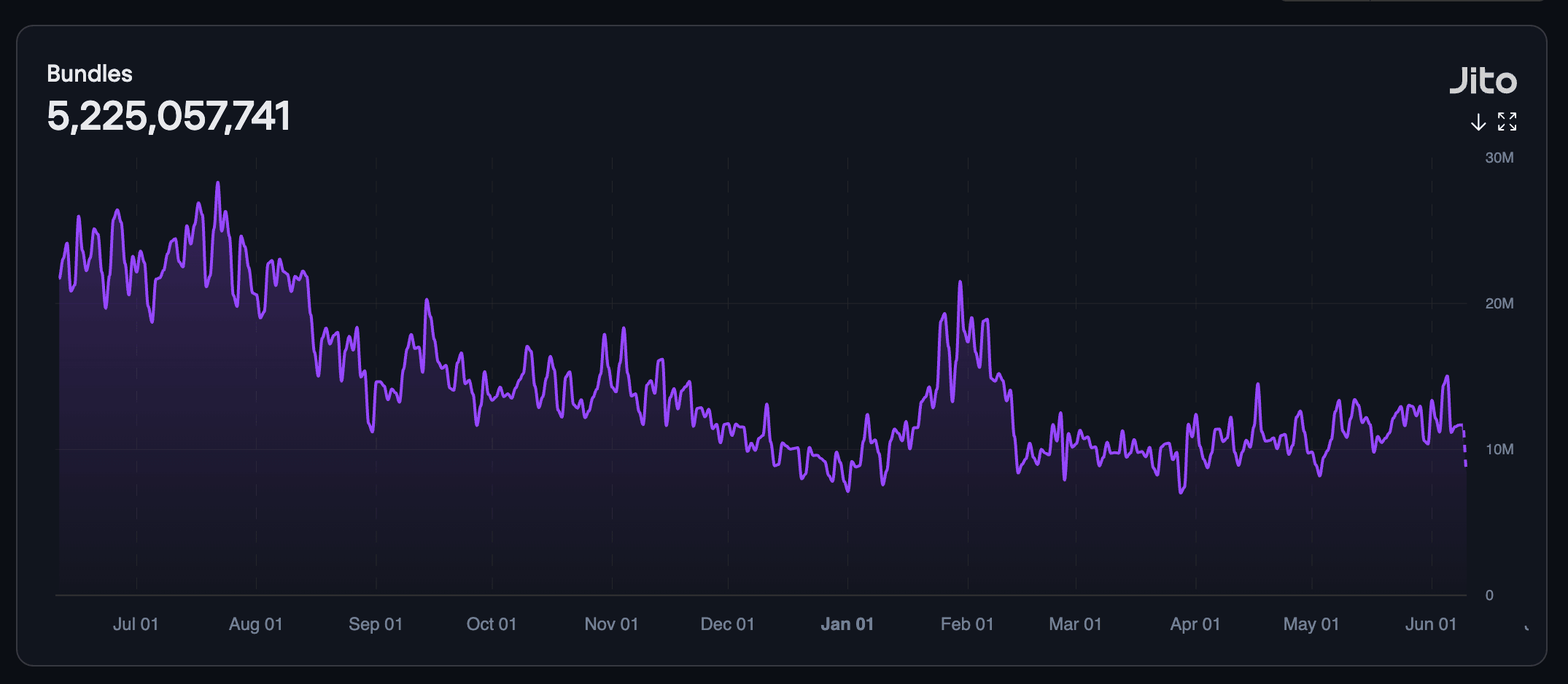
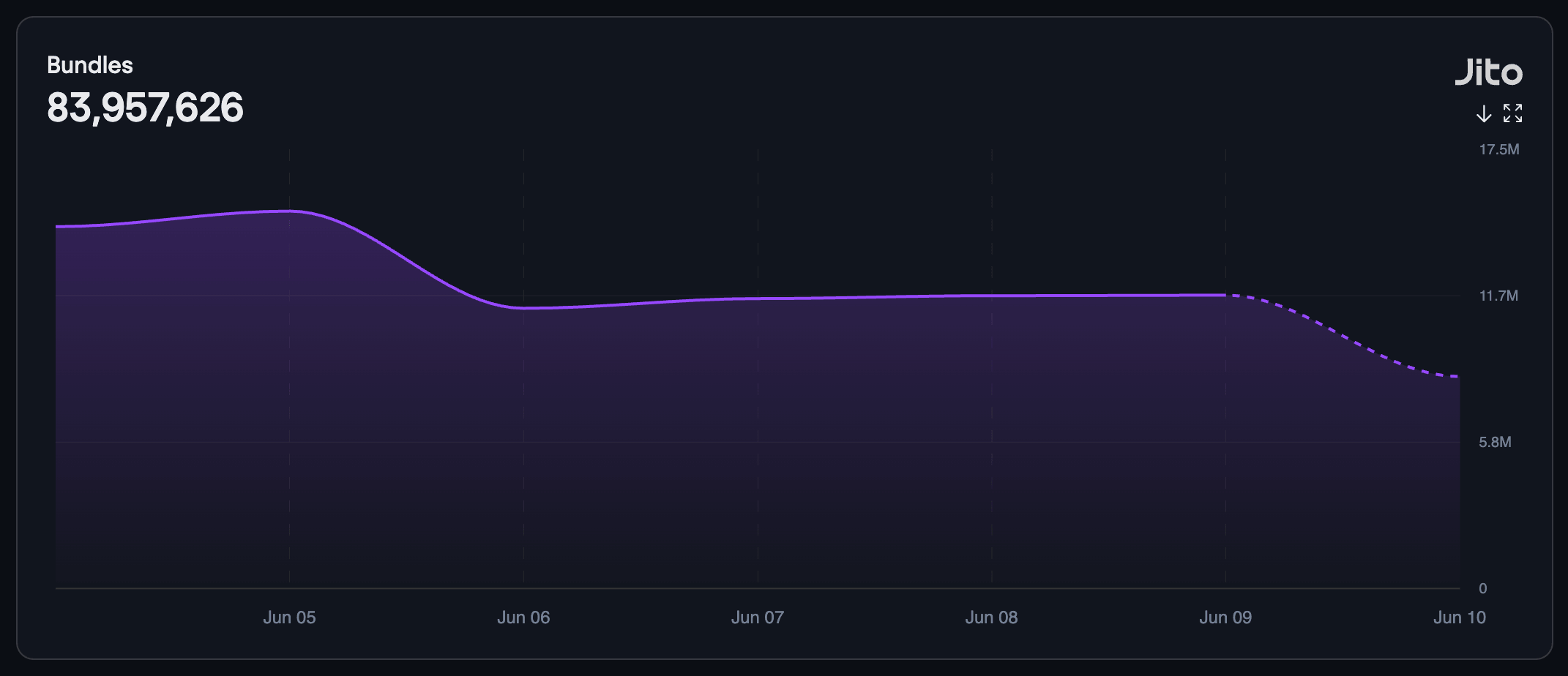
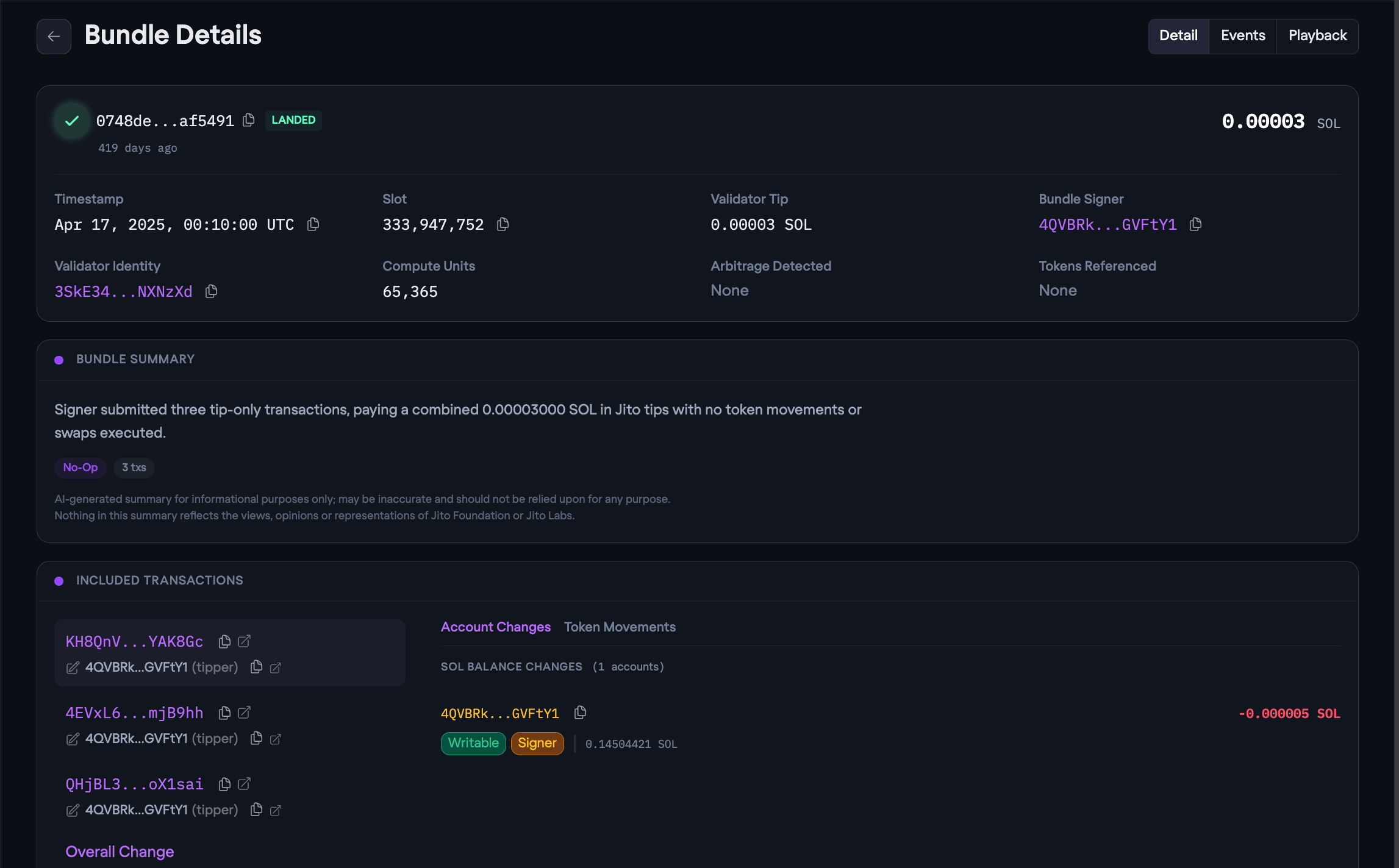
Bundle usage has become a core part of Solana’s execution layer, with billions of bundles flowing through the block engine over the past year.
Jito implements a sandwich detection mechanism at the block engine level. When a bundle matches the pattern of a known sandwich (a buy transaction before a victim transaction and a sell transaction after it), the block engine rejects it. This is enforced at the infrastructure level — the block engine will discard bundles that match sandwich patterns, protecting users submitting through Jito-enabled paths.
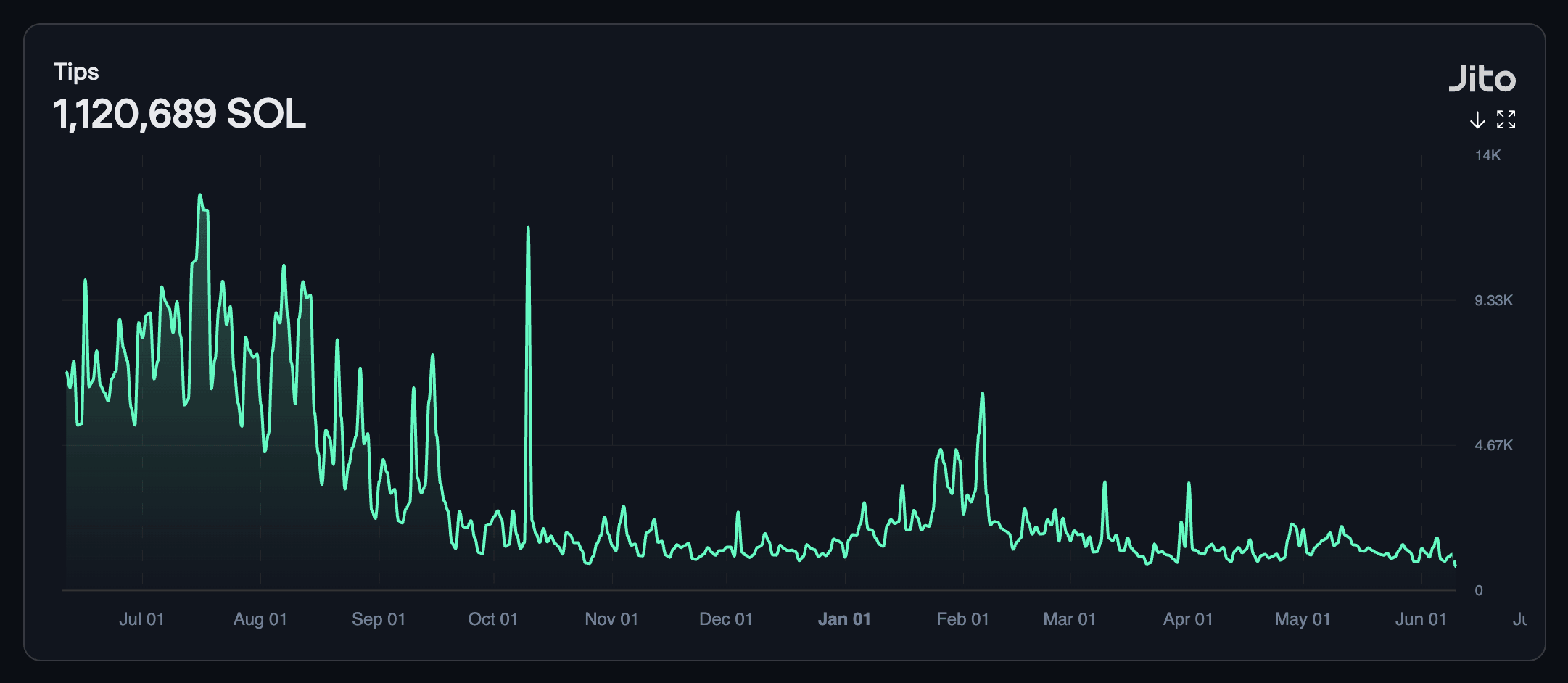
Tips are the economic signal inside the Jito system. A tip is a SOL transfer from the searcher’s wallet to one of eight Jito tip accounts. The validator receives this tip in exchange for including your bundle at its specified position in the block.
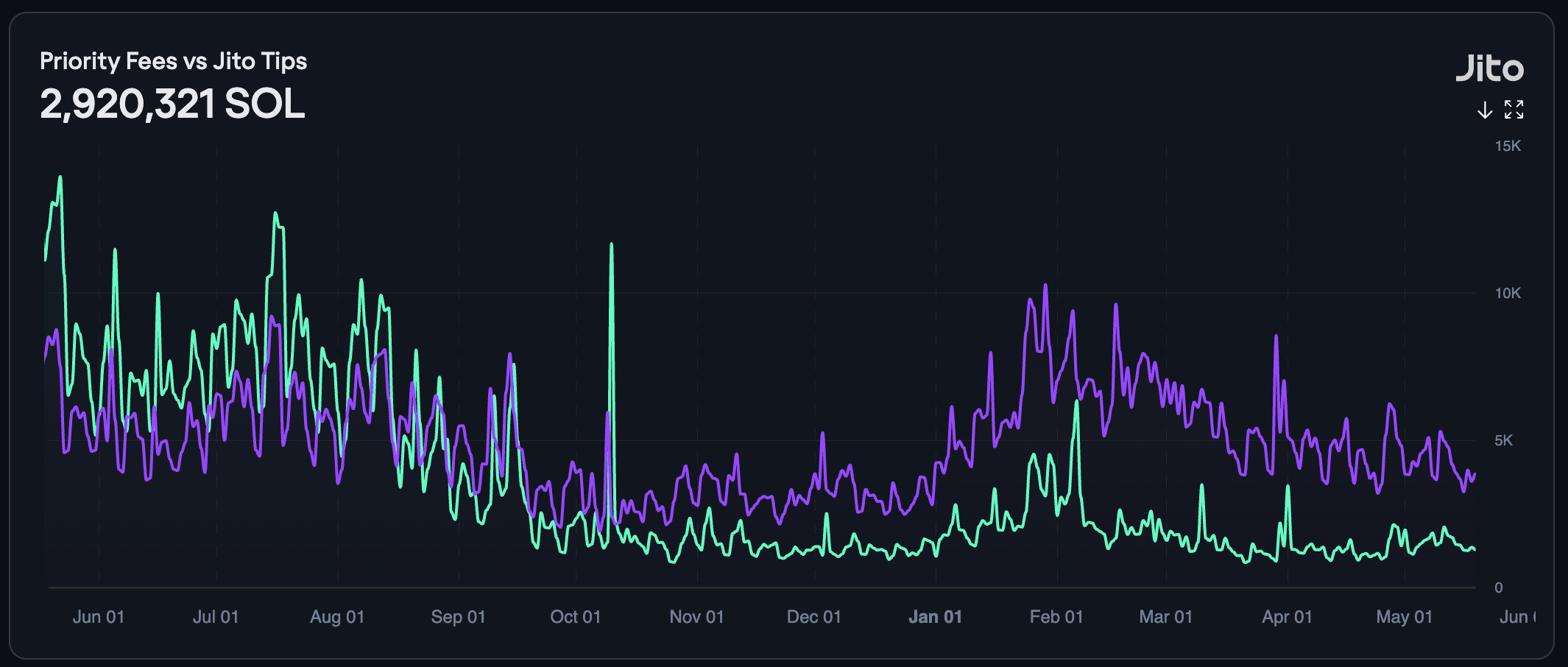
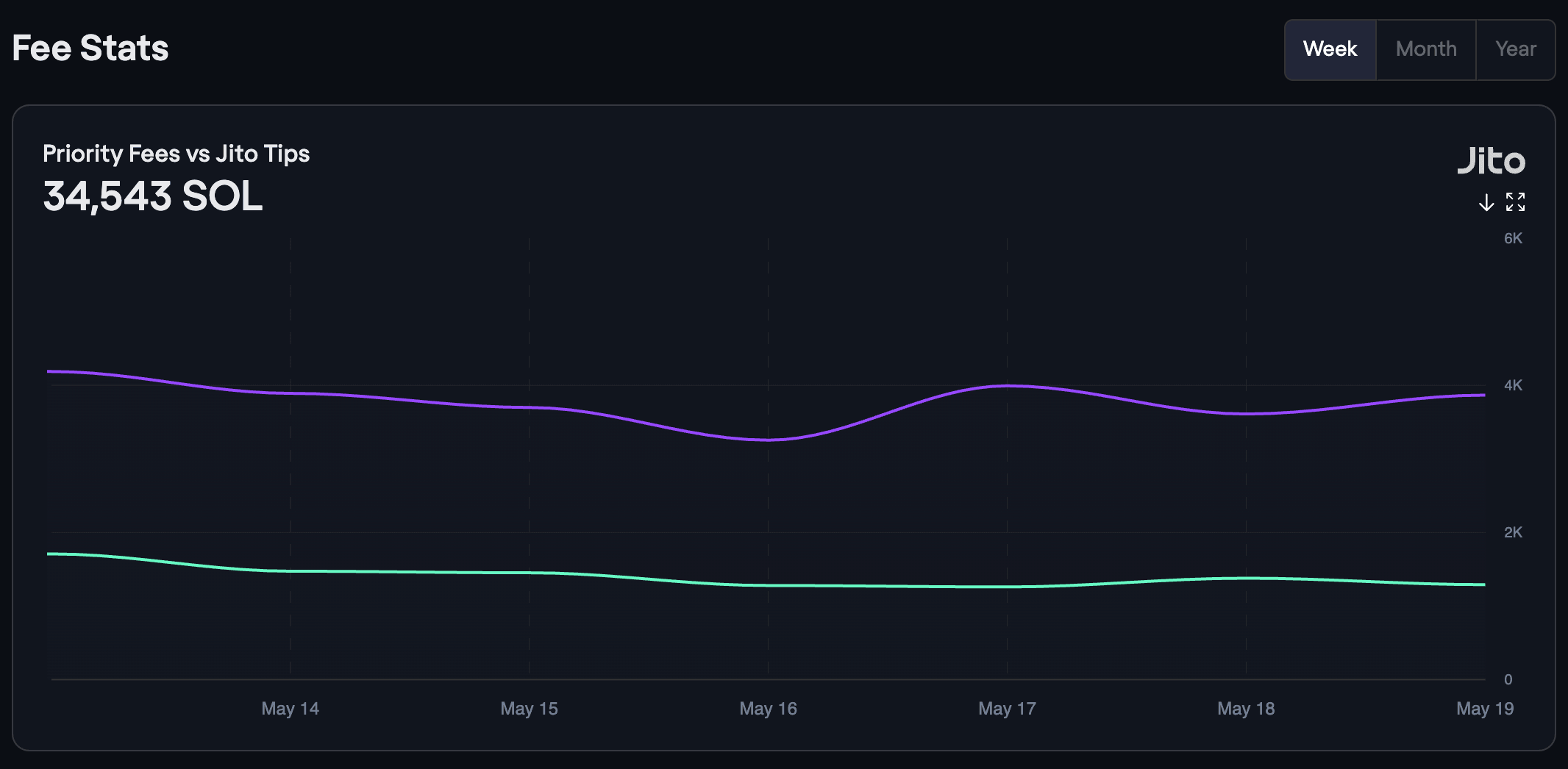
These two mechanisms are distinct and both apply to bundles:
Priority Fee
Jito Tip
What it pays
Solana base fee layer
Jito Block Engine auction
Recipient
Validators (base protocol)
Jito validator + stakers
Required for
Base transaction inclusion
Bundle ordering priority
Minimum
Dynamic (compute units × fee rate)
1,000 lamports
A bundle requires both a valid priority fee on its transactions and a tip to a Jito tip account. Omitting the priority fee risks base-layer rejection; under-tipping on the Jito side means lower auction priority.
Validators running the Jito client receive tips in exchange for including the bundle at the right position in the block. Because Jito also operates a liquid staking pool on top of this validator network, a portion of those tips flows back to ordinary stakers who have deposited SOL through the protocol. The TipRouter NCN (Node Consensus Network) decentralizes this distribution further, routing 6% of MEV tips to JitoSOL stakers and JTO governance token holders.
ShredStream
ShredStream was Jito’s low-latency block data delivery service. Jito shut it down on September 5, 2026 and recommends DoubleZero Edge as the replacement. To understand what it does, let’s understand how Solana actually moves block data across the network.
When a Solana leader validator produces a block, it splits the block data into small packets called shreds. These shreds propagate through the Turbine protocol, a tree-based broadcast network, to reach other validators and RPC nodes. A node receiving shreds via standard Turbine sits multiple hops away from the producing validator. Each hop adds time.
ShredStream short-circuited this entirely. It streamed shreds directly from Jito-connected validators to ShredStream subscribers without waiting for the Turbine fanout to reach them. The practical effect was hundreds of milliseconds of saved latency on incoming block data.
For competitive MEV, this was the margin between detecting an opportunity within the current slot and detecting it in the next one.
Typical use cases for shred feeds:
HFT bots that need to react to chain state inside a slot
MEV searchers monitoring on-chain state for triggers
Any infrastructure needing the freshest possible chain state
Status:
Jito shut ShredStream down on September 5, 2026 and recommends DoubleZero Edge as the replacement. The proxy can no longer authenticate, so setups built on it stop receiving data. Consumers that parse raw shreds only need a new shred source, not a new system.
Chainstack’s Solana Global Nodes include a managed shred feed by default (sourced via Everstake since September 2026), so there is no proxy to run yourself.
Chainstack pairs ShredStream with the Yellowstone gRPC Geyser plugin for structured real-time Solana data streaming: account updates, transaction confirmations, and slot notifications over gRPC, with ShredStream providing the sub-slot delivery path.
For RPC access, Chainstack’s Global Nodes for Solana are geo-balanced across regions and include ShredStream integration, making them suitable as the RPC layer for MEV-adjacent infrastructure without operating your own validator.
BAM
BAM is the latest infrastructure milestone from the Jito ecosystem. Built on top of the existing Jito stack, BAM introduces TEE (Trusted Execution Environment)-based transaction sequencing using AMD SEV-SNP, separating transaction ordering from block validation entirely.
BAM implements transaction sequencing through Trusted Execution Environments, enabling programmable block construction via custom plugins. The system operates through BAM Nodes that privately sequence transactions using hardware-based secure enclaves, and BAM Validators that execute the ordered transactions. The ordering is cryptographically attested at every step.
The plugin framework opens an entirely new design space for application builders. Apps gain direct control over their transaction sequencing. Oracles can update instantly when needed. Orders can be cancelled without spamming the network. Developers can define application-specific ordering logic as BAM plugins, supporting use cases like priority cancellations for options protocols, synchronized oracle updates, and time-sensitive execution primitives.
BAM also introduces a new value layer across the Jito network. All Jito fees, both BAM and block engine, route to the DAO Treasury. Plugin adoption directly benefits the Jito DAO. Validators, developers, and stakers each have a defined earning path within the system.
This section is a light introduction to BAM and what it brings to the Jito ecosystem. For a deeper dive into the architecture, plugin development, and validator onboarding, visit bam.dev.
Jito builder tools
Developers building on Solana do not always need bundles. Whether to use them depends on the application.
Bundles are useful when:
Multiple transactions require atomic execution
Liquidations must execute in order
Arbitrage depends on deterministic settlement
Trading strategies compete during congestion
Standard transactions are often sufficient for:
Wallet transfers
NFT applications
Consumer applications
General-purpose protocol interactions
Understanding this distinction helps teams choose the right execution path. When bundles are the right choice, the tools below provide everything needed to integrate them into any stack.
Jito SDKs
jito-py-json-rpc: Python SDK for interacting with the Jito Block Engine. Send transactions, submit bundles, and query tip accounts directly from Python applications.
jito-js-json-rpc: JavaScript and TypeScript SDK for Node.js and browser environments, covering bundle submission, status polling, and tip account management.
jito-rust-json-rpc: Rust SDK for high-performance MEV workflows. Designed for latency-sensitive searcher infrastructure built in Rust.
jito-go-json-rpc: Go SDK for the Jito Block Engine API, covering the same bundle and transaction endpoints as the other language clients.
Jito Resources
docs.jito.wtf: Official Jito documentation covering bundles, tips, and rate limits.
explorer.jito.wtf: Live MEV explorer with bundle history, tip distributions, and slot-level analytics.
Start for free: Get a Solana RPC node with ShredStream included.
Ecosystem
Jito Explorer: Bundle and tip analytics across the Jito network.
BAM: TEE-based programmable block sequencing built on the Jito stack.
Raydium: AMM and primary arbitrage surface on Solana.
Orca: Whirlpool-based AMM, high tip-auction volume.
Project 0: Lending protocol, active liquidation competition via Jito bundles.
Kamino Finance: Yield and lending, liquidation-relevant for MEV searchers.
Drift Protocol: Perpetuals DEX and BAM validator partner.
Conclusion
With over 95% of Solana’s staked SOL flowing through Jito-client validators, the block engine and its bundle auction are the production path for any strategy requiring execution guarantees. The architecture is layered and each piece has a distinct function. For builders in 2026, the practical checklist is:
Use Jito bundles for any multi-transaction strategy requiring atomic execution
Set priority fees on transactions and tips on your bundles, both are required
Use an RPC provider with a managed shred feed built in (e.g. Chainstack’s Global Nodes) to minimize reaction latency
The infrastructure is mature, the tooling is well-documented, and the adoption numbers confirm that operating outside this stack means competing at a structural disadvantage on every high-value transaction.
Reliable Solana RPC node infrastructure
Getting started with Solana on Chainstack is fast and straightforward. Developers can deploy a reliable Solana node within seconds through an intuitive Console — no complex setup or hardware management required.
Do I need Jito bundles for every Solana transaction?
No. Most applications can use standard Solana transactions without interacting with Jito at all. Bundles are primarily useful when multiple transactions must execute atomically, such as arbitrage, liquidations, complex DeFi workflows, or latency-sensitive trading strategies. For wallet transfers, NFT interactions, and typical consumer applications, standard transactions are usually sufficient.
What’s the difference between a Jito tip and a Solana priority fee?
They serve different purposes and are paid through different mechanisms. Priority fees increase the likelihood that a transaction is included by the Solana runtime during periods of congestion. Jito tips are bids submitted to the Jito Block Engine auction to improve a bundle’s ranking against competing bundles. For competitive bundle execution, both typically matter. A high tip with an insufficient priority fee can still fail to land, while a well-priced priority fee without a competitive tip may lose the Jito auction.
Can bundles be partially executed?
No. Bundles are atomic. A bundle can contain up to five transactions, and they execute sequentially in the specified order. If any transaction fails, all transactions in the bundle are reverted. This guarantees deterministic execution for strategies that depend on multiple state transitions occurring together.
Does Jito eliminate MEV on Solana?
No. Jito does not remove MEV; it provides infrastructure for discovering, auctioning, and executing MEV opportunities more efficiently. MEV still exists in the form of arbitrage, liquidations, back-runs, and other transaction-ordering opportunities. Jito’s role is to create a transparent auction mechanism that routes value to validators and stakers while improving execution guarantees for searchers and builders.
When should I use a shred feed?
A shred feed is primarily valuable for latency-sensitive infrastructure. Common use cases include MEV searchers monitoring state changes in real time, high-frequency trading systems, RPC providers serving trading applications, and DEX aggregators and routing engines that depend on the fastest possible market data. If your application is not competing on sub-second execution speed, the complexity of integrating a shred feed may not provide meaningful benefits.