


TL;DR
Sui’s Move-based object model and parallel execution architecture require RPC infrastructure optimized for object queries and checkpoint reads—not just account/log patterns from EVM chains.
A Sui RPC endpoint is the core infrastructure layer your app uses to read object state, track checkpoints, and submit transactions on Sui. This guide explains how to choose the right Sui RPC endpoint in 2026, compare public and private options, and move to production-ready infrastructure with reliable performance, archive access, and API roadmap compatibility.
What is a Sui RPC endpoint?
A Sui RPC endpoint is your app’s gateway to Sui’s Move-based blockchain. Unlike EVM chains where you query accounts and logs, Sui is object-centric: you query owned/shared objects, track checkpoint sequences, and submit transactions that reference object versions.
This fundamental difference means:
- API evolution differs (Sui is retiring JSON-RPC in favor of gRPC and GraphQL)
- Query patterns differ (object IDs, not account addresses)
- Historical data needs differ (checkpoint history, not just block logs)
How Sui RPC differs from EVM RPC
| What | Sui | Typical EVM |
|---|---|---|
| Data Model | Object-centric (Move) | Account-based |
| Consensus | Mysticeti DAG-based BFT, with parallel execution | Sequential (Proof of Stake/Work) |
| Primary Queries | Objects + checkpoints | Accounts + logs/events |
| Historical Needs | Checkpoint/object history | Block/log history |
| API Status (2026) | JSON-RPC being retired; gRPC and GraphQL | JSON-RPC stable |
| Indexing | Sui-specific strategy needed | Many off-the-shelf options |
This is exactly why provider selection for Sui should include API roadmap and indexing fit, not just raw RPS.
Sui RPC endpoint options
Choosing the right endpoint is mostly a reliability decision. You’re balancing convenience, cost, and operational risk.
Public vs Private Sui RPC endpoints
Common public endpoints:
- Mainnet:
https://fullnode.mainnet.sui.io:443 - Testnet:
https://fullnode.testnet.sui.io:443 - Devnet:
https://fullnode.devnet.sui.io:443
Sui Foundation’s public endpoints no longer serve JSON-RPC (it was switched off the week of July 27, 2026), so build new integrations on gRPC or GraphQL even for prototyping.
| Feature | Public RPC | Private RPC (Chainstack) |
|---|---|---|
| Access | Free and open | Restricted access |
| Resources | Shared infrastructure | Dedicated resources |
| Performance | Variable, rate-limited | Stable, high throughput |
| Object queries | May timeout under load | Consistent response times |
| Checkpoint access | Limited historical depth | Deep checkpoint window (Extended nodes) |
| Best use case | Development & testing | Production workloads |
Public RPC endpoints are useful for testing and experimentation, but treat them as shared community resources.
For production workloads, use an infrastructure RPC provider with clearer performance and availability guarantees.
Full node vs Archive access on Sui
Your data requirements should drive this decision.
| Full node access | Archive-capable data access |
|---|---|
| Current state reads | Deep historical analysis |
| Standard wallet/dapp interactions | Explorer-like products |
| Typical transaction workflows | Compliance/reporting use cases |
| Large historical backfills |
If your product depends on long-range historical queries, validate how far back your provider’s checkpoint window reaches before launch. On Chainstack, Sui Global Nodes are Extended: the node holds a rolling window of checkpoints (about 89.7 million as of September 27, 2026) rather than the full ledger from genesis, and older data comes from Sui’s archival service. Every request costs 1 RU, with no archive surcharge.
HTTPS vs WebSocket
Transport choice impacts system behavior, especially at scale.
| HTTPS | WebSocket |
|---|---|
| Request/response model | Better for event-heavy or real-time workflows |
| Simple operationally | Can reduce overhead for high-frequency interactions |
| Good for most standard backend reads/writes | Requires stronger reconnect/error handling patterns |
In practice, many teams use HTTPS broadly and add persistent channels only where real-time behavior is required. On Sui, real-time feeds now come from gRPC checkpoint streaming (SubscribeCheckpoints); JSON-RPC WebSocket subscriptions still work on Chainstack, but only until JSON-RPC is removed in mid-October 2026.
How to get a private Sui RPC endpoint with Chainstack

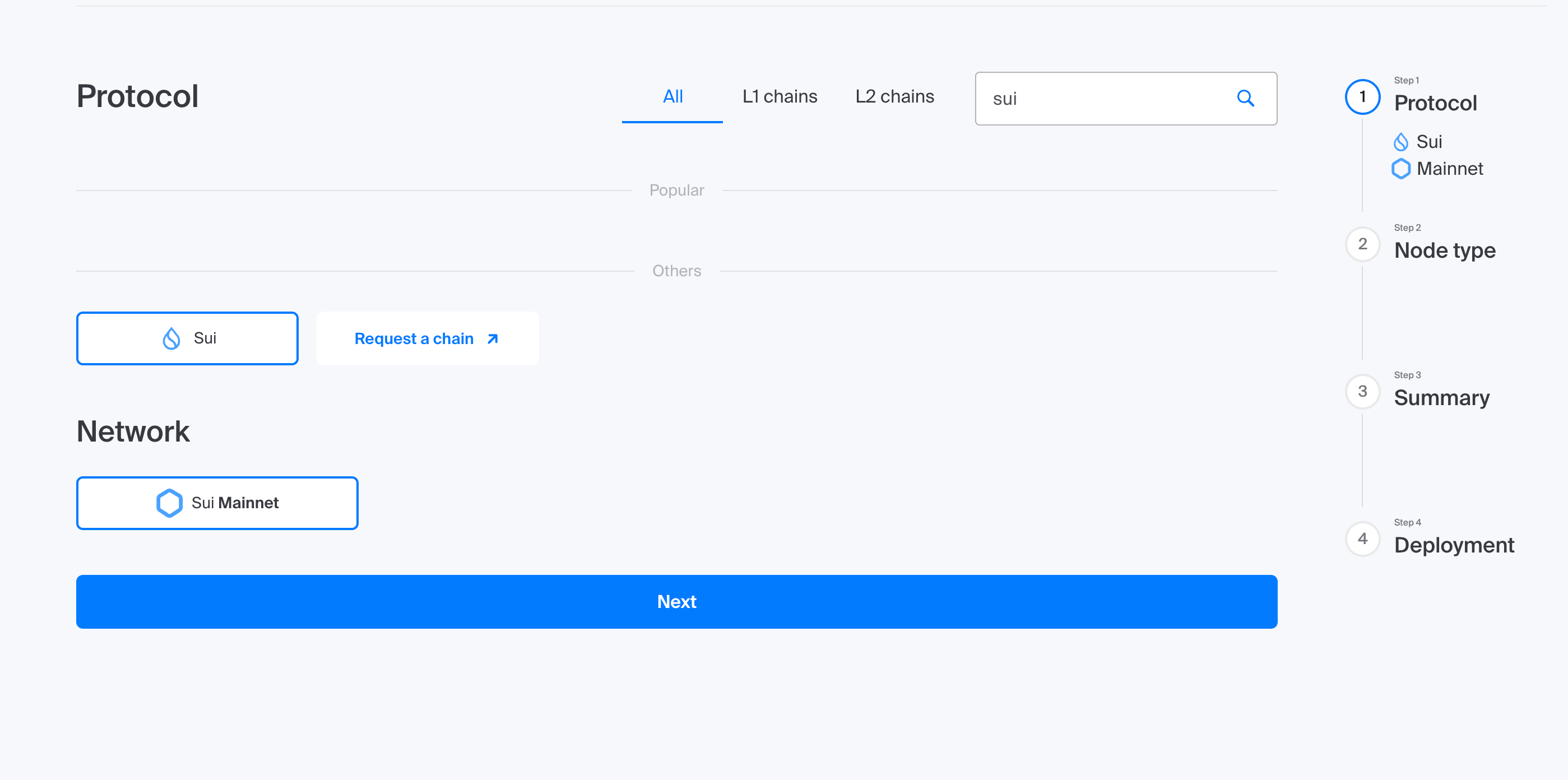
- Log in to the Chainstack console (or create an account).
- Create a new project.
- Select Sui as your blockchain protocol.
- Choose Sui Mainnet or Testnet
- Deploy the node.
- Open Access/Credentials and copy your HTTPS endpoint and x-token. The gRPC endpoint is
sui-mainnet.core.chainstack.com:443(Testnet:sui-testnet.core.chainstack.com:443), and on Mainnet GraphQL is served atYOUR_ENDPOINT/graphql. - Run a quick connectivity check in your SDK/client before wiring it into production code.
This flow keeps setup simple while giving you production-grade infrastructure earlier in the lifecycle.
A quick gRPC check with grpcurl returns the chain, the current checkpoint height, and the oldest checkpoint the node holds:
grpcurl -H "x-token: YOUR_X_TOKEN" \
  sui-mainnet.core.chainstack.com:443 \
  sui.rpc.v2.LedgerService/GetServiceInfo
Is Chainlist applicable for Sui?
Not really.
Chainlist is mainly used for EVM wallet-network configuration and is not the standard infrastructure path for Sui. For Sui, use your provider dashboard and official SDK tooling instead.
How to choose the best Sui RPC provider in 2026
Most teams pick an RPC provider too early based on “it works in dev.” For Sui, that can backfire in production because your workload profile changes quickly once users, bots, or indexers hit your app.
Use this evaluation framework before you commit:
| Evaluation Criteria | What to Check | Why It matters for Sui |
|---|---|---|
| Reliability under load | • SLA terms and incident history • Traffic burst handling • Regional failover behavior | Sui’s parallel execution can spike RPC load unpredictably. Shared infrastructure may throttle during network congestion. |
| Performance | • p95/p99 latency from your backend regions • Consistency during peak windows | Object queries and checkpoint reads are latency-sensitive. Users notice slow wallet updates immediately. |
| API roadmap compatibility | • Support for Sui’s API transition path • SDK stack compatibility | Sui is retiring JSON-RPC. Confirm your provider serves gRPC and GraphQL today. |
| Data access depth | • Archive/checkpoint retention • Historical backfill capabilities | Sui’s checkpoint-based history model means backfills and compliance queries depend on how far back your provider’s window reaches. |
| Operational controls | • Key management and access rules • Usage analytics and alerting • Support escalation process | Production incidents need fast response. Monitoring prevents surprises at scale. |
| Pricing predictability | • Request-based vs compute-unit pricing • Model costs at 3x expected traffic • Overage rules and dedicated options | Object-heavy apps fan out into many reads. Model costs before you scale. |
A practical rollout model:
- Start on public/dev endpoints for prototyping
- Move to managed shared endpoints for staging
- Use managed production tier with fallback provider before launch
Chainstack pricing for Sui RPC
Chainstack pricing is request-unit-based and easier to forecast than method-weighted credit systems. On Sui, every request, whether gRPC, GraphQL, or JSON-RPC, costs 1 RU.
| Plan tiers | Cost | Overage (per extra 1M requests) |
|---|---|---|
| Developer | $0/mo, 3M requests included, ~25 RPS | $20 |
| Growth | $49/mo, 20M requests, ~250 RPS | $15 |
| Pro | $199/mo, 80M requests, ~400 RPS | $12.5 |
| Business | $499/mo, 200M requests, ~600 RPS | $10 |
| Enterprise | from $990/mo, 400M requests, custom throughput | from $5 |
How to estimate your likely monthly cost quickly:
- Forecast average and peak requests/day
- Convert to monthly request units
- Add a 20–30% buffer for spikes
- Check if RPS limits match your peak traffic profile
- Compare shared tier vs dedicated economics at projected scale
If your traffic is bursty (bots, analytics, event-heavy apps), throughput limits and overage policy matter more than base plan price.
Production readiness checklist
Before launch, validate these basics:
- Primary + fallback RPC provider configured
- Request timeout policy set
- Retry logic with exponential backoff implemented
- Endpoint and network validated at startup
- Credentials stored in env/secret manager (never hardcoded)
- Monitoring for latency, error rate, and throttling
- Alerts for sustained degradation
These controls prevent most avoidable RPC incidents in production.
Troubleshooting common Sui RPC issues
| Issue | Likely cause | How to fix |
|---|---|---|
| Frequent rate limits | Shared endpoint saturation | Move to managed endpoint, reduce polling, batch requests |
| High latency spikes | Region mismatch or overloaded shared infra | Route to closer region and enable fallback endpoint |
| Intermittent request failures | No retry/timeout strategy | Add bounded timeouts + exponential backoff |
| Missing historical data | Requested data is older than the node’s checkpoint window | Read lowestAvailableCheckpoint from GetServiceInfo; query Sui’s archival service for older data |
| Authentication errors | Missing/invalid token config | Verify auth headers/tokens and rotate credentials |
Conclusion
Sui’s object-centric architecture makes RPC selection more critical than on EVM chains. Your provider needs to support Sui’s unique data model, API migration path, and checkpoint-based historical queries—not just provide raw RPS.
Use public endpoints for prototyping, then move to managed infrastructure with proven Sui support, clear object indexing strategy, and SLA-backed uptime before production launch.
Start with Chainstack’s free tier (3M requests/month), validate your query patterns in staging, then scale to dedicated infrastructure as traffic grows.
FAQ
Sui uses a Move-based, object-centric data model instead of the account-and-log model used by EVM chains. Developers query object states, versions, and checkpoints rather than accounts and events, which changes integration and indexing patterns compared to typical EVM RPC setups.
For TypeScript, use the official @mysten/sui SDK (version 2.16 or later), which includes SuiGrpcClient and SuiGraphQLClient; JSON-RPC has its own SuiJsonRpcClient for legacy code. For Python, use pysui.
Not for new integrations. Sui Foundation’s public endpoints no longer serve JSON-RPC, and Sui removes it from the full node code in mid-October 2026. Chainstack Sui nodes still serve JSON-RPC alongside gRPC (and GraphQL on Mainnet), so you can migrate existing calls step by step, but build new integrations on gRPC and GraphQL.
Yes for most integration and pre-production testing. Sui Testnet is suitable for validating contract logic, object lifecycle flows, SDK integrations, and API compatibility. However, you should also simulate realistic traffic patterns, concurrency, and data growth to uncover rate limits, latency spikes, and indexing edge cases before launching on Mainnet. Note that Chainstack’s Sui Testnet nodes serve gRPC and JSON-RPC but not GraphQL, so test GraphQL queries against Mainnet.
Track p95/p99 latency, failure rate, throttle events, and endpoint availability. Alert early, before user-facing transactions degrade. Monitor trends over time to detect gradual performance regression, not just sudden outages.