


TL;DR
Solana — high-performance L1 blockchain with ~400ms blocks and sub-cent fees, built for order-book trading, stablecoin infrastructure, and high-throughput dApps. With sub-second block times and massive transaction volume, every interaction with the network — from balance checks to transaction submission — starts with an RPC endpoint.
As Solana adoption continues to grow in 2025–2026, choosing the right RPC infrastructure has become a critical production decision. Public endpoints are often insufficient under load, while private RPC providers offer the performance, reliability, and scalability required for real-world applications.
In this guide, we explain how Solana RPC endpoints work, compare public and private options, and show how to get a reliable Solana RPC endpoint suitable for production workloads.
Solana RPC options
Public vs Private
When choosing a Solana RPC endpoint, developers typically decide between shared public RPC infrastructure and managed RPC providers based on workload characteristics, performance requirements, and reliability expectations.
Public endpoints (with limitations)
- Mainnet RPC: https://api.mainnet-beta.solana.com
- Testnet RPC: https://api.testnet.solana.com
- Devnet: https://api.devnet.solana.com
- WebSocket supported (use wss:// for same URLs)
Public endpoints are shared resources that often have limitations such as rate limits, stability variability, and no SLA, and they are mainly suitable for testing, development, or light usage rather than production workloads.
The sections below outline the key advantages and limitations of each approach.
| Feature | Public RPC | Private RPC (Chainstack) |
|---|---|---|
| Access | Free and open | Restricted access |
| Resources | Shared infrastructure | Dedicated resources |
| Performance | Variable, rate-limited | Stable, high throughput |
| Best use case | Development & testing | Production workloads |
Private RPC is preferred for consistent performance and reliability in production environments.
Full node vs archive Solana node
| Node mode | What it stores | When it shines |
|---|---|---|
| Full node | Current state plus ~2–3 days of recent slots | real-time wallets, games, trading bots |
| Archive node | Every slot since genesis and historical state queries | block explorers, analytics, compliance, ML models |
Archive nodes consume more storage and bandwidth, so providers usually charge extra. If you never need to query slot 100, you can safely start with a full Solana RPC node and upgrade later.
The next section describes the process for setting up a private RPC endpoint with Chainstack.
HTTPS vs Websockets
Solana’s RPC service speaks both HTTPS (request/response) and WebSocket (bi-directional stream). Choosing the right protocol affects latency, bandwidth, and even feature availability.
| Feature | HTTPS | WebSocket |
|---|---|---|
| Transport style | stateless request/response | stateful, bi-directional |
Real-time subscriptions (accountSubscribe, logsSubscribe) | polling every N ms | native push, < 50 ms latency |
| Firewall-friendly | ✅ (port 443) | sometimes blocked on corp networks |
| Easy to cache & retry | ✅ | harder, connection-oriented |
| Mobile data usage | higher (headers per call) | lower (single handshake) |
| Supported by Trader node Warp tx | ✅ | ❌ (HTTP only) |
CLI default (solana config set) | HTTPS plus inferred WSS URL* | WSS must be set manually via --ws |
Tip: The Solana CLI auto-derives a WebSocket URL from the HTTPS endpoint, but the computed value may be wrong on custom hosts. Always override with --ws if you need live streams.
For more details on WebSocket endpoints, JSON-RPC methods, and client SDKs such as Solana web3.js and solana.py, refer to Solana tooling.
How to get private Solana RPC using Chainstack
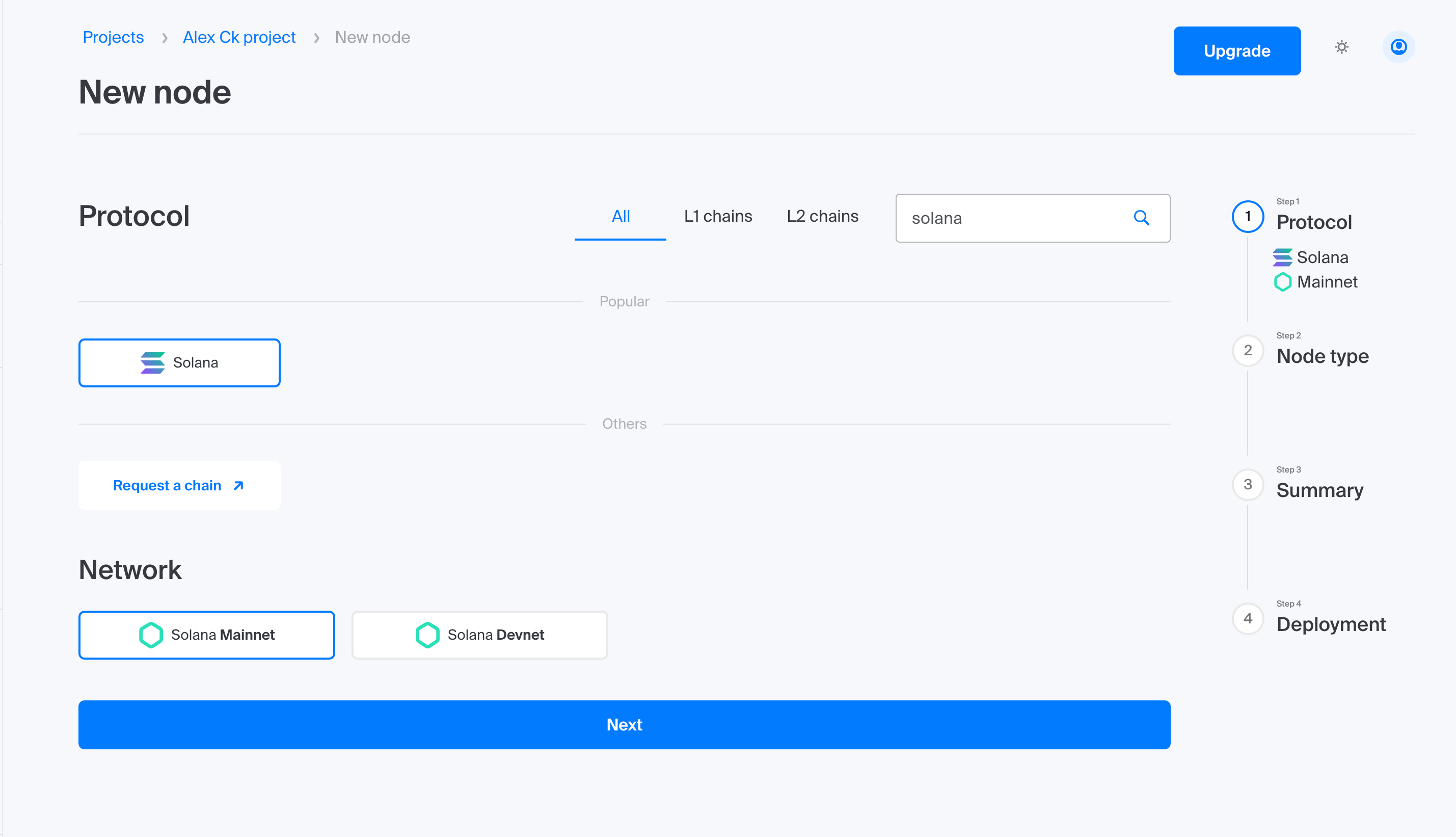
- Log in to the Chainstack console (or sign up if needed).
- Create a new project.
- Select Solana as the blockchain.
- Choose the network:
- Solana Mainnet
- Devnet
- Deploy a managed RPC node.
- Open the project dashboard and copy the generated HTTPS and WebSocket RPC endpoints.

In addition to managed RPC nodes, Solana provides community-operated endpoints with notable limitations.
Solana RPC considerations for 2026
- Throughput and request limits: Solana workloads often require very high RPS. RPC providers must handle sustained traffic spikes without hard throttling or degraded performance.
- Latency and regional availability: Low latency is essential for trading and real-time applications. Multi-region routing and proximity to validators directly impact response times.
- Reliability and uptime: RPC instability can halt applications instantly. Providers should demonstrate consistent uptime, fast failover, and resilience during network congestion.
- Validator performance: RPC responsiveness depends heavily on validator setup, hardware, and indexing efficiency, especially for state-heavy queries.
- Ecosystem tooling: Beyond JSON-RPC, mature Solana stacks include WebSockets, gRPC streams, metrics, and production-ready developer tooling.
- State growth and historical access: Rapid state growth increases demand for scalable storage and fast access to historical data and archives.
How to choose the best Solana RPC provider in 2026
The Solana ecosystem now handles billions of JSON-RPC calls each day, and the difference between a good endpoint and a great one is measured in lost trades, stalled user experiences, and unexpected invoices.
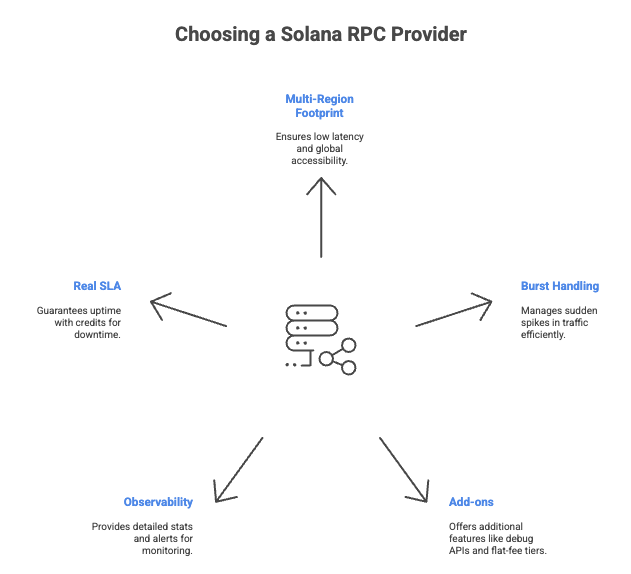
In other words, your RPC provider has become part of your application’s core logic. Before you copy-paste the first URL you find in a tutorial, step back and weigh the qualities that will keep your wallet, bot, or dApp competitive:
- multi-region footprint – latency matters when you race solana-validators.
- burst handling – can the pool absorb 10× traffic for a minute?
- add-ons – debug & trace APIs, Unlimited Node flat-fee tiers, or Warp transactions for MEV-sensitive bots.
- observability – per-method stats, logs, and alerts.
- a real SLA – credits for downtime.

Chainstack checks all boxes and adds global elastic nodes, archive mode on demand, and an Unlimited Node add-on that swaps pay-per-request for a fixed monthly bill. For production Solana apps, Chainstack = safest bet.
Still unsure? Check our Best Solana RPC providers 2026 ranking — full 6-provider comparison.
FAQ
Solana RPC operates within a unique architecture that is not compatible with EVM standards, leading to differences in data models and response formats compared to Ethereum-based networks.
Developers working with Solana typically use the official Solana JS SDK and the Anchor framework for TypeScript to build their applications and interact with the blockchain.
Solana RPC endpoints are used for a variety of applications, including decentralized finance (DeFi), stablecoins, and other Web3 solutions that require high throughput and low latency.
Public Solana RPC endpoints are useful for testing and early development but are not recommended for production. They are shared, rate-limited, and offer no uptime guarantees, which can lead to dropped requests, broken subscriptions, and degraded performance during network congestion.
When choosing a Solana RPC provider for production, focus on sustained throughput (RPS), low and predictable latency, global regional routing, WebSocket and gRPC support, and proven uptime with SLA guarantees. These factors directly impact application stability under real-world load.
Learn more about Solana architecture from our articles
- Architecture & Parallel Transactions
- Account Model and Transactions
- Anchor Accounts: Seeds, Bumps, PDAs
- Instructions and Messages
- Transaction, Serialization, Signatures, Fees, and Runtime Execution
- Transactions, Messages & Address Lookup Tables
Reliable Solana RPC provider for production
In summary, public RPC endpoints are suitable for testing and development, while managed RPC providers are the recommended production option. Getting started with Solana on Chainstack is fast and straightforward. Developers can deploy a reliable Solana node within seconds through an intuitive Console — no complex setup or hardware management required.
Chainstack provides low-latency Solana RPC access and real-time gRPC data streaming via Yellowstone Geyser Plugin, ensuring seamless connectivity for building, testing, and scaling DeFi, analytics, and stablecoin infrastructure. With Solana low-latency endpoints powered by global infrastructure, you can achieve lightning-fast response times and consistent performance across regions.
Start for free, connect your app to a Solana RPC endpoint, and experience how easy it is to build and scale on Solana with Chainstack – a trusted Solana RPC provider.