


In the Web3 world, your RPC provider is the unsung infrastructure hero that connects your frontend and smart contracts to the chain reliably.
Whether you’re launching a dApp, managing a protocol, or building a node service, providers like dRPC enable you to choose how you deploy, while giving you access to global endpoints, AI-powered routing and transparent billing.
dRPC offers: broad multichain support, flexible deployment, and a pricing model built around usage rather than locked-in bundles.

Brief history of dRPC
dRPC emerged to address common pain points: single-point-of-failure RPC providers, opaque cost models, and limited chain coverage. By building on an open routing library and a gateway layer, dRPC uses a network of independent node providers to deliver resilient and performant RPC access.
Today, the platform claims support for 100+ chains and 190+ networks, serves billions of requests per day, and partners with major dApps and chains to power their public RPC infrastructure.
Core dRPC products & services
dRPC offers several tiers tailored to different types of teams and use cases:
- NodeCloud: Ideal for teams that want instant access and minimal infrastructure overhead. Developers can connect to multichain endpoints in the cloud with no node-maintenance required.
- NodeCore: For teams that prefer to self-host and control their own stack. Open-source stack, supports custom routing, observability, and integrates with your existing infrastructure.
- NodeHaus: Tailored for blockchain foundations or large-scale RPC infrastructure. Includes managed public commercial nodes, observability dashboards, branded testnet faucet, 24/7 support, global clusters, etc.

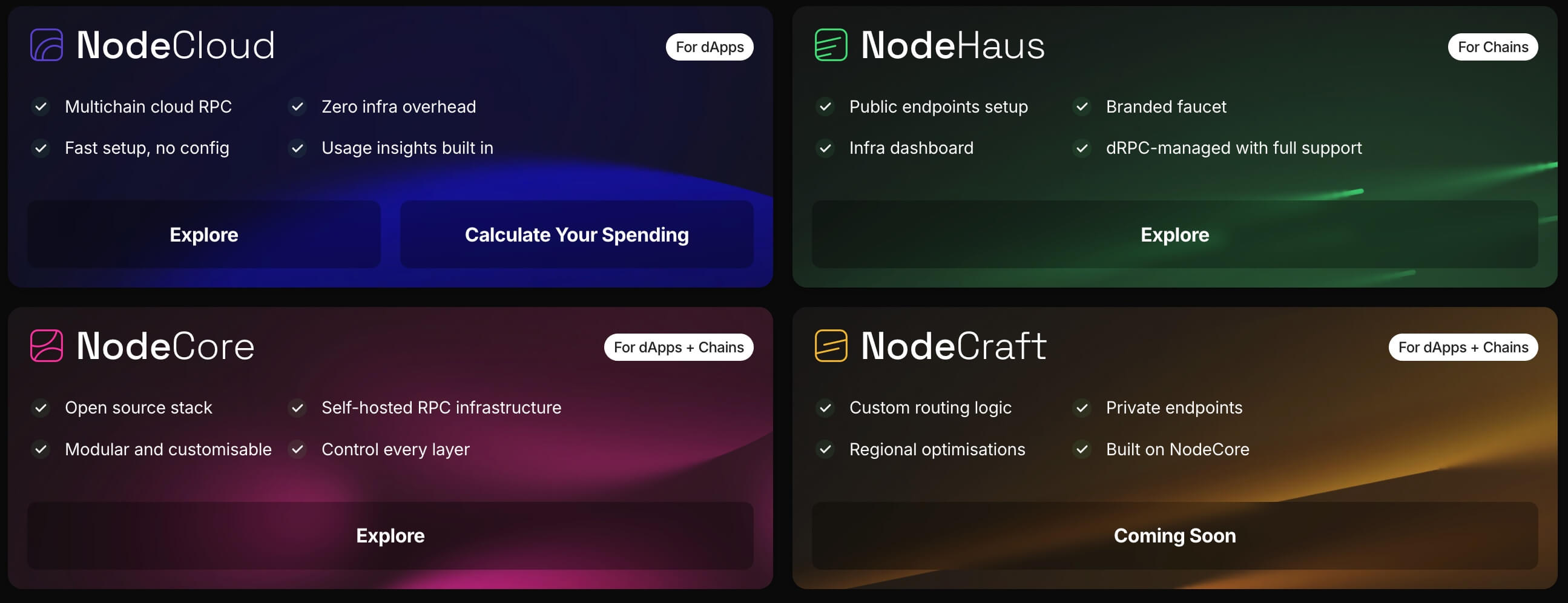
Together, these offerings let you choose how much infrastructure you own vs outsource, while still getting access to the global routing and provider network that dRPC has built.
Performance & pricing profile
Performance:
- The routing engine uses Dproxy at the gateway and instances of Dshackle at each provider node. When a request comes in, dRPC selects the best node based on region, node health, chain head height, method used and other characteristics.
- The infrastructure covers many continents via multiple geo-clusters.
Pricing:
dRPC uses a pay-as-you-go pricing model based on Compute Units rather than simple request counts. Different RPC methods consume different amounts of compute, so the actual cost depends on your method mix and traffic patterns.

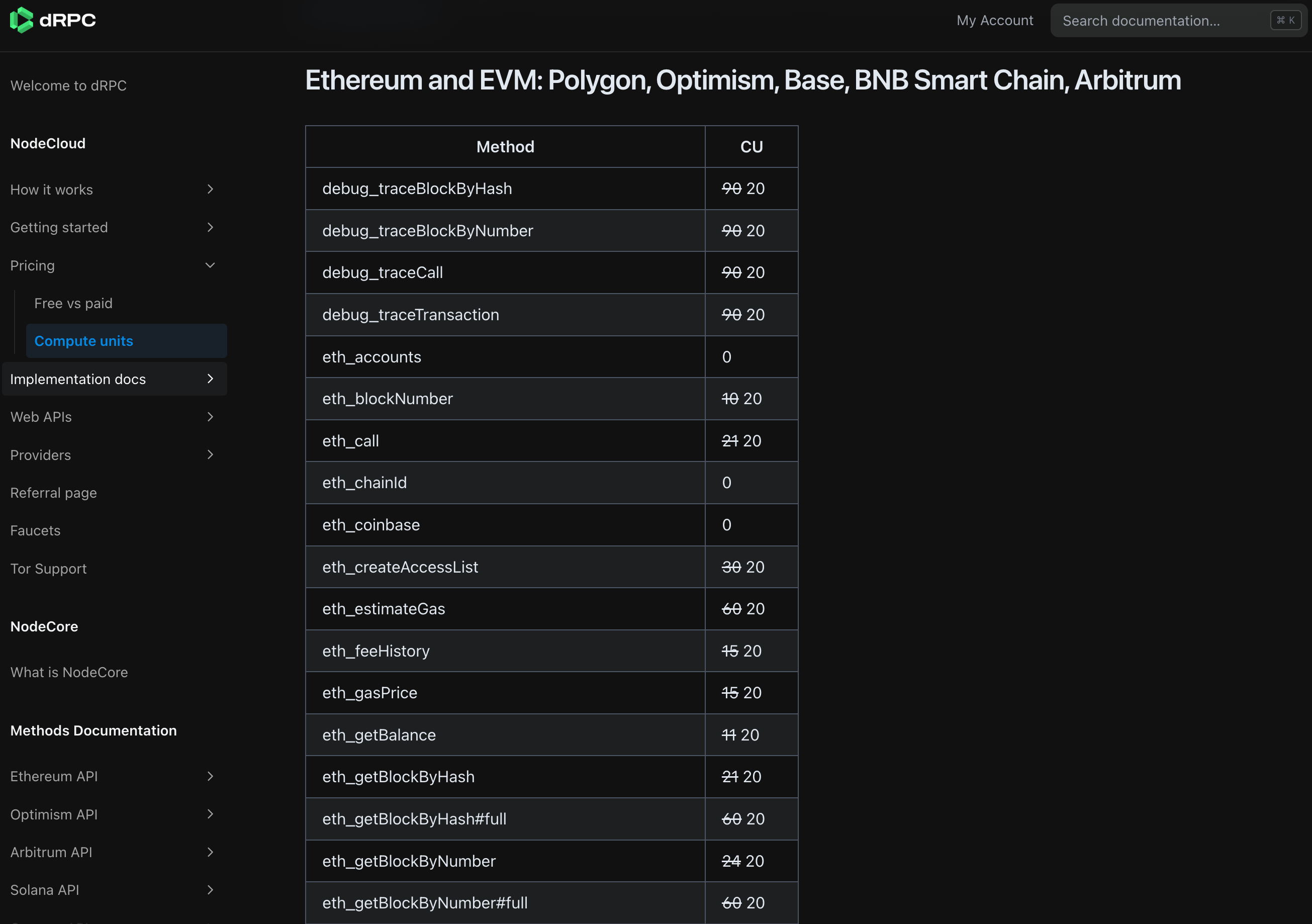
This model can be flexible for small or unpredictable workloads, but it also means costs can scale quickly if your application relies heavily on logs, traces, or complex calls.
To better understand how this works in practice, the example below shows how a typical workload translates into Compute Units and monthly cost compared to request-based pricing.
| Metric | Chainstack | dRPC |
|---|---|---|
| Plan used in example | Pro | Growth |
| Included usage | 80M Request Units | Pay-as-you-go (no bundled requests) |
| Workload equivalent | 73.5M method calls | 73.5M method calls |
| Compute usage (example workload) | Fits in included usage | ~1.4B Compute Units |
| Plan price | $199 | $0 |
| Overage charges | $0 | $420 |
| Total monthly cost | $199 | $420 |
Strengths vs potential weaknesses
| Strengths | Potential Weaknesses |
|---|---|
| Broad chain and network coverage | Performance and latency may vary by region or network depending on the provider node your request lands on |
| Modular deployment options: cloud and self-host | Usage-based billing means you must monitor usage carefully to avoid surprises |
| Transparent pay-as-you-go pricing, free tier available | For ultra high-scale or specialised compliance setups, you may enter bespoke enterprise terms |
| Smart routing & decentralized provider network for better resilience | Because infrastructure is distributed across many independent nodes/providers, consistency may depend on each provider’s performance |
dRPC vs Chainstack
Both providers aim to deliver high-performance multichain RPC infrastructure, but there are meaningful differences worth noting:
- dRPC stands out for its broad chain support, flexible deployment options, and usage-based pricing. If your project spans many networks or you’re comfortable with monitoring usage and optimizing method calls, this model can provide more flexibility and potentially lower costs for certain workloads.
- Chainstack emphasizes cost predictability, enterprise SLA (99.99%+ uptime), and flat-fee / transparent pricing models. This makes it easier to forecast infrastructure costs and operate production workloads without worrying about method-level billing or sudden usage spikes.
From an operational perspective, teams that prefer predictable monthly infrastructure costs and simpler cost modeling often lean toward request-based pricing, while teams that want maximum flexibility across many networks may prefer usage-based models.
Ultimately, the right choice depends on whether your priority is flexibility across many networks and deployments, or predictable infrastructure costs and operational simplicity.
FAQ
Sign up, select the appropriate product, generate an API key, and point your RPC call to the endpoint provided for your chain.
dRPC supports a wide range: 100+ chains and 190+ networks across both EVM and non-EVM ecosystems.
Yes. While uptime and latency will depend on the plan and region, the design is production-grade.
While it uses pay-as-you-go rather than fixed pricing, usage is transparent. You’ll still want to monitor method mix and request volume to avoid surprises.