


Chainstack stopped supporting Corda nodes. Contact our support team at support@chainstack.com if you have any questions, or visit our Help Center.
Organizations have many internal processes—either standalone or inter-related—that operate within single business units or are cross-functional. Externally, organizations also work with entities within vast, complex value chains and are embedded within a web of multi-level business or governmental networks, such as suppliers, customers, partners, banks, shippers, regulators, and even competitors.
Managing internal and external processes and workflows in such an environment is complicated.
Business process management and business process management software defined
The discipline of Business Process Management (BPM) has been used by many organizations in the past few decades to model, automate, execute, control, measure, and optimize processes and workflows in support of organizational goals.
Business Process Management Software (BPMS) is a technological suite of tools designed to help BPM professionals and business architects accomplish their goals in:
- optimizing processes and workflows;
- reducing costs and turnaround times;
- increasing flexibility, agility, compliance, and collaboration between entities.
While a workflow facilitates the simple routing of tasks or activities between parties with the aid of automation to support a process, BPMS—a superset of workflows—also connects disparate systems, offers analytics insights across business capabilities, and offers modeling tools with rules management.
New technologies and trends supporting BPM
Modern-day BPMS solutions leverage new technologies that offer organizations more automation and intelligent routing, which catches errors early in the process and reduces the need for manual intervention from humans.
Some examples of these new developments are:
- Robotic Process Automation (RPA) or bots which deal with task automation that mimics human behavior for common, repetitive, manually intensive activity, e.g., scraping, copying and pasting data between applications, or chatting to users to determine their needs before routing them to the correct workflow. RPA can be optimized by using cognitive-based technologies such as Machine Learning (ML), natural language recognition, and speech recognition.
- Adaptive Case Management (ACM) to support users with alternate, more effective decisioning for business processes in a changing environment.
- Low Code Development Platforms (LCDP) which allow users to quickly create, customize, and deploy functional, cross-functional, and cross-organizational business processes. These tools may have drag and drop UIs which allow a user to visually design and implement a business process.
- Internet of Things (IoT), where external devices trigger business processes based on events generated from remote devices.
- Artificial Intelligence (AI) to automate routine tasks, improve user interfaces, analyze large amounts of data, and aid decision making.
BPM challenges
With all these new technologies, organizations still have handovers of information in different formats between multiple central systems, using various middleware solutions and intermediaries, with a combination of manual and automated steps in a trust-less environment.
There are also “shadow business processes” where no organizational policies or rules exist for activities that must be done. Gartner predicts that 20% of these “shadow business processes” are supported by BPM cloud platforms—e.g., spreadsheets, routing of emails using rules, phone call routing, messenger solutions, etc.
This can lead to:
- Duplicate transactions.
- Stale or unconcluded transactions.
- Sidestepping of processes, which allows for fraudulent submissions and signatures.
- Bottlenecks and delays in processes.
- Half implementations, where multiple manual or off-chain processes are necessary.
- Man-in-the-middle attacks.
Reconciliation solutions—systems or operational staff—are required to handle exceptions, anomalies, and errors.
Distributed Ledger Technology addresses multiple BPM challenges across industries
I see a perfect opportunity for Decentralized Ledger Technology (DLT) to benefit BPMS implementations and offer the industry-wide digital transformation benefits we are all seeking across our value chains. Modern business requires dynamic collaborations among organizations, where globalization, increasing regulation and competition urges the need for:
- Accuracy;
- Speed;
- Privacy and security;
- Reliability and flexibility;
- Scalability and agility;
- and trust.
Multiple DLT technologies are currently available, and at Chainstack we believe that there is no single DLT solution that is best suited for all use cases. Based on the use case you are addressing, you should select a technology and protocol considering the attributes, such as scalability, speed, privacy, confidentiality, developer-friendliness, fault tolerance, interoperability, and agility.
R3 Corda
That said, I see R3’s Corda a natural fit for the needs of enterprise and governments, where a BPM or Business Architecture discipline may be in operation to optimize inter- and intra-organizational processes between multiple parties.
Corda is a DLT platform that allows multiple parties running their own nodes—running their own CorDapps, applications with their own vault and database—can exchange data or value with each other on the same network while benefiting from the following features:

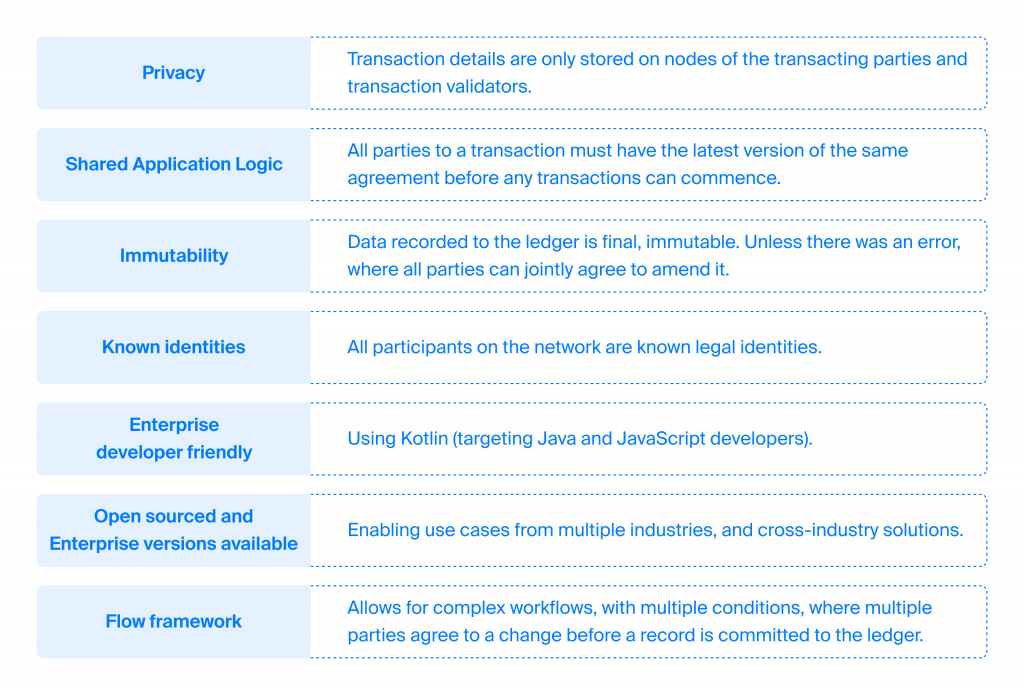
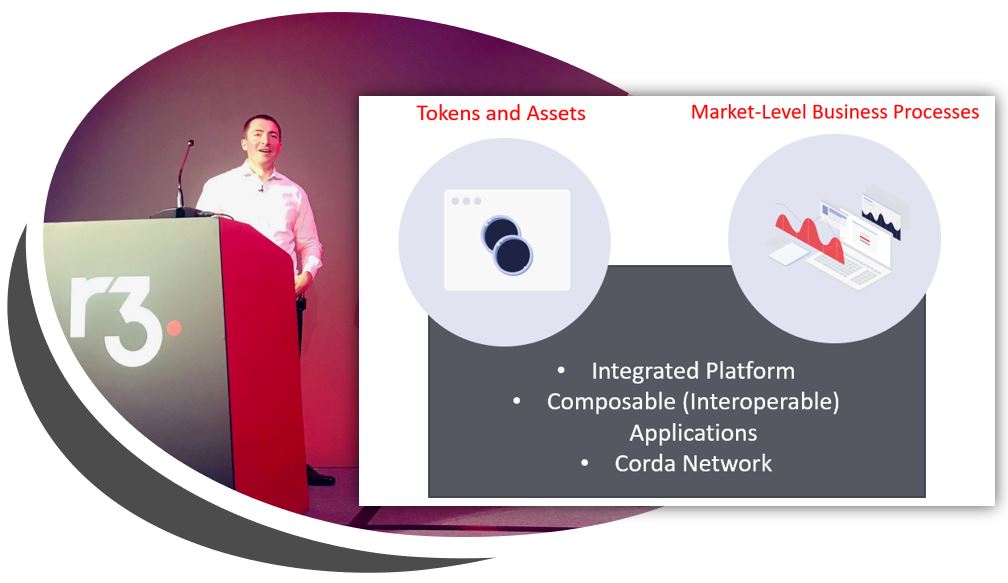
This flow framework is where I really see the natural fit of Corda’s DLT benefiting the BPM discipline. Richard Gendal Brown, CTO at R3, recently highlighted how many of their customers are, in fact, using Corda to manage “Market-Level” business processes.

Key Corda components
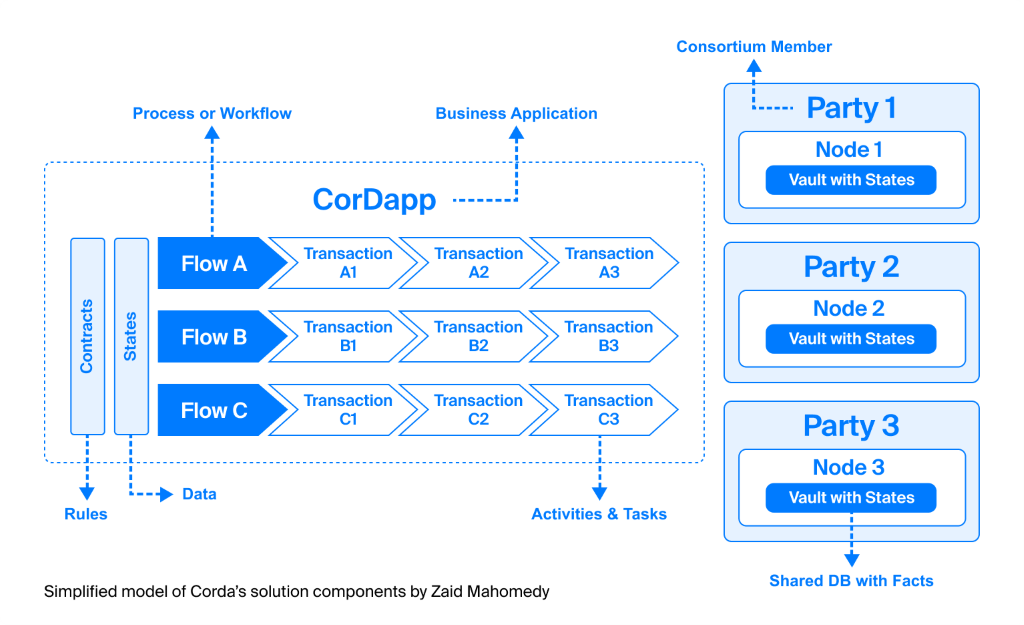
These are the key components within Corda’s solution architecture that relate to the management and execution of business processes, and retain a record of it.
- CorDapps, or Corda Distributed Applications, are distributed applications that run on the Corda platform. The goal of a CorDapp is to allow nodes to reach an agreement on updates to the ledger. They achieve this goal by defining the flows that Corda node owners can invoke over RPC.
- Flows are embedded within CorDapps and deployed to a participant’s node for execution. A flow encodes a sequence of steps that a node can perform to achieve a specific ledger update. By installing new flows on a node, we allow the node to handle new business processes. They enable complex multi-step, multi-party business transactions and interactions, without the need for an intermediary.
- Transactions in Corda are the atomic units of change that update the ledger.
- Contracts define the rules and conditions on what transactions constitute a valid ledger update.
- States are an atomic unit of information in Corda. They are never changed, are current, and are known by one or more Corda nodes.

Corda and BPM
Corda’s flows can be used to manage business processes between entities where they introduce trust, reliability, and accuracy of the atomic tasks and transactions. Third-party validators or notaries—individual or a group—can observe and sign transactions to ensure the uniqueness and validity before it is recorded on the ledgers of only those parties involved in the transaction, which ensures confidentiality is maintained.
With Corda, every party involved in a transaction within these consortia knows with certainty what happened, when it happened, and can confirm the other parties are seeing the same thing, with no need for an intermediary to provide assurance, and without having to reconcile multiple copies of data afterwards. This results in no need for a reconciliation solution to manage duplicates, exceptions, or mismatched records stored in the databases of each party.
Business Processes that are supported by smart contracts on Corda can be executed faster as activities can be executed automatically if certain conditions within the flow are met.
The specific features that Corda customers are leveraging to manage their Market-Level business processes are listed on this slide from Richard Gendal Brown at CordaCon 2019:

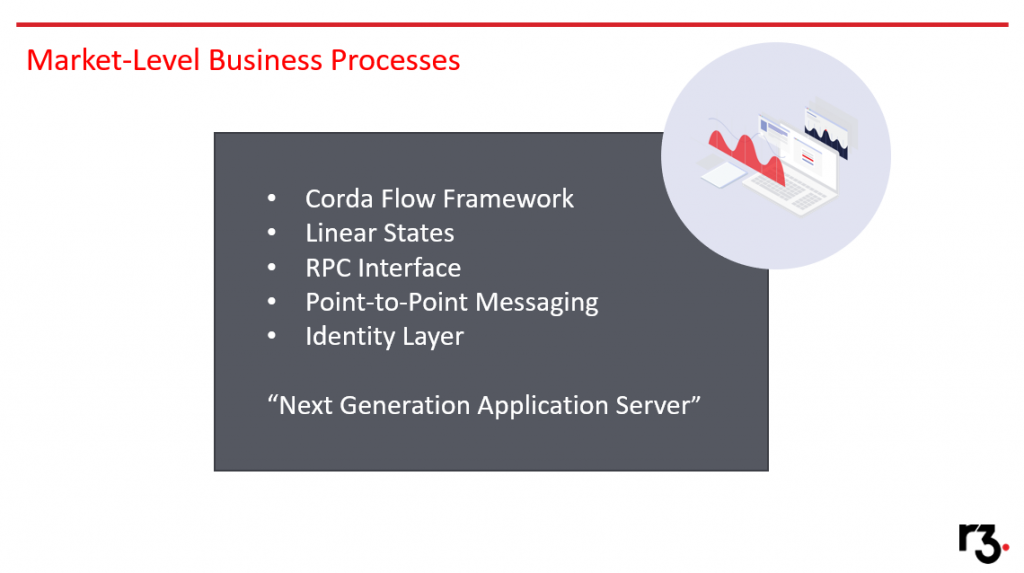
Corda is not going to replace modern-day BPMS solutions. Like RPA, ML, ACM, LCDP, IoT, AI, and other emerging technologies, I believe Corda offers multiple benefits that contribute to the BPM discipline, and I look forward to seeing them integrated into BPMS suites and more business implementations.
To facilitate the rapid deployment of new business processes, I believe R3 should consider adding or integrating with an LCDP in the future. This will enable process analysts, business and process architects with minimal or no coding experience to visually design and deploy process changes easily.
Consortia running Corda
Multiple consortia have already formed between a number of entities globally, where Corda has been selected as the DLT to support the complex business processes and interactions around various industry use cases.
- MarcoPolo: 19 institutions, trade and working capital finance;
- Voltron: 18 institutions, trade finance and documentary trade;
- MonetaGo: 20 institutions, ports fraud mitigation;
- Ubin: 16 institutions, central bank digital money;
- B3i Tech: 18 institutions, insurance and reinsurance;
- Tradle: 15 institutions, KYC.
Corda can be used to support solutions in any industry that has organizations sharing data between internal or external entities.
Getting started with Corda
Chainstack offers a Blockchain Platform as a Service solution that allows you to create, deploy, and manage a number of DLT networks, including Corda, onto a choice of cloud platforms in mere minutes, from its simple control panel that requires no coding.

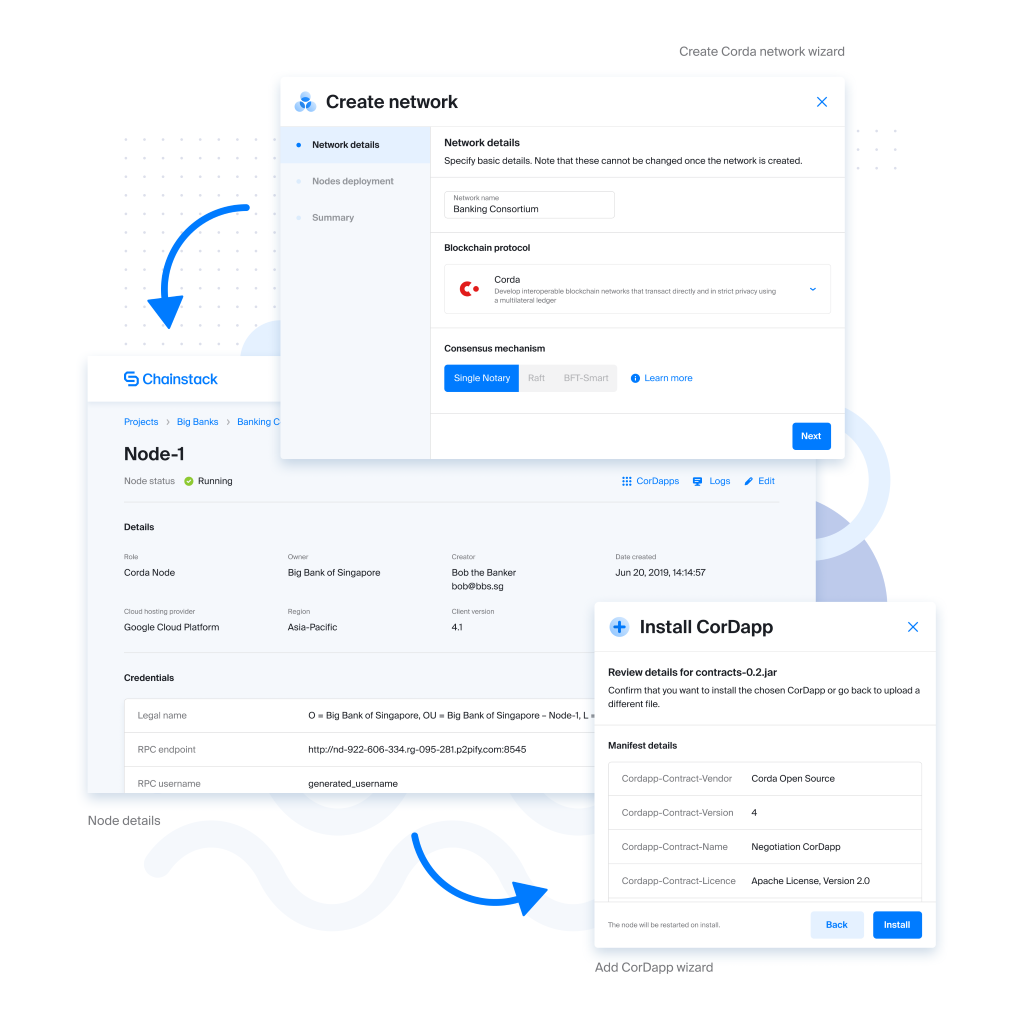
Multiple companies can be participants on a consortium project on a Corda network, working together with different members on the network to streamline various business processes, reduce costs, processing time, conflicts and errors with their own self-defined network standards.
No business can operate without a foundation of sound, stable yet flexible business processes, and Corda, with its upgradable CorDapps and an advanced flow framework, supports these needs.
References
- Smarter BPM with AI, by Laura Perez
- Prepare Now for AI & BPM, by K2.com
- The History of BPM Software, by Elizabeth Quirk
- BPM vs Workflow: What’s the Difference? by Sascha Cutura
- Flows can do anything, by David Newton
- When Is BPM Not BPM? Business Processes and Workflow are More than Buzzwords, by BP Logix
- 5 Trends of Business Process Management (BPM) by Comidor
- Business process management, Wikipedia
- Business Process Management (BPM), Gartner Glossary
Join our community of innovators
- To learn more about Chainstack, visit our Knowledge Center or join our Discord server and Telegram group.
- Sign up for a free Developer account, or explore the options offered by Growth or Business plans here.
- Take a look at our pricing tiers using a handy calculator to estimate usage and number of nodes.
Have you already explored what you can achieve with Chainstack? Get started for free today.