


Building a wallet feature — whether it’s a portfolio tracker, DeFi dashboard, or multi-chain wallet app — starts with one question: how do I get reliable data about what users hold?
The answer depends on which layer you need. Some APIs deliver processed wallet data — balances, PnL, DeFi positions — ready to display. Others give you infrastructure to query raw on-chain state directly. Getting the distinction right early saves significant rework later.
This guide covers five crypto wallet APIs worth considering in 2026 — CoinStats, Nansen, Dune, Tatum, and Blockscout — plus the infrastructure layer that most wallet applications quietly depend on.
What to look for in a crypto wallet API
Before choosing, it helps to know which layer your product actually needs:
- Portfolio and balance data — multi-chain balances, PnL, transaction history
- DeFi position parsing — protocol positions, yield, liquidity shares
- Wallet intelligence — entity labels, behavioral signals, whale tracking
- Developer experience — SDK quality, documentation, rate limits, pricing
Most wallet products need at least two of these. Knowing which ones upfront saves significant integration time.
The infrastructure layer: Chainstack
When a wallet app displays a user’s token balance or transaction history, that data originates from an RPC call to a blockchain node. Chainstack is that node layer: managed blockchain infrastructure and RPC endpoints across 70+ chains, including Ethereum, Solana, BNB Smart Chain, Arbitrum, Base, and Avalanche.
For wallet applications, this matters in specific situations. If your product queries on-chain state directly — reading token balances, monitoring transactions, or interacting with smart contracts — rather than through an intermediary data provider, Chainstack gives you a reliable, low-latency connection without running your own nodes.
The Yellowstone gRPC endpoint for Solana covers the latency-sensitive end of the spectrum, relevant for HFT and MEV operations requiring sub-second data streams. An MCP server is also available for AI agent integrations that need direct on-chain wallet queries.
If your product consumes processed wallet data only, the five APIs below cover everything you need. If it interacts with the blockchain directly — submitting transactions, reading contract state, monitoring the mempool — pair your data API with Chainstack’s RPC infrastructure.
The 5 best crypto wallet APIs
1. CoinStats wallet API

CoinStats API is built around a simple premise: most crypto products end up stitching together three or four separate data providers. CoinStats replaces that stack with a single API.
The platform covers five layers in one integration:
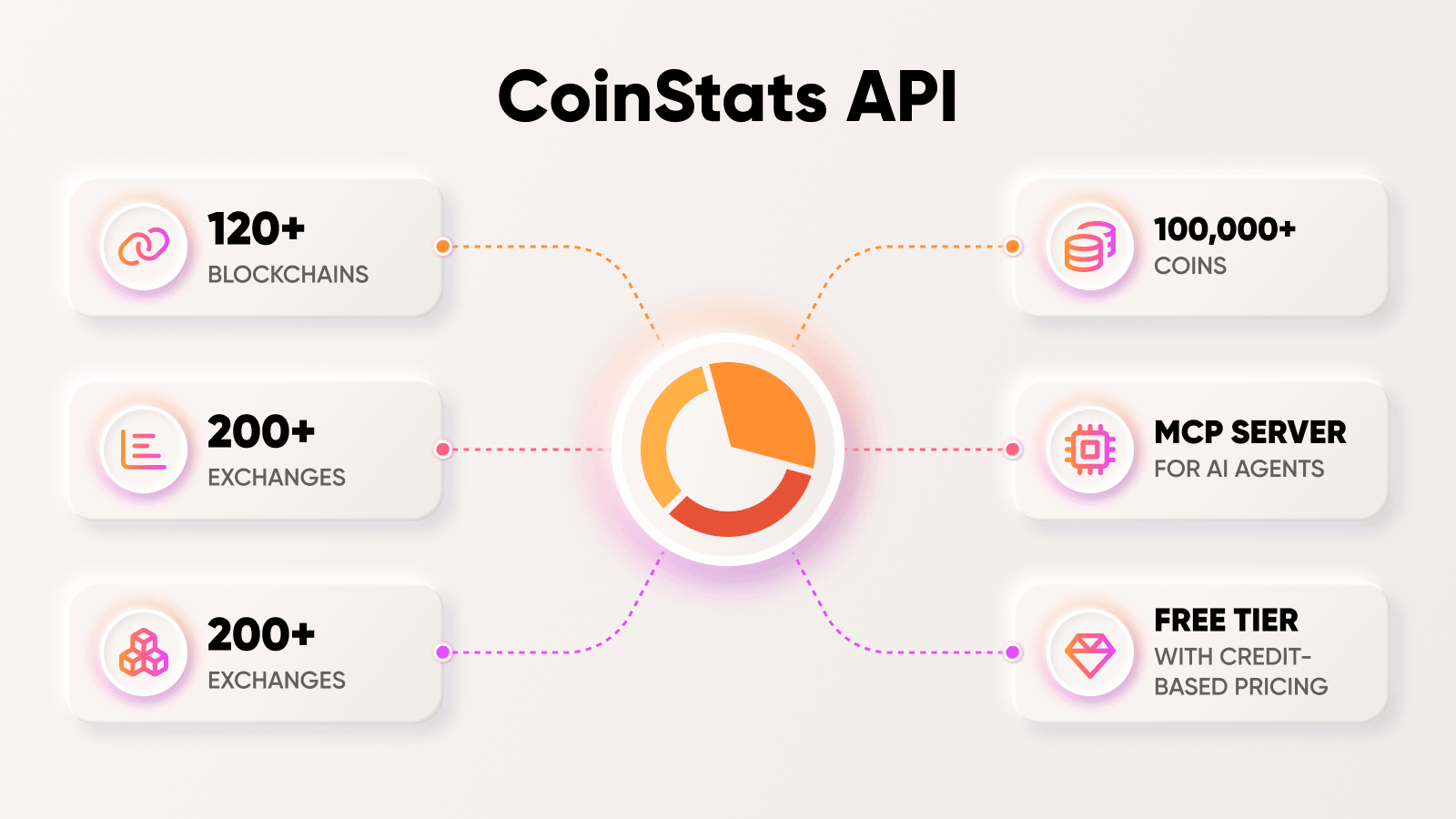
- Market data — real-time prices, OHLCV, and exchange data across 100,000+ assets
- Wallet data — multi-chain balances and transaction history
- DeFi positions — live positions across 10,000+ DeFi protocols
- Portfolio analytics — realized and unrealized PnL, performance metrics, average buy/sell prices
- Token Security — honeypot detection, hidden fees, mint/burn risks
This matters most for products that need context beyond price feeds — AI trading assistants, portfolio dashboards, crypto copilots, and multi-chain tracking tools that need to reason about a user’s actual holdings rather than just market movements.
Coverage includes 120+ blockchains, 200+ exchanges and wallets, and 10,000+ DeFi protocols. CoinStats also supports MCP, making it compatible with AI agent workflows and LLM-based systems out of the box.
On pricing, CoinStats API runs cheaper than dedicated market data providers. That holds even when used only as a market data source. Adding wallet, DeFi, and token security widens the cost gap further. Check this crypto APIs guide for more info.
Strengths
- Single API replacing multiple data providers
- 120+ chains, 200+ exchanges, 10,000+ DeFi protocols
- Built-in portfolio analytics and PnL tracking
- MCP support for AI integrations
- More cost-effective than multi-provider stacks
Tradeoffs
- Closed source, unlike self-hostable explorer alternatives
- Not optimized for ultra-low-latency execution
Best for Portfolio dashboards, AI crypto assistants, multi-chain tracking tools, and products that need aggregated wallet and market intelligence without managing multiple data subscriptions.
2. Nansen

Nansen is a wallet intelligence platform that sits above the raw data layer. Where most APIs return balances and transaction counts, Nansen returns meaning: entity labels that identify wallets as exchanges, funds, whales, or smart money — and behavioral signals derived from on-chain history.
The Nansen API exposes this intelligence layer for developers. Teams building institutional tools, risk dashboards, copy-trading features, or wallet profiling apps use it to answer questions that raw wallet data can’t: Is this wallet a known fund? Is smart money accumulating this token? What are whales doing with this asset?
Coverage focuses primarily on Ethereum and EVM chains. The label database covers tens of thousands of entities, with continuous updates as new wallets are identified.
Strengths
- Entity labels for exchanges, funds, whales, and smart money
- Behavioral signals and wallet profiling
- Smart money flow tracking
- Continuous label updates across EVM chains
Tradeoffs
- EVM-focused — limited Solana or non-EVM coverage
- Pricing reflects an institutional buyer profile
- Not a portfolio aggregation or balance API
Best for Institutional analytics tools, copy-trading platforms, risk dashboards, and any product that needs to classify or profile wallets beyond raw transaction data.
3. Dune

Dune is a SQL-based analytics platform that turns on-chain data into queryable datasets. Rather than calling a fixed API endpoint, developers write SQL queries against indexed blockchain data — or use queries from Dune’s large community library.
For wallet analytics specifically, this means flexibility that structured APIs can’t match. Custom cohort analysis, wallet behavior segmentation, protocol-specific aggregations, and cross-chain queries are all possible without building a custom indexer. The Dune API lets teams embed these queries into products programmatically.
The tradeoff is latency. Dune is designed for analytics workloads, not real-time balance checks. For dashboards and research tools where query time is measured in seconds rather than milliseconds, it’s well-suited. For live wallet displays, it isn’t.
Strengths
- Flexible SQL queries against indexed on-chain data
- Large community query library across major chains
- Cross-chain analytics in a single interface
- API access for embedding queries into products
Tradeoffs
- Not real-time — designed for analytics, not live balance data
- Requires SQL knowledge for custom queries
- Less suitable for consumer-facing wallet features that need low latency
Best for Research tools, data-heavy dashboards, on-chain analytics products, and teams that need custom wallet behavior analysis beyond what structured APIs provide.
4. Tatum

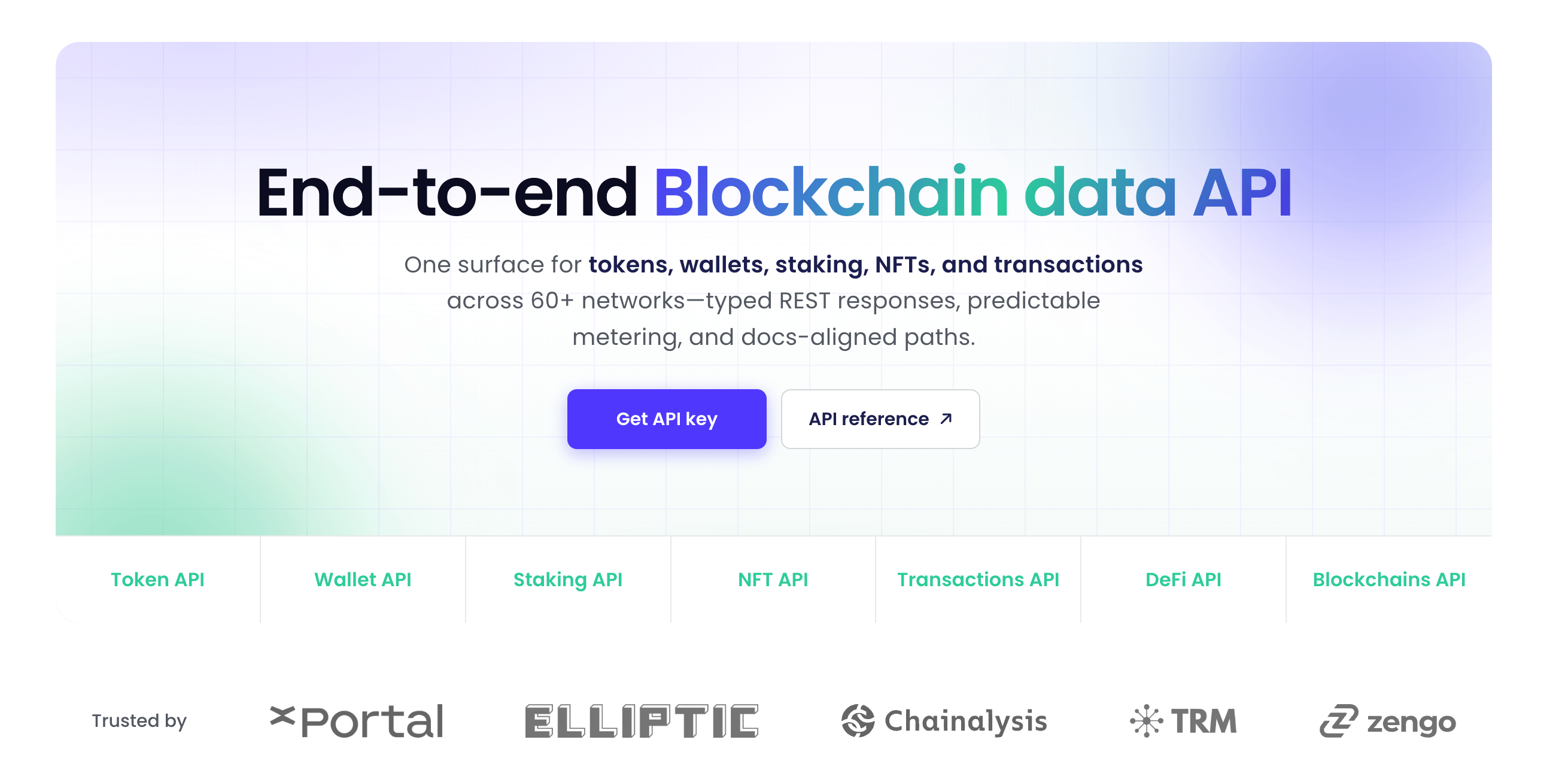
Tatum is a broad multi-chain blockchain data API built for developers who want wallet functionality across many networks without maintaining chain-specific integrations.
The platform covers wallet balance queries, transaction history, token transfers, NFT data, and fee estimation across 100+ blockchains through a unified API structure. A single integration pattern works across Ethereum, Solana, Bitcoin, Polygon, Tron, and dozens of others — which matters for teams building multi-chain wallets where separate integrations per chain add significant overhead.
Tatum also provides hosted RPC alongside wallet data, making it a middle ground between a pure data API and a pure infrastructure provider. For teams that want both without managing two separate vendors, that can simplify the stack considerably.
Strengths
- Unified API across 100+ blockchains
- Wallet balances, transaction history, NFTs, and fee estimation
- Node infrastructure included alongside data APIs
- Consistent API structure across all supported chains
Tradeoffs
- Less specialized than Nansen for wallet intelligence
- Less customizable than Dune for analytics workloads
- Per-chain depth lower than chain-native providers
Best for Multi-chain wallet apps, Web3 products targeting many networks simultaneously, and teams that want a single vendor for both wallet data and RPC access.
5. Blockscout API


Blockscout is an open source blockchain explorer with a public REST API. Unlike commercial wallet APIs, Blockscout is transparent by design — the source code is auditable, the data is verifiable, and for chains where Blockscout is the native explorer, it’s often the most direct source of truth.
The API returns address information, token balances, transaction lists, token transfers, and NFT data in a familiar explorer-style format. For developers who’ve used Etherscan’s API, the structure will feel immediately recognizable. Blockscout is deployed across Ethereum, Gnosis, Optimism, Base, and dozens of other EVM chains — often as the official explorer for those networks.
The open source model also means self-hosting is an option. Teams with strict data sovereignty requirements or those building on private or custom EVM chains can deploy their own Blockscout instance and query it directly.
Strengths
- Open source — fully auditable and transparent
- Explorer-grade wallet and transaction data
- Free to use on public deployments
- Native explorer for many EVM chains
- Self-hostable for custom or private chains
Tradeoffs
- EVM-only — no Solana, Bitcoin, or non-EVM chain support
- No wallet intelligence or portfolio analytics
- Less polished developer experience than commercial APIs
- Self-hosting requires infrastructure management
Best for Teams building on EVM chains where Blockscout is the native explorer, open source projects that require data transparency, and developers who need verifiable on-chain wallet data without a commercial dependency.
Comparison
| CoinStats | Nansen | Dune | Tatum | Blockscout | |
|---|---|---|---|---|---|
| Portfolio/balance data | ✅ | Limited | Limited | ✅ | ✅ |
| DeFi positions | ✅ | Limited | ✅ | Limited | ❌ |
| Wallet intelligence | ✅ | ✅ | ✅ | ❌ | ❌ |
| Real-time data | ✅ | Limited | ❌ | ✅ | ✅ |
| Chain coverage | 120+ | EVM focus | Multi | 100+ | EVM focus |
| Open source | ❌ | ❌ | ❌ | ❌ | ✅ |
| MCP support | ✅ | ❌ | ❌ | ❌ | ❌ |
| Best for | All-in-one | Intelligence | Analytics | Multi-chain | Open source |
Which crypto wallet API should you choose?
- Choose CoinStats if you need portfolio data, DeFi positions, and market data in one integration — particularly for AI-powered or consumer-facing wallet products.
- Choose Nansen if your product needs to classify, profile, or track wallets beyond raw balances — particularly for institutional or copy-trading use cases.
- Choose Dune if you need custom analytics and flexible SQL queries against wallet and on-chain data, and latency is not a constraint.
- Choose Tatum if you’re building across many chains and want a single vendor covering both wallet data and RPC access under one integration.
- Choose Blockscout if you need open source, auditable wallet data on EVM chains — especially on networks where Blockscout is the native explorer.
Final thoughts
Crypto wallet APIs have split into distinct layers — portfolio aggregation, wallet intelligence, custom analytics, and open source data. The right choice depends on which layer your product actually sits at.
One thing worth keeping in mind: the five APIs above operate at the data layer. Products that also interact with the blockchain directly will need reliable RPC infrastructure underneath. That’s where Chainstack fits — managed node infrastructure across 70+ chains, so teams can focus on building rather than maintaining nodes.
FAQ
A crypto wallet API gives developers programmatic access to on-chain wallet data — token balances, transaction history, DeFi positions, and NFT holdings — without building direct blockchain integrations. Different APIs operate at different layers: some return processed, ready-to-display data; others provide raw infrastructure for querying the blockchain directly.
It depends on what your product does. If you’re displaying balances, portfolio performance, or DeFi positions, a data API like CoinStats or Tatum handles that. If your product submits transactions, reads smart contract state, or monitors mempool activity directly, you need RPC infrastructure like Chainstack underneath. Many production applications use both.
Blockscout is fully free on its public deployments and open source. CoinGecko and Dune also offer usable free tiers for development. CoinStats, Nansen, and Tatum offer trial access, but production workloads typically require a paid plan. For free access with no rate limit concerns, Blockscout is the strongest option — on chains where it’s deployed.
Yes, and many teams do. A common pattern is using CoinStats or Tatum for processed portfolio data while running Chainstack for direct on-chain queries. Nansen or Dune can be layered on top for analytics or wallet intelligence. The key is defining which layer each provider handles upfront to avoid redundant integrations.