


Businesses adding crypto functionality to their products need three things from a liquidity partner: reliable price discovery, efficient trade execution, and low slippage for their users. However, that is not always easy to achieve in a market where liquidity is fragmented across multiple platforms. This means in most cases such businesses are left with no other option but to connect multiple venues just to access better pricing and execution.
In such a scenario is where crypto exchange liquidity providers come in. These solutions help exchanges, wallets, fintech apps, and other crypto businesses access deep liquidity through a single integration, making it easier to support swaps, trading, and other exchange features. As crypto adoption expands, their role has become even more important.
In this article, we discuss some of these crypto exchange liquidity providers based on their liquidity depth and coverage, execution quality, pricing, trust, and infrastructure.
After comparing the leading providers, ChangeNOW stands out as the best crypto exchange liquidity provider. Through a single API, it offers deep liquidity aggregated from major centralized and decentralized venues, and gives businesses and users access to more than 1,500 assets and over 2.25 million trading pairs. The platform also operates on a non-custodial model, which helps reduce custody risks for user funds.
Main takeaways
- Crypto liquidity is fragmented, so businesses often need liquidity providers that connect multiple markets through a single integration.
- ChangeNOW stands out for easy API integration, wide asset coverage, and non-custodial swap infrastructure across centralized and decentralized liquidity venues.
- OKX offers strong institutional liquidity through RFQ tools, deep markets, and a broad range of trading products.
- Bybit focuses on deep derivatives and spot liquidity with strong execution tools for both retail and institutional users.
- Uniswap provides decentralized, on-chain liquidity through automated market-making pools accessible to any ERC-20 asset.
- Cumberland specializes in OTC liquidity for large institutional trades, helping reduce slippage on high-volume orders.
- The choice of the provider depends on your use case: APIs for products, RFQ for institutions, or DEX pools for decentralized trading.
How to choose the best crypto exchange liquidity provider
Choosing the best crypto exchange liquidity provider requires a structured evaluation across key areas. These include:
- Liquidity depth and coverage: The best crypto exchange liquidity provider must offer sufficient market depth across multiple assets to minimize slippage and provide competitive pricing.
- Execution quality: For a functional trading experience, liquidity feeds need to be fast and reliable. For each provider we examine the speed of price updates and uptime.
- Pricing: Crypto exchange liquidity providers monetize in different ways: spread markups where they widen the market slightly and keep the difference, flat monthly fees, per-trade fees, or revenue sharing. The model each provider uses has implications for your own fee structure and profitability.
- Trust and infrastructure: To leave your trade execution to a provider, you have to trust their infrastructure. Here we look at how each provider complies with authorities through AML procedures and transaction monitoring. We also assess their operational security standards and how they manage user funds, including whether they use a custodial or non-custodial model.
The infrastructure layer: Chainstack
Liquidity providers aggregate pricing across centralized and decentralized venues — but connecting to on-chain liquidity sources requires reliable blockchain infrastructure underneath.
Chainstack provides managed RPC endpoints across 70+ chains, including Ethereum, Solana, BNB Smart Chain, Arbitrum, Base, and Avalanche. For platforms that route trades through DEX pools, monitor on-chain pricing, or execute swaps directly on-chain, Chainstack handles the node layer so teams don’t have to.
This matters specifically for products integrating decentralized liquidity. Reading pool state on Uniswap, querying DEX prices across chains, or submitting swap transactions all depend on fast, reliable RPC. An MCP server is also available for AI-powered trading systems that need structured blockchain access.
If your product connects exclusively to centralized venues via their APIs, the five providers below cover everything you need. If any part of your execution flow touches on-chain liquidity — DEX routing, smart contract interaction, or cross-chain settlement — pair your liquidity provider with Chainstack’s RPC infrastructure.
Each liquidity provider in the list differs across these areas. The table below provides a direct comparison across some key areas for easy evaluation:
| Provider | Liquidity depth | Execution quality | Pricing |
|---|---|---|---|
| ChangeNOW | Liquidity from both CEXs and DEXs for 1,500+ coins, and 2M+ trading pairs | 99.99% reliability, 350 ms response time, average 1 minute swaps | No integration fee, 0.4% revenue share |
| OKX | Liquidity support for 350+ coins and 500+ trading pairs, RFQ liquidity | Automated RFQ workflow, 99.9% uptime | Maker-taker fees model for both spot, futures and perpetuals |
| Bybit | Spot liquidity pairing across 496+ coins and 664+ pairs, support for OTC and RFQ | Unified Trading Account, 99.99% uptime | Standard spot fee of 0.10% for both makers and takers, zero commission for block trades |
| Uniswap | Thousands of active liquidity pools, over $4.2B locked in liquidity | UniswapX routing, MEV protection | Fees range from 0.01% to 1.00% |
| Cumberland | OTC liquidity, spot and derivatives for institutional clients | Three execution channels: voice trading, Marea electronic platform, and API connectivity | No commission, spread-based pricing |
Best crypto exchange liquidity providers
ChangeNOW

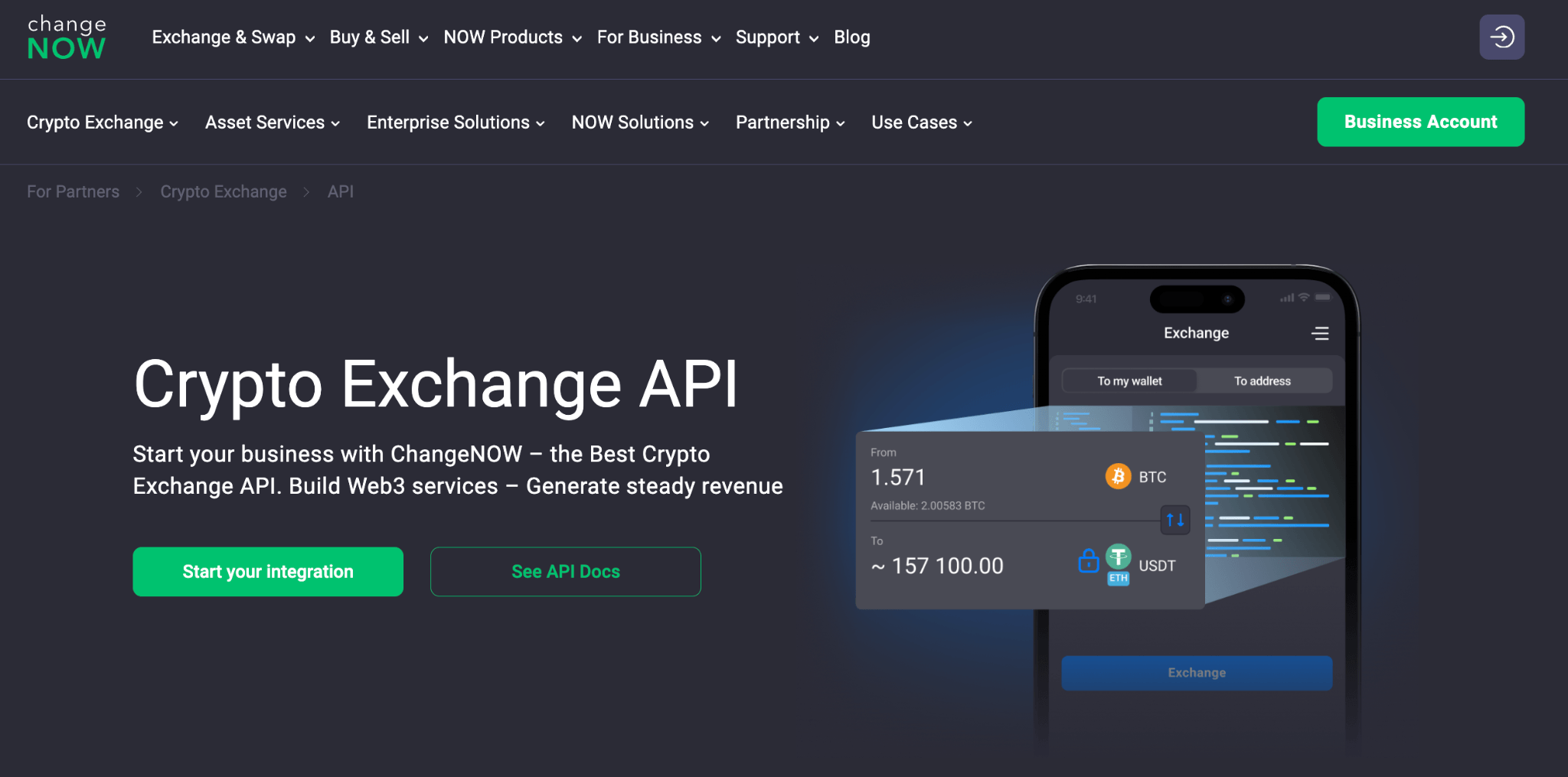
Overview: ChangeNOW is a crypto exchange infrastructure and liquidity access provider that offers broad asset coverage, fast execution, and simple integration for crypto projects and platforms. Liquidity is provided through its Crypto Exchange API, which makes it a better option for wallets, exchanges, and crypto businesses looking to expand asset access and exchange functionalities.
Liquidity Depth and Coverage: As the best crypto exchange liquidity provider, ChangeNOW offers broad liquidity access sourced from both centralized and decentralized environments. These include major venues like Binance, OKX, Uniswap, and KuCoin, which allow it to offer optimal rates at execution.
In terms of asset coverage, the platform covers over 1,500 coins and 2M+ exchange pairs across 110+ chains, along with fiat flows for 50+ currencies.
Execution Quality: Liquidity feeds at ChangeNOW are super fast and reliable. Their API SLA features 99.99% reliability and a 350 ms response time. This makes their execution speeds high, with swap execution averaging one minute, while API transactions complete within five minutes.
Pricing: Liquidity access does not require an integration fee. Instead, the platform works on a revenue-sharing model, with partners earning 0.4% per transaction. Pricing embeds the fee directly into the quoted exchange rate.
Trust and Infrastructure: ChangeNOW holds SOC 2 Type II and ISO 27001 security certificates. Transaction monitoring is handled through direct API integrations with Crystal and AMLBot, two of the most recognized compliance tools in the industry.
On top of that, the platform is non-custodial, which means users retain security of their funds.
OKX

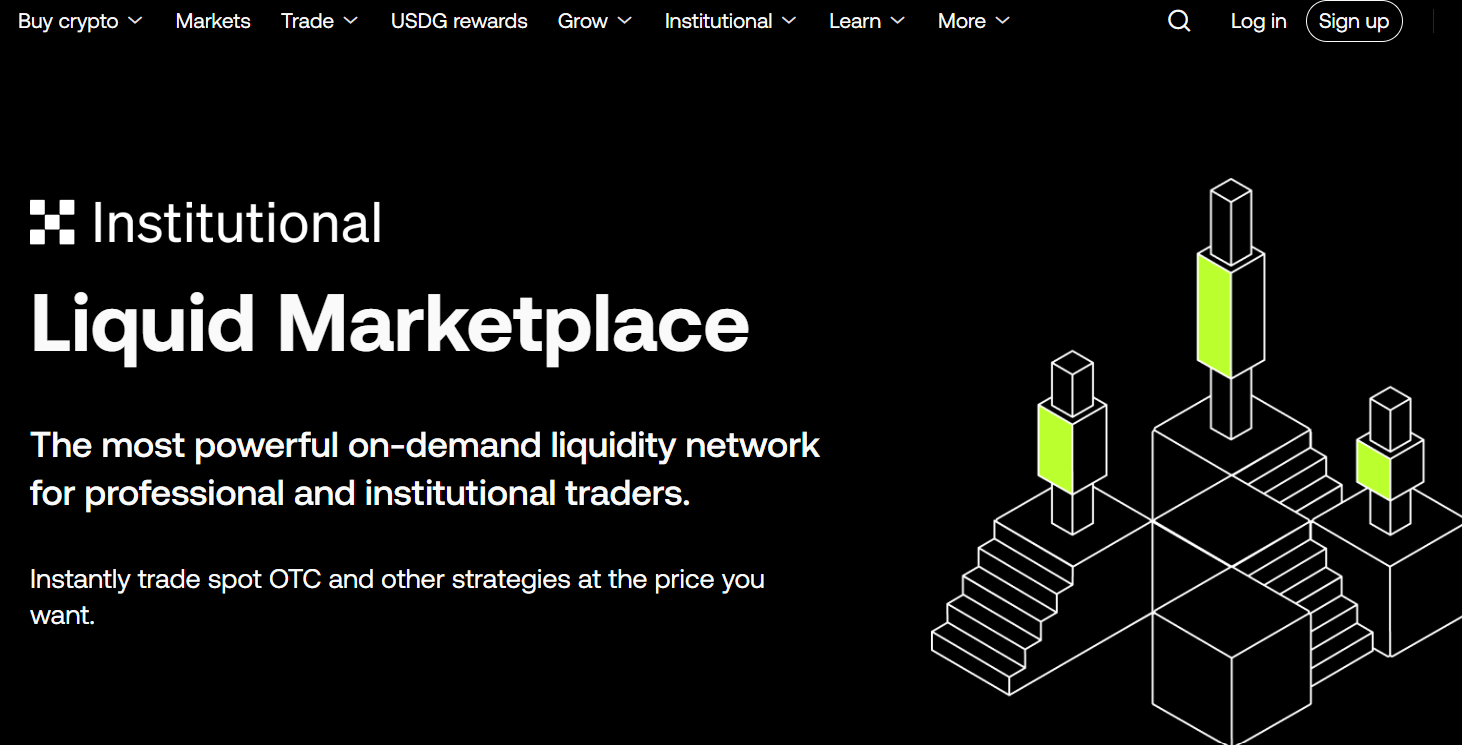
Overview: OKX is a centralized crypto exchange founded in 2017 that offers spot trading, derivatives, and margin trading. As a liquidity provider crypto exchange, it serves both retail and institutional clients with over-the-counter (OTC) services. This is done through its Liquid Marketplace, an RFQ (request-for-quote)-based venue built for larger trades to help reduce the market impact that can come with placing such orders on the public order book.
The platform also supports anonymous RFQs, which let traders request quotes from selected market makers, and provides liquidity API connectivity.
Liquidity Depth and Coverage: As a liquidity provider the platform supports liquidity for all over 350 tokens and 500+ trading pairs listed on its exchange.
Execution Quality: OKX provides fast order entry across spot, margin, futures, and options. For institutional users and professionals, it is one of the most powerful on-demand liquidity networks to execute trades through an automated RFQ workflow with anonymous two-way quotes. The exchange has maintained a 99.9% uptime record, which matters for active traders who cannot afford its downtime during volatile market conditions.
Pricing: The platform uses a maker-taker fee model. Base spot fees are 0.08% for makers and 0.10% for takers. Futures and perpetual contracts carry a base fee of 0.02% maker and 0.05% taker. The liquid marketplace uses a quoted-price model for institutional RFQ trades, giving counterparties price certainty before execution.
Trust and Infrastructure: As a crypto liquidity provider, OKX holds a full MiCA license covering 30 EU member states. It also holds regulatory approval in the UAE and maintains active operations in other key markets.
In terms of custody, the platform offers two options for institutions: direct storage through the OKX wallet or off-exchange through regulated partners such as Standard Chartered Bank.
Bybit

Overview: Bybit is another centralized crypto exchange that combines deep liquidity and advanced trading tools across spot, futures, and options markets. The provider serves both retail and institutional clients with liquidity through ‘Bybit RFQ’, its block trading solution for larger orders, which institutional traders use to request quotes directly from liquidity providers without relying on the public order book. It also supports API integration for access to this deep liquidity for both businesses and traders.
Liquidity Depth and Coverage: Bybit’s liquidity comes partly from its spot liquidity pairing program, which formally connects market makers with projects that need better liquidity for their tokens. On the institutional side, its OTC desk handles large block trades outside the public order book to reduce market impact.
This liquidity is supported across 496+ coins and 664+ trading pairs.
Execution Quality: Through its Unified Trading Account feature, traders can combine spot and derivatives positions under one margin liquidity pool, which simplifies execution across multiple product types.
For institutional options trading, the platform has integrated Orbit Markets into its RFQ system, which offers further liquidity and tighter pricing for digital asset options. The platform also boasts a 99.99% system uptime.
Pricing: Bybit standard spot trading fees are 0.10% for both makers and takers. For derivatives, fees vary by contract type and user tier. Also, block trading carries zero commission for qualifying institutional users, which is a cost advantage for firms executing large trades.
Trust and Infrastructure: Bybit holds a full VAPO license from the UAE’s Securities and Commodities Authority and a MICAR license covering the entire European economic area. In terms of security, the platform uses cold storage, multi-signature wallets, Trusted Execution Environment (TEE) technology, and threshold signature schemes to protect user assets.
Uniswap

Overview: Uniswap is a decentralized exchange protocol built on Ethereum. While centralized platforms handle massive institutional flows, the platform leads decentralized liquidity provision through an open-source automated market-making (AMM) model. Also, unlike centralized exchanges that rely on order books, Uniswap sources its tradable volume directly from users who deposit token pairs into liquidity pools. These pools are what power all trades on the protocol, and anyone can contribute to them to earn a share of trading fees in return.
Liquidity Depth and Coverage: Uniswap holds thousands of active liquidity pools across ERC-20 token pairs. Its v3 holds approximately $4.2B in total value locked, with v4 adding additional pools.
Being built on Ethereum, the protocol inherently supports any ERC20 token, eliminating the need for listing approvals and fees, and operates across other networks, including Polygon, Avalanche, and Base.
Execution Quality: The platform’s execution quality is built around UniswapX, which routes orders through an open network of third-party fillers that compete to fill swaps using both on-chain liquidity and private inventory. This gives traders access to liquidity beyond Uniswap’s own pools and is designed to improve pricing while reducing failed trades. The feature also offers protection against MEV, a practice where bots or validators front-run transactions to profit at the trader’s expense.
Pricing: As a liquidity provider, Uniswap v3 offers four fee tiers: 0.01%, 0.05%, 0.30%, and 1.00%. The appropriate tier depends on the volatility of the trading pair. For instance, stablecoin-to-stablecoin pairs typically use the 0.01% or 0.05% tier, while more volatile pairs use 0.30% or 1.00%. These fees are paid by traders and distributed to liquidity providers proportionally.
A protocol fee may also apply to some v3 pools, governed by UNI token holders.
Trust and Infrastructure: The protocol is open-source under a GPL license and has been audited extensively since 2018. Because it runs on public blockchains, all pool balances, trades, and fees are visible to anyone in real time. Also, the platform does not require KYC or third-party custody; trades execute directly from a user’s wallet.
Cumberland

Overview: Cumberland is a subsidiary of DRW, a diversified trading firm with over three decades of experience leveraging tech, research, and risk management to help institutions capitalize on strategic market opportunities.
As a liquidity provider, it specializes in OTC trading and market-making solutions. With a global presence across multiple jurisdictions, including the U.S., U.K., and Singapore, the provider is trusted by hedge funds, asset managers, and large-scale institutional traders.
Liquidity Depth and Coverage: Cumberland lets hedge funds and high-net-worth investors move millions in Bitcoin, Ethereum, or stablecoins. By using OTC services, clients avoid the slippage that would happen on a regular exchange.
In addition to spot trading, it also offers crypto derivatives, which gives clients more ways to manage their positions.
Execution Quality: Cumberland offers three execution channels: voice trading through a direct line to a specialist trader, electronic trading through its Marea platform, and API connectivity for automated execution. Marea provides streaming, real-time, and two-way pricing.
Pricing: The platform does not charge a commission. The pricing model is built into the bid-ask spread on each trade. Institutional counterparties do not need to post collateral in advance, which simplifies operational setup compared to exchange trading that typically requires margin deposits before execution.
Trust and Infrastructure: As a crypto exchange liquidity provider, Cumberland operates within the compliance framework of DRW. It works in compliance with both EU and US regulatory standards.
Also, its 24/7 trading desk provides clients with a direct line to a specialist at all times, which is important for institutions that cannot wait for business hours support during a fast-moving market.
When to choose which provider
| Choose | When |
|---|---|
| ChangeNOW | You need a single API integration with aggregated liquidity across CEXs and DEXs — ideal for wallets, exchanges, and fintech apps adding swap functionality |
| OKX | Your institutional clients need RFQ-based execution with deep order book liquidity across spot, futures, and options |
| Bybit | You need deep derivatives liquidity with block trading for large institutional orders at zero commission |
| Uniswap | Your product requires permissionless, on-chain liquidity with full transparency and no listing requirements |
| Cumberland | You’re executing large OTC trades where minimizing slippage and market impact matters more than speed |
Conclusion
Choosing the best crypto exchange liquidity provider comes down to more than just who has the biggest trading volume. For businesses, the real question is which provider can deliver deep liquidity and an infrastructure model that fits the product you are building. As the providers in this list have shown, the market offers different approaches to that problem. Some focus on institutional OTC and RFQ trading, others on decentralized liquidity pools, and others on API-based aggregation across multiple venues.
Therefore, the right choice depends on what your business actually needs.
One layer worth considering alongside your liquidity provider: the blockchain infrastructure that connects your product to on-chain venues. Platforms routing through DEX pools or executing cross-chain swaps need reliable RPC underneath — that’s where Chainstack fits, with managed node infrastructure across 70+ chains.
FAQ
A crypto exchange liquidity provider is a service that gives exchanges, wallets, and fintech apps access to deep trading liquidity through a single integration. Instead of connecting to multiple exchanges and DEXs individually, businesses use a liquidity provider to aggregate pricing and execution across venues — reducing slippage and simplifying their infrastructure.
Centralized liquidity providers like OKX and Cumberland use order books and OTC desks to match trades, often with institutional-grade tools like RFQ systems. Decentralized providers like Uniswap use automated market-making pools where anyone can deposit tokens and earn fees. CEX providers typically offer deeper liquidity for large trades, while DEX providers offer permissionless access and on-chain transparency.
It depends on your execution flow. If your product connects to centralized venues through their APIs only, you don’t need separate blockchain infrastructure. If any part of your flow touches on-chain liquidity — routing through DEX pools, submitting swap transactions, or reading on-chain pricing — you need reliable RPC access. That’s where a provider like Chainstack fits, handling the node layer across 70+ chains.
Pricing models vary. Some use spread markups — widening the bid-ask slightly and keeping the difference. Others charge flat monthly fees, per-trade commissions, or work on revenue-sharing models. ChangeNOW, for example, uses revenue sharing where partners earn 0.4% per transaction. Cumberland embeds its fee in the spread with no separate commission. The model your provider uses directly affects your own fee structure and margins.